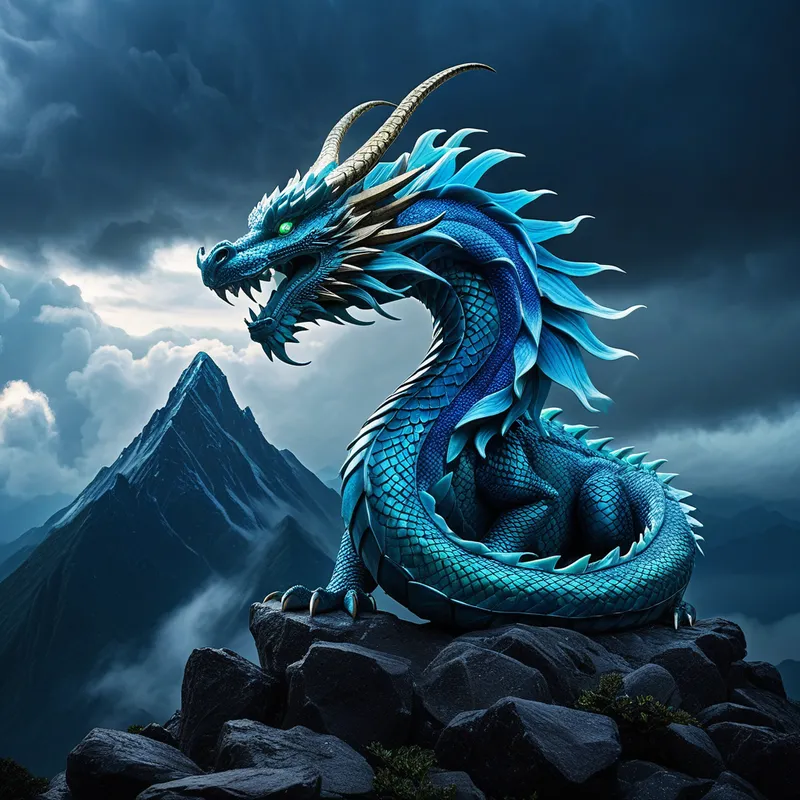
Qinglong Myth Meaning & Symbolism
The Azure Dragon, guardian of the East, embodies the rising yang force of spring, cosmic order, and the soul's journey from chaos to conscious power.
The Tale of Qinglong
Before the world knew its name, there was a season of pure potential. It was the time between the deep, silent death of winter and the riotous life of summer—a breath held in the throat of the cosmos. In that liminal space, where the frozen earth remembered warmth, a presence stirred in the East.
It was not born, but unfurled. From the womb of the pre-dawn sky, where the last star of night bleeds into the first hint of day, a form took shape. It was the color of the deepest ocean meeting the clearest sky—the color of life pushing through a crack in a tomb. This was Qinglong. His body was not flesh and bone, but the essence of the rising yang, a river of celestial energy flowing from the Purple Forbidden Enclosure. His scales were like plates of polished jade, catching the light that had not yet reached the world below. His eyes were twin suns, holding the promise of germination.
His arrival was not silent. It was heralded by a sound that split the stillness—the first thunder. Not the violent crash of summer storms, but a deep, resonant crack that vibrated in the marrow of mountains and the roots of sleeping seeds. This was his voice. With it, he called forth the east wind, the Mingtiao, which carried not just air, but the very imperative to grow.
He saw the world below, locked in the grip of yin. The waters were sluggish, the trees stood as bare skeletons, and the hearts of animals and humans alike were heavy with dormancy. His task was not to conquer, but to awaken. He began his celestial dance, a sinuous, coiling movement across the eastern quadrant of the heavens. Where his claws passed, the constellations—Jiao, Kang, Di, Fang—blazed with renewed purpose. His breath, moist and warm, became the spring rains, soaking the parched earth.
The conflict was not against a monster, but against entropy itself—the eternal pull toward stillness and dissolution. His rising action was the gradual, irresistible infusion of vitality. Sap began to flow upward in the veins of trees. Rivers shed their icy skins. Creatures stirred in their burrows, their blood quickening to the rhythm of the dragon’s distant heartbeat. He was the great awakener, the cosmic catalyst, turning the potential of the Wuji into the directed force of life.
His resolution was the establishment of order. He did not bring chaos, but the opposite: the precise, beautiful order of the season. He governed the element of Wood, directing the upward, expansive energy of growth. He established the direction of the East as a sacred axis. And when his work was complete, when the world was verdant and humming with new life, he did not depart. He remained, a vigilant sovereign in the azure vault, his presence a constant guarantee that after every winter, without fail, the thunder would speak, the wind would stir, and the world would be born anew.
Cultural Origins & Context
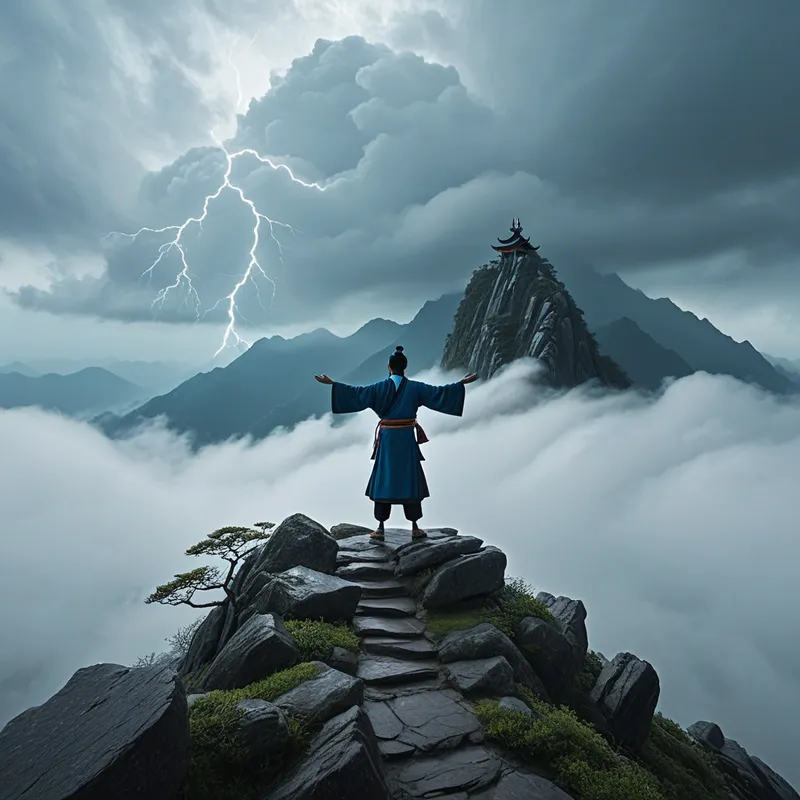
The myth of Qinglong is not a singular story with a defined plot, but a foundational archetype woven into the very fabric of ancient Chinese cosmology. Its origins are as old as the Shang Dynasty, with dragon motifs appearing on ritual bronzes as mediators between heaven and earth. It was during the Zhou Dynasty and the subsequent Warring States period that this imagery crystallized into a systematic astrological and philosophical system.
This myth was passed down not by bards around a fire, but by astronomers-astrologers observing the heavens, by philosophers like those of the Yin-Yang School, and by imperial ritualists. Qinglong became one of the Four Symbols (Si Xiang), a cornerstone of the correlative cosmology that linked the macrocosm of the heavens to the microcosm of the state and the human body. Its societal function was profound: it provided a model of benevolent, orderly governance (the dragon as ruler), it dictated the agricultural calendar (its appearance heralding planting time), and it offered a cosmic blueprint for harmony. Emperors aligned their palaces and rituals with its eastern direction, seeking its legitimizing power.
Symbolic Architecture
Psychologically, Qinglong represents the archetypal force of conscious structuring emerging from the unconscious. It is the principle of order born from chaos, the ego's formative power arising from the primal waters of the psyche.
The Dragon does not create the seed, but commands it to sprout. It is the divine imperative of form.
Its azure color symbolizes the heavens, spirituality, and the clarity of consciousness. Its association with Wood and spring points to directed growth—not wild, uncontrolled proliferation, but growth according to an innate, celestial pattern. The thunder is its voice, representing the shocking, awakening insight that breaks through psychic stagnation. The east wind is its breath, the gentle but persistent influence of a new attitude that slowly reshapes the inner landscape.
Most critically, Qinglong is a sovereign. It does not fight for its throne; it is the throne. It symbolizes the achieved state of psychic sovereignty where one's innate authority (the yang principle) is integrated and exercised with benevolence and in harmony with cosmic law (Dao). It is the opposite of the tyrannical ruler; it is the ruler who serves the greater order of life itself.
The Dreamer's Resonance
When Qinglong appears in modern dreams, it seldom manifests as a literal dragon. Instead, one dreams of its attributes. You may dream of a tremendous, clarifying thunderclap that resolves an impossible dilemma, symbolizing a sudden psychic reorganization. You may dream of a powerful, warm east wind clearing a fog of confusion, representing the influx of a new, life-giving perspective.
Somatically, this dream process often correlates with a feeling of energy rising up the spine—a quickening, an awakening of vitality after a period of depression or "psychic winter." There is a sense of right timing, of an internal season changing. The conflict in such dreams is often between this rising, ordering energy and a heavy, stagnant, or chaotic inner environment (represented by flooded basements, tangled forests, or crumbling structures). The dragon's appearance signals that the psyche's own innate ordering principle is activating, initiating a phase of growth, new projects, or the confident assertion of one's will in the world.

Alchemical Translation
The journey of Qinglong models the alchemical stage of citrinitas, the dawning of the solar consciousness, or in Jungian terms, a major step in the individuation process. It is the transition from the nigredo (the blackening, winter, chaos of the unconscious) and the albedo (the whitening, purification) into the conscious application of the transformed self.
Individuation is not about becoming perfect, but about becoming sovereign over one's own inner kingdom, aligning personal law with cosmic law.
The adept's work is to become the vessel for this dragon-energy. First, one must endure the "winter"—a period of introspection, often feeling lost in the undifferentiated unconscious (the Wuji). Then, one must attend to the first "thunderclap"—the often disruptive insight or life event that signals a call to growth. The alchemical task is to cooperate with this rising yang. This means consciously directing the new energy (Wood) into constructive forms: building healthy habits, initiating creative endeavors, establishing personal boundaries (the dragon's scales), and speaking one's truth with authority (the dragon's thunder).
The ultimate transmutation is becoming the Qinglong oneself. It is to no longer be subject to inner chaos or external tyranny, but to embody a benevolent, structured vitality. Your will becomes aligned with the generative will of life. Your actions become timely, like the seasons. You govern your inner realm with the same majestic, effortless order as the Azure Dragon governing the eastern sky, ensuring that after every period of contraction and darkness, the spring within you will always, inevitably, return.
Associated Symbols
Explore related symbols from the CaleaDream lexicon: