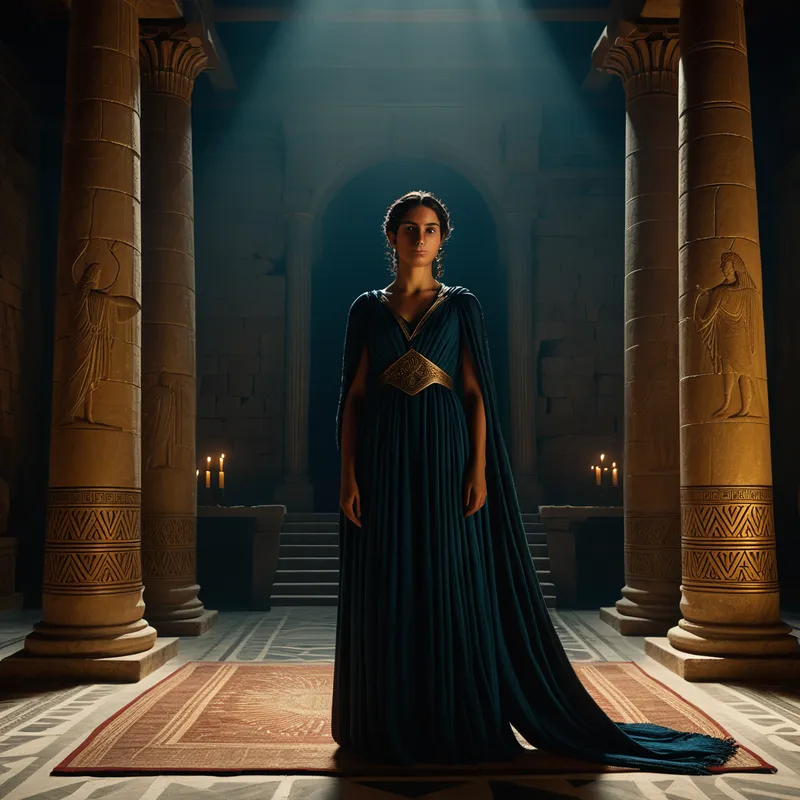
Penelope's Shroud Myth Meaning & Symbolism
A queen weaves and unravels a shroud to delay suitors, embodying the soul's cunning endurance and the creative power of patient resistance.
The Tale of Penelope's Shroud
Hear now the tale of the patient queen, she who held a kingdom together with a single thread. The halls of Ithaca echoed not with the laughter of its lord, but with the clamor of vultures. For twenty years, Odysseus was gone—ten at war, ten lost upon the wine-dark sea. In his stead, a plague of suitors descended, a hundred princes from neighboring isles, who gorged on the royal flocks, drained the wine jars, and clamored for the prize they believed was theirs: the queen herself, and the throne of Ithaca.
Penelope, daughter of Icarius, stood as a lone cliff against this crashing sea of arrogance. By day, she moved among them with a face of polished stone, her grief a private ocean. By night, in the silent women’s quarters, a different work began. Before the elders of Ithaca, she made a vow, a cunning stratagem born of despair and divine intelligence. “My lords,” she said, her voice clear as a spring, “you press me to choose a husband. But first, I must discharge a sacred duty. The lord Laertes grows old and fears death without honor. I am weaving a great funeral shroud for him. It would be a shame upon me and my house if I wed before this task is complete. When the shroud is finished, I will choose.”
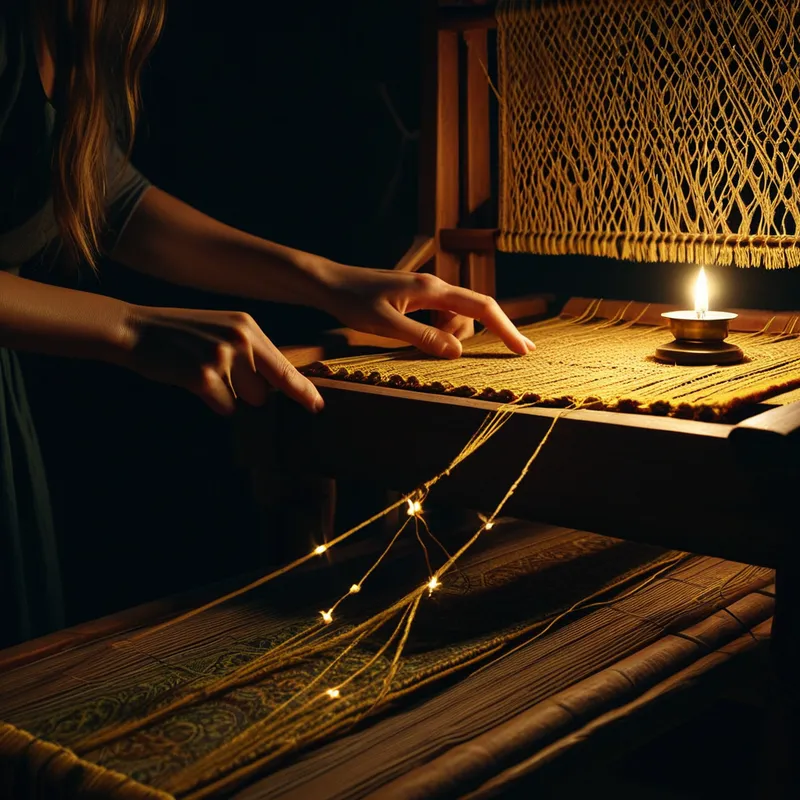
The suitors, blinded by their own desire, agreed. And so, the great loom was set up in the hall. By daylight, all could see the queen and her handmaidens at their work, the shuttle flying back and forth, the pattern growing—a tapestry of such complexity it spoke of a lifetime’s devotion. The threads were fine, the colors deep. But what the suitors saw in the firelight was a lie. For in the secret heart of the night, by the guttering light of a single lamp, Penelope the unraveler performed her true labor. With fingers made deft by desperation, she would pick apart the day’s work. Stitch by careful stitch, she would pull the threads loose, undoing the pattern, returning the woven image to a chaos of yarn. The shroud that was to be a symbol of an ending became, instead, a living act of postponement, a prayer woven into time itself.
For three years, this sacred deceit held. The day’s creation, the night’s dissolution—a cycle as reliable as the moon. The suitors feasted, growing fat and impatient, but the shroud, they were told, was not yet done. It was a masterpiece that could never be completed, a boundary woven from air and cunning. It was a wall built not of stone, but of time, and Penelope was its architect and its sole guardian. The tension was a harpstring stretched to breaking. Then, a treacherous maidservant, bought with promises, revealed the nightly unraveling. The suitors’ rage exploded. The game was up. The loom, the symbol of her resistance, now stood as a testament to her exposed trickery. The sea of demands crashed against her anew, more violent than before. Yet, in that moment of exposure, her fidelity had already done its work. For the wheels of the gods had turned. Her long-delayed husband was even then sailing home, drawn across the waves by the persistent signal of her unwavering heart. The unraveling was over; the reckoning was at hand.
Cultural Origins & Context
This core episode of Penelope’s cunning is preserved for us in Homer’s <abbr title="The second epic poem attributed to Homer, detailing Odysseus's journey home">Odyssey</abbr>, the foundational epic of homecoming. It was not a standalone folktale but an integral strand in the vast tapestry of Odysseus’s journey. Performed orally by bards (<abbr title="Ancient Greek epic poets and singers">rhapsodes</abbr>) for aristocratic audiences, the Odyssey served as a cultural mirror. In a society where women’s agency was legally and socially constrained, Penelope’s story provided a powerful archetype of feminine metis. Her shroud was a socially acceptable weapon. Weaving was the quintessential female craft, a domain of honor and skill. By using this approved domestic art as an instrument of political and personal resistance, the myth validated a form of power available within the oikos (household). It showed that fidelity (<abbr title="Good faith, trust, reliability">pistis</abbr>) was not passive waiting, but an active, intelligent, and creative endurance. For the Greek listener, Penelope was the ideal counterpart to Odysseus: both wielded cunning, but his was mobile and external (the Trojan Horse, the Cyclops’s escape), while hers was static, internal, and woven into the very fabric of the home.
Symbolic Architecture
The shroud is far more than a plot device; it is a perfect symbolic object, a mandala of the soul in stasis. It represents the psyche’s ability to create a container for time itself.
The act of weaving is the act of creating order from chaos, of imposing a pattern (logos) on the raw threads of experience (chaos). The unraveling is the deliberate return to chaos, not out of nihilism, but as a sacred preservation of potential.
Penelope is the archetypal <abbr title="The anima, or inner feminine principle, in a state of faithful waiting">[anima](/symbols/anima "Symbol: The feminine archetype within the male unconscious, representing soul, creativity, and connection to the inner world.")</abbr> in its most developed form: not a passive prize, but the conscious, creative center that holds the psychic kingdom together during the ego’s (Odysseus’s) long absence. The suitors represent the legion of unconscious contents—unintegrated impulses, facile solutions, collective pressures—that swarm the psyche when the central governing principle is absent. They are the temptations to abandon the difficult, individual path for easier, collective answers. Her nightly unraveling is the ultimate psychological resistance: the refusal to let the process be finalized on anyone’s terms but her own. It is the ego’s (in this case, the feminine ego’s) stubborn maintenance of a liminal space, a temenos or sacred precinct, where the true king (the integrated Self) can still return.
The Dreamer's Resonance
When this myth pattern stirs in the modern dreamer, it often manifests as dreams of repetitive, futile, or cyclical tasks. Dreaming of weaving a tapestry that constantly falls apart, writing a message that fades, or building a sandcastle only for the tide to wash it away—these are somatic echoes of Penelope’s labor. The dreamer is not experiencing mere frustration. They are in a state of necessary, soul-enforced waiting. Psychologically, this is a process of “holding the tension of the opposites.” The conscious mind (the day’s weaving) is attempting to construct a solution, a narrative, or a life structure. But a deeper, instinctual wisdom (the night’s unraveling) knows the time is not right. The proposed solution is premature. The dream imagery signals that the psyche itself is engaged in a creative delay, protecting a nascent, undeveloped potential from being claimed by external demands or internal anxieties (the suitors). The somatic feeling is often one of suspended animation—a creative frustration paired with a deep, unshakeable knowledge that to act would be a profound betrayal of the self.
Alchemical Translation
The alchemical process mirrored here is the nigredo, the blackening, but a nigredo held in conscious patience. In the individuation journey, there are long periods where the conscious ego does not know the way forward. The old king (a previous identity or adaptation) is gone, and the new one has not yet appeared. The temptation is to fill the void—with a new relationship, a dogmatic belief, a rash decision (choosing a suitor).
Penelope’s shroud is the alchemical vessel itself. The weaving is the coagulatio (the making solid), the effort to give form. The unraveling is the solutio (the dissolving), the return to the primal waters. The cycle is the circulatio, the circular distillation that purifies through repetition.
The modern individual engaged in this “Penelope work” is performing a supreme act of psychic alchemy: they are transmuting the base metal of enforced waiting into the gold of conscious fidelity to the Self. They are not just waiting for something; they are waiting with something, tending the inner loom. The triumph is not in the final, violent battle (Odysseus’s revenge), which restores the outer order, but in the three years of inner fortitude that made that restoration possible. To master this myth is to understand that the most profound creativity can sometimes look like destruction, and the most powerful action can be a deliberate, cunning, and loving inaction. The completed shroud, in the end, is not the cloth for Laertes, but the restored wholeness of the kingdom—the integrated psyche, where the cunning wanderer and the faithful weaver are reunited.
Associated Symbols
Explore related symbols from the CaleaDream lexicon: