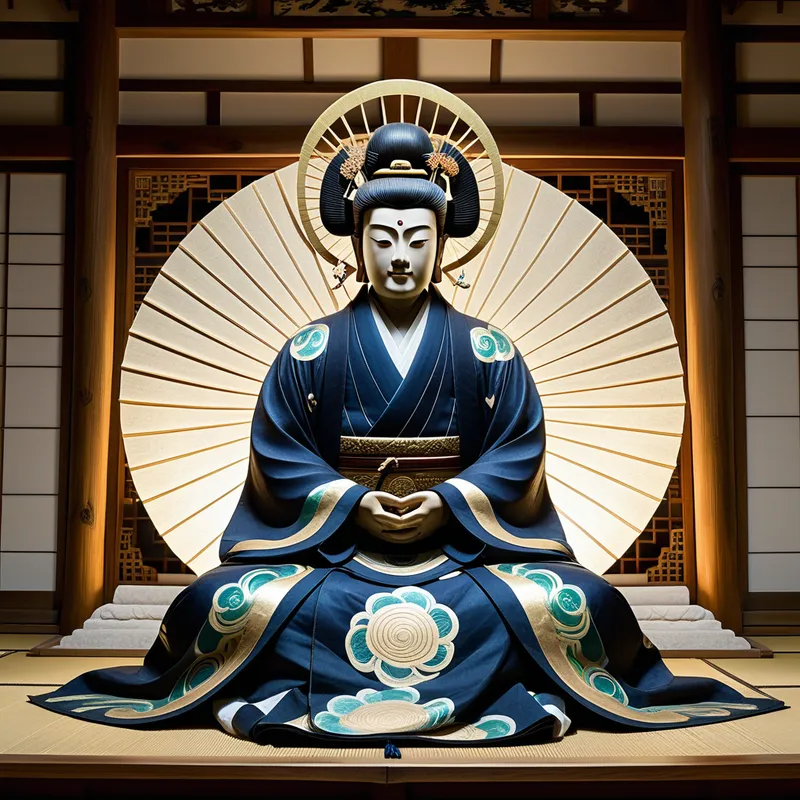
Omoikane Deity of Wisdom Myth Meaning & Symbolism
The myth of Omoikane, the deity summoned for counsel, embodies the sacred act of collective, profound thought to resolve divine crises.
The Tale of Omoikane Deity of Wisdom
Listen, and let the tale unfold from the mists of the High Heavenly Plain. The air in Takamagahara was thick, not with cloud, but with a palpable dread. The Sun herself, Amaterasu, had vanished. She had sealed herself within the Ama-no-Iwato, plunging the world and the heavens into a chilling, silent darkness. The laughter of the gods had died. The rivers of light had ceased to flow.
The assembled kami gathered on the banks of the Ama-no-Yasukawa, their divine faces etched with a fear they had never known. Mighty Susanoo raged, his thunder impotent. The gentle moon god Tsukuyomi stood silent, his light extinguished. A crisis not of force, but of spirit, had befallen them. How does one coax the light back when the source of all light has turned away?
Then, a voice, calm and deep as an ancient forest pool, spoke. It was Takamimusubi, one of the Zōka Sanshin. “We must think,” he said. “Not with one mind, but with the mind that gathers all minds. We must summon the one who embodies this act.” And so they did. They did not call for a warrior or a trickster. They called for the deity of thought and wisdom. They called for Omoikane.
He did not arrive with fanfare. His presence was a settling, a focusing. Imagine the moment when scattered ripples on a pond still into a perfect, reflective surface. That was Omoikane’s arrival. The gods fell silent, their chaotic energies drawn into the vortex of his contemplation. He listened—to their fears, their fragmented ideas, the echoes of Amaterasu’s grief.
Then, the council began. But this was no debate. It was a symphony of cognition orchestrated by Omoikane. He gathered the fragments of divine intention—the suggestion of a sacred mirror, the idea of a provocative dance, the plan for a festal tree. He weighed them, turned them over in the light of his profound mind, not as separate things, but as parts of a single, elegant solution. He saw the connection where others saw only disparate acts. The mirror to reflect and attract her light, the dance to spark curiosity and joy, the tree to hold the offerings of the world. He synthesized the collective intelligence into a coherent, resonant plan.
His wisdom was the loom on which the scattered threads of their desperation were woven into a tapestry of salvation. And when the plan was set, when the Ame-no-Uzume began her divine stomping, when the laughter finally burst forth from the gods and echoed against the stone door, it was the fruit of Omoikane’s deep thought. The rock door slid open, a sliver of glorious light spearing the darkness, and the world was reborn. Not by force, but by the power of a wisdom that thinks things through.
Cultural Origins & Context
The myth of Omoikane is preserved in Japan’s oldest chronicles, the Kojiki and the Nihon Shoki. These texts were compiled under imperial auspices to establish a divine lineage for the ruling house and a cosmological order for the state. Within this framework, Omoikane occupies a critical, if subtly powerful, role. He is not a major actor in sprawling epics but a pivotal functionary in moments of cosmic crisis.
His stories were likely disseminated by kannushi and miko at local shrines and during court rituals. The societal function of Omoikane’s myth is profoundly instructive. In a culture that valued group harmony (wa) and collective decision-making, Omoikane models the ideal process. He represents the move from chaotic, individual reaction to orderly, collaborative resolution. He legitimizes the practice of nemawashi—laying the groundwork through careful discussion—on a divine scale. His wisdom is not the solitary insight of a hermit, but the emergent intelligence of a council properly guided.
Symbolic Architecture
Omoikane is not wisdom as a stored object, but wisdom as an active, catalytic process. He is the personification of the [moment](/symbols/moment “Symbol: The symbol of a ‘moment’ embodies the significance of transient experiences that encapsulate emotional depth or pivotal transformations in life.”/) of [insight](/symbols/insight “Symbol: A sudden, deep understanding of a complex situation or truth, often arriving unexpectedly and illuminating hidden connections.”/) that arises from deep, collective contemplation. His primary [symbol](/symbols/symbol “Symbol: A symbol can represent an idea, concept, or belief, serving as a powerful tool for communication and understanding.”/) is the [council](/symbols/council “Symbol: A council represents collective decision-making and guidance, embodying communal wisdom and authority.”/) itself—the sacred [space](/symbols/space “Symbol: Dreaming of ‘Space’ often symbolizes the vastness of potential, personal freedom, or feelings of isolation and exploration in one’s life.”/) where disparate voices are held and synthesized.
True wisdom is not merely knowing; it is the capacity to hold multiple, often contradictory, truths in the mind at once and to find the pattern that connects them.
Psychologically, Omoikane represents the transcendent function, the psychic [capacity](/symbols/capacity “Symbol: A measure of one’s potential, limits, or ability to contain, process, or achieve something, often reflecting self-assessment or external demands.”/) described by Carl Jung that arises from the [tension](/symbols/tension “Symbol: A state of mental or emotional strain, often manifesting physically as tightness, pressure, or unease, signaling unresolved conflict or anticipation.”/) of opposites to generate a new, third position. The [crisis](/symbols/crisis “Symbol: A crisis symbolizes turmoil, urgent challenges, and the need for immediate resolution or change.”/) of darkness (Amaterasu’s withdrawal) and the [chaos](/symbols/chaos “Symbol: In Arts & Music, chaos represents raw creative potential, uncontrolled expression, and the breakdown of order to forge new artistic forms.”/) of the gods’ fear are the opposites. Omoikane is the psychic function that refuses to take a side, instead creating a [vessel](/symbols/vessel “Symbol: A container or structure that holds, transports, or protects something essential, representing the self, emotions, or life journey.”/)—the council—in which a novel [solution](/symbols/solution “Symbol: A solution symbolizes resolution, clarity, and the overcoming of obstacles, often representing a sense of accomplishment.”/) can be born. He is the ego’s [ability](/symbols/ability “Symbol: In dreams, ‘ability’ often denotes a recognition of skills or potential that one possesses, whether acknowledged or suppressed.”/) to step back from emotional reactivity and engage the deeper, integrative capacities of the Self. He is the [archetype](/symbols/archetype “Symbol: A universal, primordial pattern or prototype in the collective unconscious that shapes human experience, behavior, and creative expression.”/) of the inner advisor, the one who says, “Let us think this through.”
The Dreamer’s Resonance
When the pattern of the Omoikane myth stirs in the modern dreamer, it often manifests as dreams of being in a meeting, a council, or a classroom where a critical decision is pending. The dream ego may feel pressured, lost in debate, or surrounded by conflicting voices (internalized as dream figures). The somatic feeling is one of tension, mental congestion, or a “knot” in the head or chest.
This dream state signals that the psyche is facing a complex life situation—a relational impasse, a career crossroads, an ethical dilemma—where instinctual or habitual responses have failed. The psyche is convening its own internal council of archetypal voices (the inner critic, the child, the rebel, the caregiver) but lacks the presiding function to integrate them. The dream is an expression of the Self’s attempt to summon the Omoikane function: the capacity for patient, non-judgmental, synthetic thought. The resolution in such dreams may not be a clear answer, but the appearance of a calming, focused presence, a sudden quiet in the dream space, or a simple, elegant object (like a clear mirror or a single light) symbolizing the nascent insight.
Alchemical Translation
The alchemical process mirrored in Omoikane’s myth is solutio followed by coagulatio—dissolution and coagulation. The initial crisis is the solutio: the solid light of consciousness (Amaterasu) dissolves into the darkness of the unconscious (the cave). The gods’ panic is the psychic material in a chaotic, dissolved state.
Omoikane’s intervention is the beginning of coagulatio. He does not fight the dissolution; he accepts it as the necessary prima materia. His deep thought is the alchemical vessel, the vas hermeticum. Within this vessel, the disparate elements (the gods’ suggestions) are stirred, heated by the urgency of the crisis, and allowed to interact. The mirror, dance, and tree are not invented from nothing; they are extracted and recombined from the dissolved material of the old order.
Individuation often requires the courage to enter a state of not-knowing, to allow the old conscious attitudes to dissolve, so that a new synthesis, guided by the wisdom of the Self, can coalesce.
For the modern individual, the myth teaches that transformation is not achieved through willpower alone. It requires the creation of an inner sanctum—a meditative, reflective space—where the conflicting demands of one’s life can be “convened” and held in mindful attention. The “Omoikane practice” is to consciously step into the role of the presiding sage within oneself, to listen to one’s internal council without immediate identification or judgment, and to trust that from that deep, collective listening, a resonant path forward will crystallize. The light returns not because we chase it, but because we create, through wise reflection, the conditions to which it cannot help but be drawn.
Associated Symbols
Explore related symbols from the CaleaDream lexicon:
- Mirror — In the myth, the Yata-no-Kagami is a key artifact of the plan, representing reflection, self-awareness, and the tool to attract hidden truth or light back into the world.
- Light — The central goal of Omoikane’s counsel: to restore the lost light of Amaterasu, symbolizing consciousness, clarity, revelation, and the return of psychic order after a period of darkness.
- Council — The very form of Omoikane’s power, representing the collective unconscious, the internal assembly of archetypal voices, and the process of synthesizing multiple perspectives into one wise course.
- Cave — The Ama-no-Iwato where Amaterasu hides, representing the unconscious, withdrawal, depression, or a necessary retreat where light/consciousness must undergo a period of gestation.
- Dance — The act of Ame-no-Uzume, born from the council’s plan, symbolizing embodied expression, ecstatic revelation, and the joyful, provocative act that lures new consciousness from its hiding.
- Tree — The sacred Sakaki decorated with jewels and mirrors, representing the axis mundi, a conduit between realms, and the structure upon which the offerings of insight and appeal are hung.
- Wisdom Pearls — Symbolizing the luminous, perfect insights that are produced through the process of deep, concentrated thought and council, each one containing a condensed solution.
- Roots of Wisdom — Representing the deep, unseen, and foundational processes of contemplation that feed and support the visible flowering of intelligent action and resolution.
- Dream — As the realm where modern individuals may encounter the Omoikane pattern, symbolizing the psyche’s own council chamber where unconscious material is convened for integration and problem-solving.
- Order — The ultimate result of Omoikane’s function, representing the restoration of cosmic and psychic harmony (wa) from chaos through applied intelligence.