
Odysseus's Journey Myth Meaning & Symbolism
A warrior's decade-long voyage through monstrous seas and enchanted isles, a struggle against gods and self to reclaim his throne and soul.
The Tale of Odysseus's Journey
Hear now the song of a man of twists and turns, driven time and again off course, once he had plundered the hallowed heights of Troy. Ten years of war, and ten more of wandering—such was the price paid by Odysseus to walk once more on the stones of his own courtyard.
His voyage began in the ashes of victory, his fleet a dozen proud ships cutting the wine-dark sea for home. But the heart of Poseidon</ab title> was hardened against him. A great tempest, born of the god’s wrath, scattered his vessels. Odysseus alone was cast upon the shores of strange and dreaming lands.
He outwitted the Cyclops, blinding the monstrous Polyphemus with a heated stake, earning the sea god’s eternal fury. He lingered a year in the languid, lotus-scented arms of the Lotus-Eaters. He descended to the very rim of the world, to the dank House of Hades, where the ghost of the blind seer Tiresias whispered of the trials to come.
His crew, hearts faltering, opened the bag of winds given by Aeolus, hurling them back from the sight of Ithaca’s shores. They were devoured by the cannibal Laestrygonians. On the isle of Aeaea, the sorceress Circe transformed his men into swine, but Odysseus, protected by the herb moly, became her lover for a year, learning the secrets of the sea roads.
He sailed past the sweet, soul-destroying song of the Sirens, bound to the mast while his crew rowed on, ears stoppered with wax. He navigated the deadly strait between the ravenous whirlpool Charybdis and the six-headed serpent Scylla, losing six men to her snapping jaws. His last companions, starving, slaughtered the sacred cattle of the sun-god Helios on the isle of Thrinacia. For this sacrilege, Zeus shattered their ship with a thunderbolt. All were drowned.
Only Odysseus survived, clinging to wreckage for nine days before washing up, broken and alone, on the shore of Ogygia. There, the nymph Calypso, whose name means "she who hides," held him in her flowered cavern for seven years, offering him immortality if he would stay and forget his mortal wife, Penelope. But his heart, a lodestone, ever pointed home. Commanded by the gods, Calypso released him. He built a raft and sailed on, only to be shipwrecked once more by Poseidon.
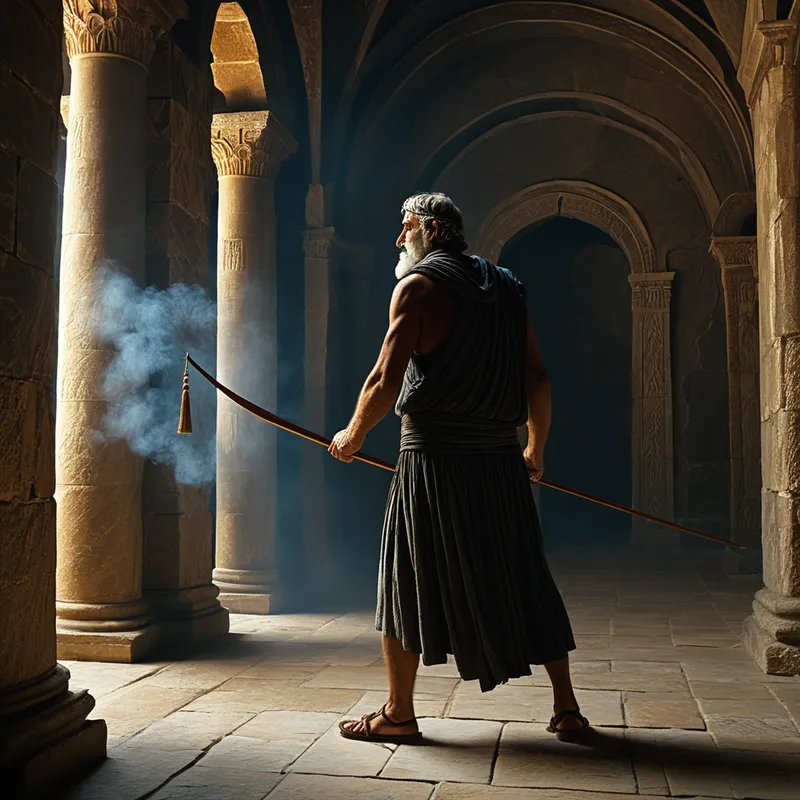
Naked and exhausted, he crawled onto the land of the Phaeacians. There, in the court of King Alcinous, he told his long tale. Moved by his suffering, they gave him a magical ship that carried him, in a deep, dreamless sleep, to the hidden harbor of Ithaca. He awoke, an old man in a young land, his home overrun by arrogant suitors vying for his throne and his wife. With the aid of his son, Telemachus, and the goddess Athena, he disguised himself as a beggar. He entered his own hall, endured insults, and watched the corruption. In the final trial of his spirit, he strung the great bow that no other man could bend. Then, with terrible, righteous fury, he revealed himself and cleansed his house with blood and bronze. After twenty years, the wanderer was home. The king was restored. The journey, at last, was complete.
Cultural Origins & Context
This epic song, the Odyssey, is attributed to the blind poet Homer, and it crystallized from a rich oral tradition in the 8th century BCE. It was not mere entertainment but a foundational text of Greek paideia—education and culture. Performed by rhapsodes at festivals, it served as a communal mirror. It reinforced core values: xenia (the sacred duty of hospitality), metis (cunning intelligence), piety towards the gods, and the supreme importance of the oikos (household and lineage).
The tale functioned as a mythic map of the known and unknown world. The journey from Troy, in the east, back to Ithaca, in the west, traced a psychic and geographic arc from the chaos of war and foreign shores back to the center of order: the homeland, the hearth, the legitimate social structure. It was a narrative that taught a people, themselves great sailors and colonists, about the perils and wonders of venturing beyond the horizon, and the even greater imperative of returning to define and defend the center.
Symbolic Architecture
The journey of Odysseus is the archetypal journey of the conscious ego through the unconscious. Ithaca is not just a physical island; it is the integrated Self. The voyage is the necessary detour, the katabasis (descent) required for any meaningful anabasis (ascent).
The hero does not conquer the world to possess it, but is dismantled by the world to remember himself.
Each island is a state of consciousness, a complex to be navigated. The Cyclops represents brute, unreflective instinct—the monstrous "I" that consumes all in its path. Circe is the seductive power of enchantment and animal transformation, the lure of abandoning one's higher nature for sensual oblivion. The Sirens are the call of idealized knowledge, the beautiful song that promises total understanding but leads to psychic death upon the rocks of obsession. Scylla and Charybdis are the classic psychological double-bind, the impossible choice between two forms of loss, where passage requires accepting sacrifice. Calypso is the ultimate temptation: the offer of eternal, painless stasis, a blissful immortality that is also a complete annihilation of one's mortal purpose and connections.
Odysseus’s primary weapon is not strength, but metis—cunning, adaptable intelligence. This is the quality of consciousness that can bend and shape itself to circumstance, that uses disguise, story, and patience as its tools. His final disguise as a beggar is his ultimate initiation: the king must become nobody to become himself again.

The Dreamer's Resonance
When this myth stirs in the modern psyche, it often manifests in dreams of endless travel, of being lost or trying to find a way home through a shifting, unfamiliar landscape. You may dream of being on a ship with no land in sight, of encountering strange, alluring, or threatening figures who offer cryptic advice or demands. The dream-ego is in the state of Odysseus: displaced, tested, and seeking reorientation.
Somatically, this can correlate with feelings of profound fatigue, a "weariness of the long road," even when life appears static. Psychologically, it signals a process of mid-life reckoning or a post-traumatic journey. The dreamer is navigating the aftermath of a great life change—a "Troy" they have sacked (a career achieved, a relationship ended, a trauma survived)—and now must face the often more confusing voyage of integration. The monsters are internal: a consuming rage (Cyclops), an addictive pull (Lotus, Circe), an impossible dilemma (Scylla and Charybdis), or a depressive stasis (Calypso). The dream is the psyche’s way of charting this interior Aegean.

Alchemical Translation
The alchemical work modeled by the Odyssey is the opus contra naturam—the work against one's own raw, untamed nature. It is the transmutation of the leaden, war-scarred veteran into the golden, restored king. The process is one of relentless solve et coagula: dissolution and coagulation.
First, the ego (Odysseus) is violently dissolved from its triumphant, identified state (the Sack of Troy) by the storm (Poseidon’s wrath, or life’s unexpected crises). It is then subjected to a series of purgative trials, each designed to burn away a specific impurity: arrogance (Cyclops), forgetfulness of purpose (Lotus-Eaters), fear of death (Hades), lust (Circe), grandiosity (Sirens), and impulsivity (Helios's cattle).
The true destination is not a place on a map, but a state of being—the capacity to hold the throne of the Self with wisdom earned through suffering.
The long captivity with Calypso is the nigredo, the blackening, the dark night of the soul where all seems lost in comfortable despair. Release comes only when the ego fully accepts its mortal journey and renounces the false immortality of escape. The final stage, the return, is the coagulatio. The scattered, wandering consciousness must re-enter its own life (Ithaca) not as a conqueror, but incognito. It must see its own realm with new eyes, endure humiliation (the beggar), gather its resources (Telemachus, Athena as inner wisdom), and only then, with precise and focused intent (stringing the bow), execute the necessary, often painful, act of re-ordering (the slaughter of the suitors). The suitors represent the parasitic complexes, the false claimants to the psyche’s throne that have grown in the ego’s absence. Their removal is the final, violent act of integration, making the whole psyche once again a sovereign domain. The journey ends where it began, but the man who returns is not the man who left. He is the alchemist who found his philosopher’s stone not in a foreign land, but in the reclaimed hearth of his own soul.
Associated Symbols
Explore related symbols from the CaleaDream lexicon: