Odin's Halls of Valhalla Myth Meaning & Symbolism
The hall where Odin gathers the slain, preparing for Ragnarök, a myth of chosen fate, cyclical war, and the psyche's preparation for its final battle.
The Tale of Odin's Halls of Valhalla
Hear now, of the hall that is not for the living. Listen, and feel the chill of the northern wind that carries not snow, but the whispers of the chosen dead.
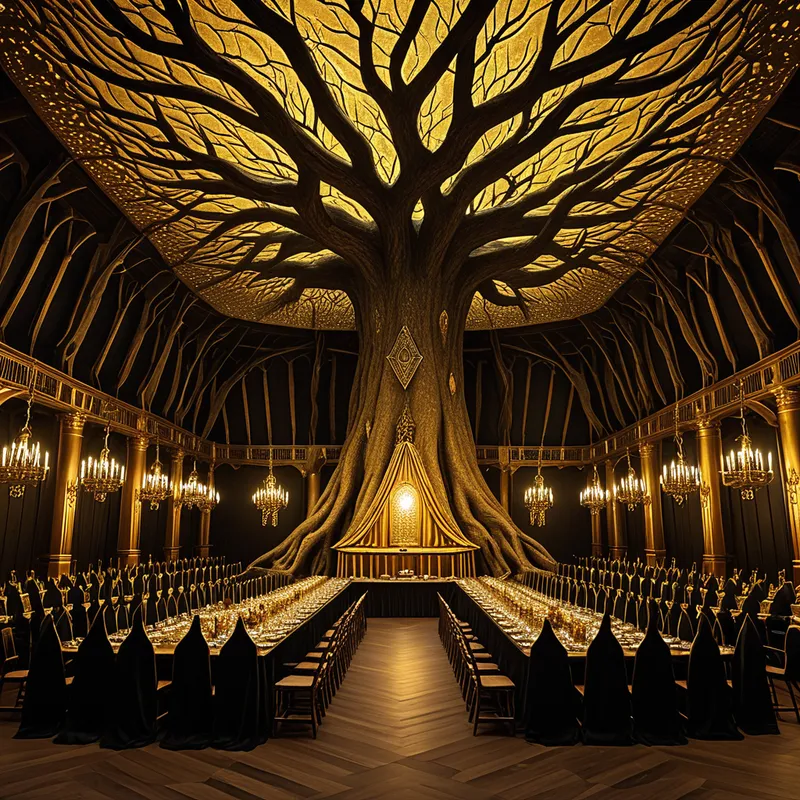
In the high places of Asgard, where the air is thin with power and the light is the colour of old gold, stands a hall beyond mortal measure. Its name is Valhalla. Its rafters are spears, its roof thatched with shields that gleam like a field of frozen stars. Five hundred and forty doors it has, each wide enough for eight hundred warriors to march through, shoulder to shoulder. And before its gates stands the tree Gullinbursti, and within, the goat Heiðrún chews the leaves of Yggdrasil.
But this hall is silent, waiting. Its master is the one-eyed wanderer, Odin. He does not sit idle on his high seat, Hliðskjálf. His gaze, sharpened by the price of a well, pierces the veils of the worlds. He watches the mud and blood of Midgard’s battlefields. He seeks a certain glint—not of gold, but of spirit. The unyielding stare of a warrior who knows death is upon him, yet chooses the manner of his meeting it.
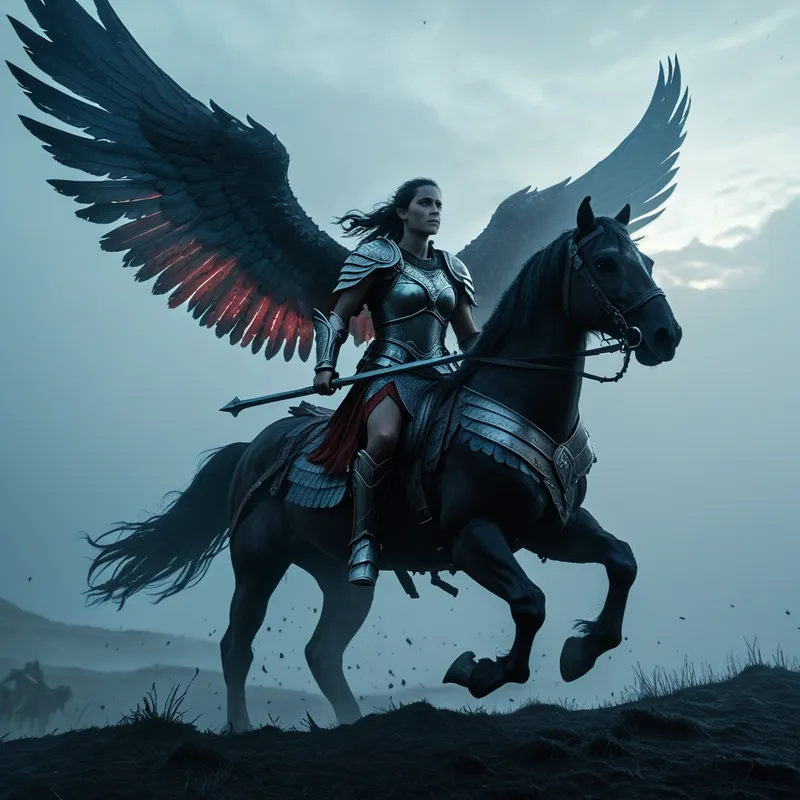
Then, he sends his choosers. The Valkyries. They ride not on horses, but on the very tempest of battle. Their armour sings a deadly song, and their spears point the way home. To the warrior who has fallen, sword in hand, the world dissolves into the thunder of wings and a face of terrible, beautiful judgment. A cold hand grasps his soul, and he is lifted from the ruin of his body, borne upwards on a wind that smells of iron and pine.
He arrives in the shimmering field before the great hall. The wounds that killed him are gone, leaving only the memory as a badge. He is now Einherjar, “the once-fighters.” And here, the endless day begins. By day, on the vast plain of Vígríðr, they clash. Sword rings on shield, axe bites into helm. They fight, they fall, and they are made whole again. It is a practice of perfect violence, a honing of the will.
When the sun’s chariot dips, a horn sounds. All strife ceases. The fallen rise, laughing, clasping the arms of those who struck them down. They stride through the towering doors of Valhalla. And here is the feast. The great boar Sæhrímnir is slaughtered, boiled, and reborn whole for the next day. Mead flows endlessly from the udders of Heiðrún, served by the Valkyries themselves. They drink, they boast, they sing songs of lives that are already legend.
But in the midst of the roaring feast, the Allfather sits. His two ravens, Huginn and Muninn, whisper in his ears. His single eye holds no revelry, only a deep, grim knowledge. This glorious hall, these magnificent warriors, this endless feast—it is all preparation. It is an army being assembled, a weapon being forged in the fires of eternity. For the final day, Ragnarök, is written in the roots of the world tree. And when the wolf breaks his bonds and the ship of nails sails, the doors of Valhalla will swing open one last time. The Einherjar will march out, not to a field of practice, but to the last battle, where even gods will die. This is the tale. The hall is not a reward. It is a muster. And its master is a general who sacrifices his peace for a hope, however desperate, against the coming dark.
Cultural Origins & Context
The myth of Valhalla was not scripture, but a living breath within the oral tapestry of the Viking Age (c. 793–1066 CE). It was preserved in later written texts like the Poetic Edda and the Prose Edda, but its heart beat in the halls of chieftains and around campfires. Skalds, the poet-historians, were its custodians, weaving tales of Odin’s hall into praise-poems for living warriors, implicitly linking their courage to this glorious destiny.
Its societal function was multifaceted. For the warrior aristocracy, it provided a powerful eschatology that glorified death in battle, channeling the terror of mortality into a narrative of eternal honour and camaraderie. It reinforced a social ideal of bravery, loyalty, and skill-at-arms. Importantly, it was a selective myth. Valhalla was not for all; it was for the chosen slain, typically those of noble or heroic stature who died weapon-in-hand. This mirrored and justified the hierarchical structure of Norse society. The myth also served Odin’s cult specifically, portraying him not as a distant creator, but as an active, needy god, gathering an army and offering a potent form of immortality in exchange for devotion and a specific kind of death.
Symbolic Architecture
Beneath the epic feasting and battle, Valhalla is a profound symbolic structure about consciousness, choice, and confronting inevitable ends.
The hall itself is a psyche prepared for crisis. Its countless doors represent the multiplicity of ways one may enter a state of heightened, focused readiness. The roof of shields is a defended consciousness, while the spears-for-rafters suggest a structural framework built upon directed will and aggression. It is not a peaceful paradise but a dynamic, fortified state of mind.
Valhalla is the psyche's barracks, where the disparate forces of the self are drilled into a single, purposeful army to face its ultimate dissolution.
Odin’s role is crucial. He is the archetypal sage who has traded an eye for wisdom, who hangs on the world tree in a ritual of self-sacrifice. His gathering of the Einherjar symbolizes the conscious ego (Odin) recruiting and organizing the powerful, often destructive, heroic energies of the psyche (the warriors) that would otherwise be lost to unconsciousness (forgettable death). The daily battle and resurrection is the endless process of confronting and integrating one’s own shadow—fighting oneself, “killing” old identifications, and being reborn wiser from the conflict. The feast represents the necessary celebration and sustenance of this integrated, potentiated self.
The entire myth orbits the black hole of Ragnarök. Valhalla’s meaning is empty without it. This reveals the core Norse (and deeply psychological) acceptance of cyclical destruction. The purpose of all this preparation is not victory in a conventional sense, but to meet fate with full awareness and impeccable conduct. It is the difference between being swept away by a unconscious complex and consciously facing a necessary, if tragic, transformation.
The Dreamer's Resonance
When motifs of Valhalla surface in modern dreams, the dreamer is likely in a process of psychological “muster.” This is not about literal battle, but about preparing the self for a looming, existential challenge.
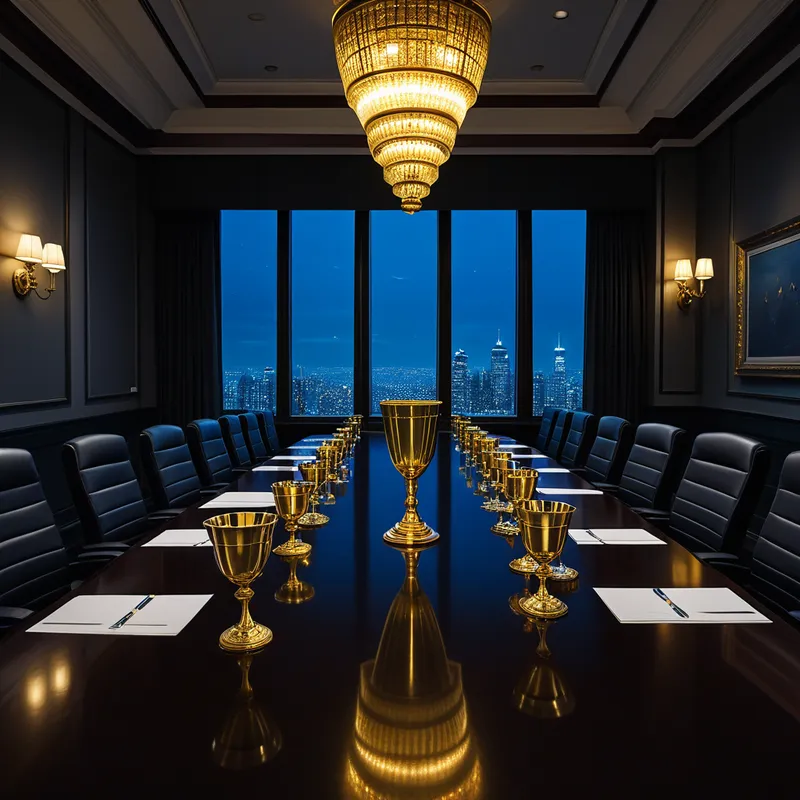
Dreaming of a vast, empty hall with a long table may indicate a feeling of inner potential waiting to be filled, a call to gather one’s resources. A dream of repetitive, non-lethal conflict—fighting the same opponent, losing and restarting—mirrors the Einherjar’s daily battle, suggesting a current life situation where one is “rehearsing” for a bigger confrontation, working through a persistent internal or external conflict. The appearance of a watchful, authoritative figure (Odin) or guiding, decisive women (Valkyries) can symbolize an emerging inner authority or a fateful, non-negotiable choice that “selects” the dreamer, pulling them toward a difficult but necessary path.
Somatically, this can feel like a gathering of tension, a coiling of energy in the chest and gut—not quite anxiety, but a focused readiness. It is the psyche assembling its strength, its arguments, its courage, for a coming “battle” that might be a career-defining project, the end of a relationship, a health crisis, or any event perceived as a fateful reckoning.
Alchemical Translation
The alchemical journey mirrored in the Valhalla myth is the preparation of the philosophical warrior for the Nigredo of Ragnarök. It models a crucial, often skipped, phase of individuation: not just confronting the shadow, but systematically organizing and strengthening the ego to withstand that confrontation’s ultimate consequence—the death of the current conscious standpoint.
The first operation is selection (the Valkyrie’s choice). Psychologically, this is the moment of brutal self-honesty. Which parts of my personality, which achievements, which “deaths” of old ways of being, were meaningful? Which were merely accidents? We must “choose the slain”—acknowledge only the experiences where we were truly present, weapon (will) in hand.
The mead of Valhalla is the intoxicating wisdom brewed from the daily fermentation of conflict into insight, served only to those who have earned it through conscious struggle.
Next is disciplined integration (the daily battle). This is the hard, repetitive work of therapy, reflection, or artistic practice where we engage our inner conflicts (anger, pride, fear) not to annihilate them, but to know them, to make them allies. We “fight” our complexes daily, and each time we understand them better, we are “resurrected” with greater wholeness.
Finally, purposeful orientation toward the end (the wait for Ragnarök). This is the most profound step. It is living with the conscious knowledge of one’s mortality, limitations, and inevitable transformations, not in morbid fear, but as a focusing principle. Like Odin, we sacrifice immediate peace (the innocent’s paradise) for the wisdom of the end. We build our hall, gather our strength, and feast on the joy of a fully engaged life, all while holding the sober, one-eyed gaze that sees the wolf approaching. In doing so, we transmute the terror of fate into the dignity of preparedness. When our personal Ragnarök arrives—be it failure, loss, or death—we do not meet it as confused children, but as Einherjar, marching out of our own well-prepared consciousness to meet it, chosen, and whole.
Associated Symbols
Explore related symbols from the CaleaDream lexicon: