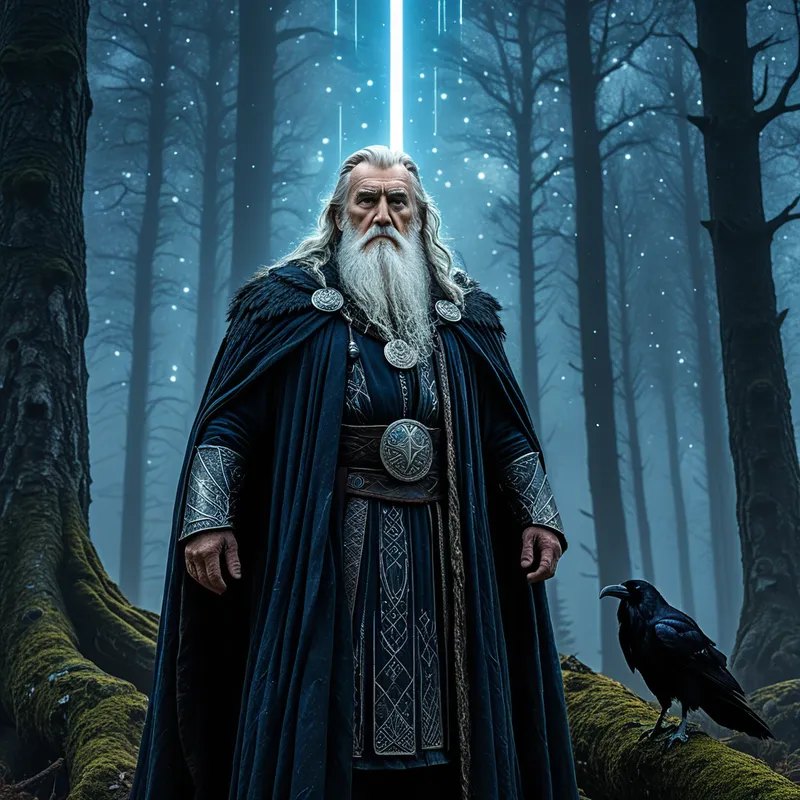
Odin Myth Meaning & Symbolism
The Allfather, Odin, endures self-sacrifice on the World Tree to gain the runes, embodying the eternal quest for wisdom through profound personal ordeal.
The Tale of Odin
Listen, and I will tell you of the price of sight.
In the time before time, when the mists of Ginnungagap still clung to the bones of the world, there was one who was not content with being. He was the Allfather, Odin, lord of the slain, master of the gallows. He held the high seat of Hliðskjálf and saw the nine worlds spread beneath him like a tapestry of fire, ice, and shadow. Yet, for all he saw, he was blind. He knew the fate of gods and men, the doom of Ragnarök, written in the roots of the great Yggdrasil, but he could not read the script. The whispers of the Norns, the weavers of destiny, were a maddening murmur in the deep places.
This blindness was a spear in his side, a thirst that no mead could quench. He had given an eye, a gleaming sapphire of sight, to drink from the well of Mímisbrunnr, and gained the wisdom of the ages. But it was not enough. He needed the primal language, the bones of creation itself. He needed the runes.
So he went to the heart of all things. He walked to where Yggdrasil, the World Ash, groans under the weight of the cosmos, its roots gnawed by serpents, its branches scraping the cold stars. There was no counsel, no trick, no bargain to be made. The only path was the one of total surrender. With his own spear, Gungnir, the very symbol of his will and sovereignty, he pierced his own side, opening a sacred wound. He hung himself upon that terrible tree, a sacrifice to himself.
For nine nights and nine days, a number of becoming and ending, he hung. The winds of the worlds scoured his flesh. The ice of Niflheim bit into his bones. He stared into the abyss below the root, into the seething waters of memory and origin. He died to the god he was. He passed beyond pain, beyond identity, into the raw, singing void of potential.
And there, in the absolute stillness of his annihilation, they came to him. Not as shapes, but as sounds; not as light, but as knowing. They fell from the darkness above, carved themselves from the agony in his side, rose from the depths below—the runes. They burned themselves into his being, a searing, ecstatic alphabet of power. He saw them, he knew them, he was them. With a final, gasping cry that was both a death rattle and a birth scream, he understood. He cut himself down, reborn, whole in his brokenness, sovereign in his sacrifice. The Allfather now held the keys to the universe, paid for with his own blood and breath.

Cultural Origins & Context
This central myth of Odin’s ordeal comes to us primarily from the Old Norse poem Hávamál ("The Sayings of the High One"), preserved in the 13th-century Poetic Edda. It is a first-person account, Odin himself recounting his sacrifice. This was not a story for children or a simple explanation of natural phenomena. It was a foundational mystery, recited by skalds and perhaps within more esoteric circles, explaining the source of the god’s terrifying, often ruthless, wisdom.
In the pragmatic and fatalistic worldview of the Norse, knowledge was not a gentle pursuit but a tool for navigating a harsh and predetermined cosmos. Odin’s myth served a crucial societal function: it modeled the extreme cost of true power and insight. It legitimized the god’s often morally ambiguous actions—his deceptions, his incitement of wars to gather heroes for Valhalla—by showing the unimaginable price he paid for the foresight to prepare for Ragnarök. He was not a benevolent king but a sovereign engaged in a desperate, cosmic salvage operation, and his myth provided a framework for understanding leadership, sacrifice, and the pursuit of fate-altering knowledge.
Symbolic Architecture
Odin’s myth is a masterclass in the symbolism of conscious suffering for transcendence. The Yggdrasil is the axis of reality, the structure of the psyche itself. To hang upon it is to suspend one’s ordinary consciousness, to be stretched between the heavens of aspiration and the underworld of the unconscious.
The wound is the place where the world enters the self, and the self exits to meet the world.
His spear, Gungnir, represents focused will and intention. That he turns this instrument of outward power inward is the pivotal act. It signifies the moment when the ego’s drive for conquest is redirected to pierce its own illusions. The nine nights echo the nine months of gestation, a full cycle of dissolution and rebirth. He is not rescued; he endures until the ordeal itself becomes the crucible of transformation.
The runes he wins are not merely an alphabet. They are the archetypal patterns of existence, the fundamental code of reality. They represent the moment when chaos reveals its hidden order, when suffering yields meaning, when the raw data of experience coalesces into comprehensible, wieldable wisdom. Odin becomes the Sage not through passive study, but through a harrowing, active participation in his own dismemberment and reconstitution.
The Dreamer's Resonance
When this myth stirs in the modern dreamer, it often manifests as dreams of profound ordeal or initiatory suspension. One might dream of being pinned, trapped, or wounded in a way that feels strangely sacred. There may be imagery of hanging, of being pierced by a beam of light or a tree branch, of staring into a dark well or abyss with a sense of dreadful necessity.
Psychologically, this signals a critical phase of initiation. The ego-structure is being challenged to its core. The dreamer is undergoing a process where old identities, certainties, and ways of being must be sacrificed—not by external force, but by an inner, agonizing consent—to make room for a deeper, more authentic knowing. It is the somatic feeling of being at the absolute limit of one’s resources, where the only way forward is through a total surrender of the current self. The dream is not a prediction of literal suffering, but a map of the psychic death required for a more integrated consciousness to be born.
Alchemical Translation
The alchemical journey parallels Odin’s ordeal precisely: Solve et Coagula—Dissolve and Coagulate. The first stage, Nigredo (the blackening), is his nine nights of hanging: the ego’s dissolution into the primal murk of the unconscious, a state of despair, confusion, and felt annihilation.
The crucible of the self is forged in the fire of its own undoing.
His act of self-spearing is the intentional application of the fire of suffering to this raw matter. This is not passive victimhood but an active, if terrifying, engagement with one’s shadow and depths. The moment the runes are perceived is the Albedo (the whitening), the illumination, the revelation of hidden pattern and meaning extracted from the blackness.
For the modern individual, Odin’s path models the process of individuation through radical self-confrontation. It asks: What cherished perception, what comfortable identity, what "eye" of partial sight are you willing to sacrifice for a more complete vision? What wound must you willingly open to discover the hidden wisdom within your own pain? The myth teaches that the most profound knowledge—self-knowledge—cannot be found in books or external validation, but must be carved from the living timber of one’s own experience through an ordeal of solitary courage. We do not find our truth by building higher towers of the ego, but by descending, willingly wounded, into the roots of our own World Tree, and hanging there until the stars themselves whisper their secrets.
Associated Symbols
Explore related symbols from the CaleaDream lexicon:
- Ability
- Grandpa
- Beard
- Glasses
- Receiver
- Mad
- Supervisor
- Wizard
- Overall
- Santa
- Intention
- Blind
- Although
- Aren
- Detective
- Newspaper Pile
- Remote Work
- Missing Tooth
- Echoing Voice
- Dislocated Hip
- Pulling Strings
- Juggling Balls
- Tearing Paper
- Druid
- Helicopter View
- Torn Map
- Iolite Gem
- Ruthenium Gaze
- Cairn of Sticks
- Tegus
- Wizard Staff
- Rune Carving
- Norse Rune Stone
- Cloaked Figure
- Writer's Quill
- Photographer's Camera
- Software Developer's Code
- Coach's Clipboard
- Jigsaw Puzzle
- Axe Throwing Target
- Antique Collectibles
- Chess Tournament
- Chess Clock
- Shakespeare's Quill
- Churchill's War Room
- Jane Austen's Letters
- Quill Pen
- Pages in the Wind
- Saga of Shadows
- Adventurous Anthology
- Epic Sage
- Safety Goggles
- Reclining Lounge Chair
- Ballpoint Pen
- Invisible Ink
- Moonlit Sharpie
- Treetop Walk
- Unfinished Puzzle
- Spirit of Inquiry
- Spear Throwing
- Hunger for the Abyss
- Sunset foraging
- Bone Carving
- Father Sky
- Sage
- Authority
- Authority Symbol
- Obligation
- Determiner
- Adverb
- Implicature
- Alphabet
- Rune
- Ai
- Roguelike
- Minmax
- Pacing
- Sacrifice
- Riddle
- Mystery
- Cost
- Speculation
- Necromancy
- Crutch
- Xray
- Insomnia
- Outward
- Nasal
- Aphelion
- Plummet
- Contrast
- Dominance
- Diffraction