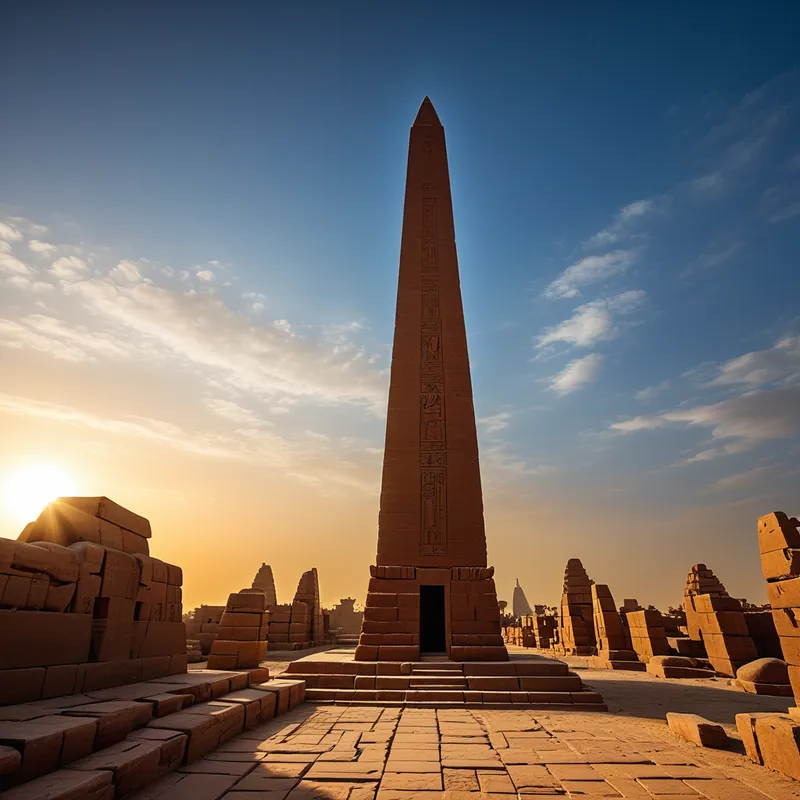
Obelisk of Hatshepsut Myth Meaning & Symbolism
A pharaoh's quest to carve a needle of light, bridging earth and sky, challenged by shadows and crowned by the sun's enduring kiss.
The Tale of the Obelisk of Hatshepsut
Hear now a tale not of gods battling in the heavens, but of a mortal hand reaching to touch them. It begins in the silent heart of the earth, in the red granite quarries of Aswan. The air is thick with dust and purpose. Under the unblinking eye of the desert sun, a mountain is being asked to become a needle. Not by the whim of a giant, but by the will of a king who was a queen: Hatshepsut.
She stood before the living rock, a figure in the regalia of a pharaoh—the double crown, the false beard, the crook and flail. But her gaze held a vision that saw through stone. She did not command slaves; she conversed with artisans, with priests of Ptah, with the master quarrymen whose hands could feel the soul of granite. “We shall not merely cut stone,” her decree echoed. “We shall coax a finger of the earth itself to point the way to my father, Amun-Ra. It will be a petrified ray of his light, a ladder for his ka to descend.”
For months, the symphony of creation rose: the rhythmic tap of dolomite pounders, the hiss of water on heated stone to split the bedrock, the groaning of ropes thicker than a man’s thigh. They worked as if painting the sky with earth, carving a single, perfect shaft—thirty cubits of solid ambition. Then came the journey. Imagine the river Nile groaning under the weight of a god’s dream. A barge, a floating mountain, crept northward. The obelisk lay upon it like a sleeping giant, its raw surface whispering of the underworld it left behind. People lined the banks, not in silence, but in song and strain, hauling the vessel against the current, a nation’s sinews bending to a single, sacred task.
At Ipet-Isut (Karnak), the true trial began. A ramp of sand and earth, a sloping pathway to the heavens, was built against the temple’s pylon. The granite needle was coaxed, inch by agonizing inch, up this artificial dune. The air crackled with tension, with chants to Thoth for precision, with prayers to Isis for protection. One slip, and the dream would shatter into a million fragments of failure.
Then, the moment of erection. A collective breath held. The sand was pulled from its cunningly designed chambers beneath the stone’s base. With a deep, seismic sigh that was felt in the bones of every witness, the obelisk settled into its plinth, upright and absolute. Now the artists swarmed, their chisels dancing, inscribing the stone with the story of its making: “Her majesty did this for her father Amun… she made as her monument two great obelisks of hard granite, the pyramids of which are of electrum, which can be seen from the river on both sides… the sun is dazzling between them.”
Finally, the capstone—the pyramidion—was sheathed in beaten electrum, an alloy of silver and gold. At the first dawn after its dedication, as Ra’s barque crested the horizon, a blinding spear of light erupted from that golden tip. The shadow it cast was not one of darkness, but a precise, black line of measurement, of order imposed upon chaos. The obelisk stood: no longer stone, but a solidified moment of communion between a sovereign’s will and the sun’s eternal fire.
Cultural Origins & Context
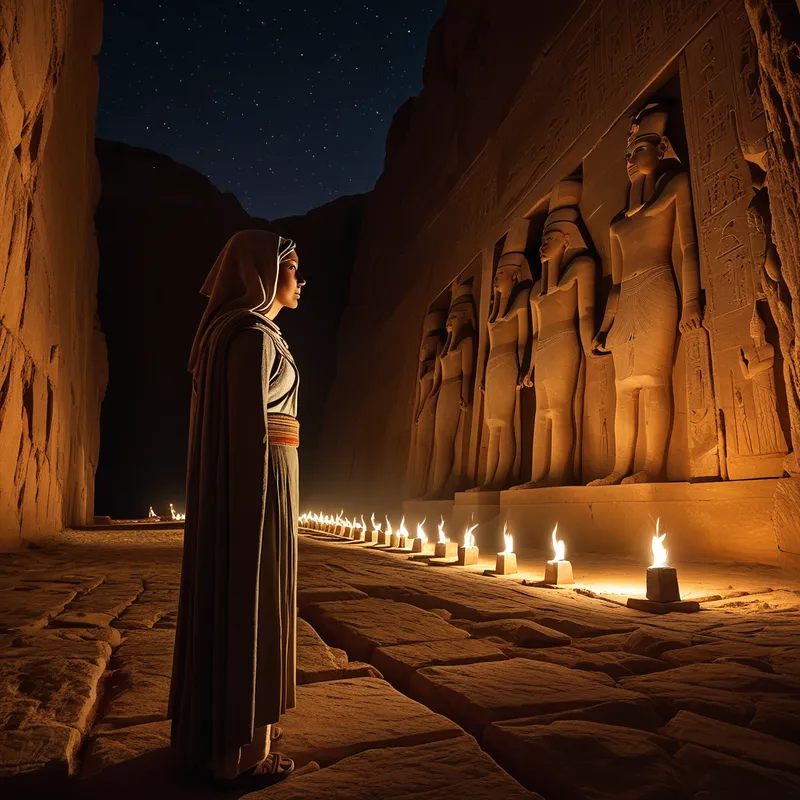
This is not a myth from the primordial age of gods, but a documented, monumental act of myth-making in real time. The “myth” of Hatshepsut’s obelisks is rooted in the historical reality of her reign (c. 1479–1458 BCE) during the New Kingdom. The narrative was not passed down by oral bards but was literally set in stone—the hieroglyphic inscriptions on the obelisks themselves are its primary scripture. These texts, composed by royal scribes and priests, served a dual societal function: religious and political.
Religiously, the obelisk was a tekhenu, a symbol of the first mound of creation that emerged from the primordial waters of Nun. It was a petrified sunbeam, a docking place for the solar barque, and a direct conduit for the god Amun-Ra’s power to bless the land. Politically, for Hatshepsut, it was an act of profound legitimacy. As a female pharaoh in a deeply patriarchal system, her authority was perpetually under subtle threat. By undertaking the most extravagant, expensive, and technically demanding building project possible—one traditionally reserved for male kings to prove their divine favor—she was writing her name into the cosmic order. She was saying, in indelible granite, “My reign is not an aberration; it is a fulfillment of divine will.” The myth was told through ritual, through the public spectacle of its transport and erection, and through the enduring, awe-inspiring presence of the obelisk itself, which functioned as a permanent, silent herald of her sanctioned power.
Symbolic Architecture
At its core, the obelisk is a symbol of axis mundi—the world axis connecting the underworld (Duat), the earthly realm, and the heavens. Hatshepsut’s story encodes the psychological process of erecting one’s own axis: the struggle to align personal will with transcendent meaning.
The raw granite in the Aswan quarry represents the unformed Self, heavy with potential, buried in the unconscious (the earth). Hatshepsut’s vision is the emerging consciousness that seeks to give this massive potential a defined shape and direction. The arduous process of quarrying, shaping, and transporting is the labor of the ego, enduring friction, doubt, and immense effort to bring a fragment of the inner world into external reality.
The obelisk is the individuated spine of the psyche: rooted in the dark earth of instinct and history, yet aiming unequivocally for the illuminating light of consciousness and purpose.
The electrum capstone is crucial. It is not pure gold (perfection, the sun god), but an alloy—a fusion of silver (the lunar, intuitive, feminine) and gold (the solar, logical, masculine). This represents the achieved sovereignty of the Self, which integrates opposites. For Hatshepsut, this was a literal integration of her feminine being with the masculine office of pharaoh. For any individual, it symbolizes the culmination of inner work: the creation of a personal “capstone” that is unique, reflective, and brilliantly conductive of transcendent energy.
The Dreamer's Resonance
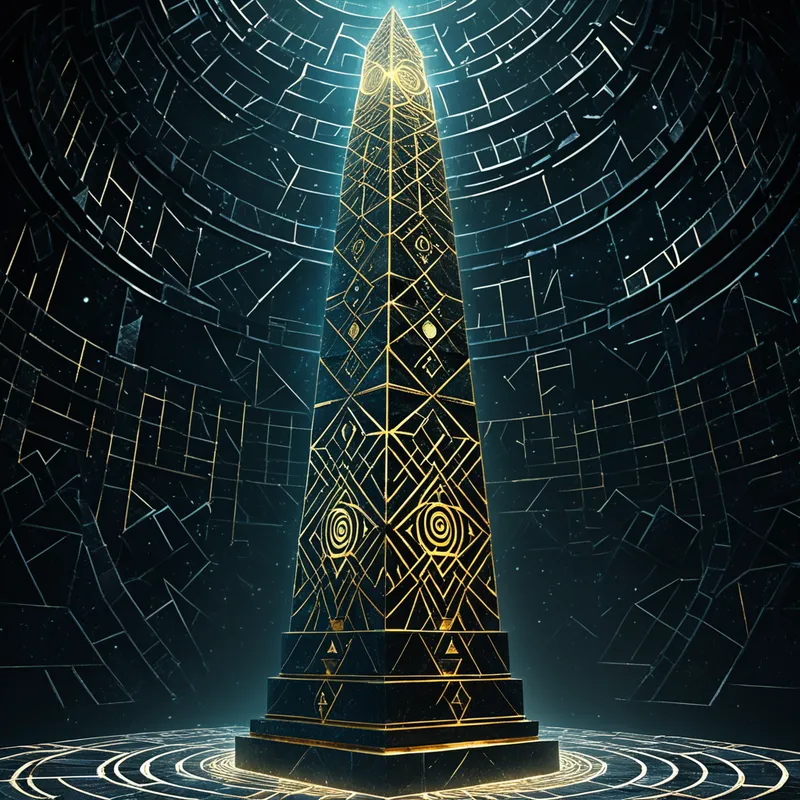
When this myth pattern stirs in the modern dreamer, it often manifests as dreams of immense, impossible tasks; of moving monolithic objects; of constructing or discovering towering, slender structures. Somatically, one might awaken with tension in the spine—the body’s own axis mundi—or a feeling of being stretched between a deep, gravitational pull and a longing to ascend.
Psychologically, this dream signals a process of psychic erection. The dreamer is in the midst of, or being called to, a great labor of self-definition. The “quarry” is often a period of introspection or crisis where the raw material of one’s identity feels both burdensome and full of promise. The “transport” phase mirrors the vulnerability of bringing a nascent part of oneself into the world, fearing it will sink or be rejected. The dream may highlight the “ramp”—the support systems, skills, and patience required to elevate this new self-aspect into a position of stability and visibility. To dream of the completed, shining obelisk is to experience a moment of profound self-validation, where one’s life feels aligned with a purposeful, vertical connection to something greater.
Alchemical Translation
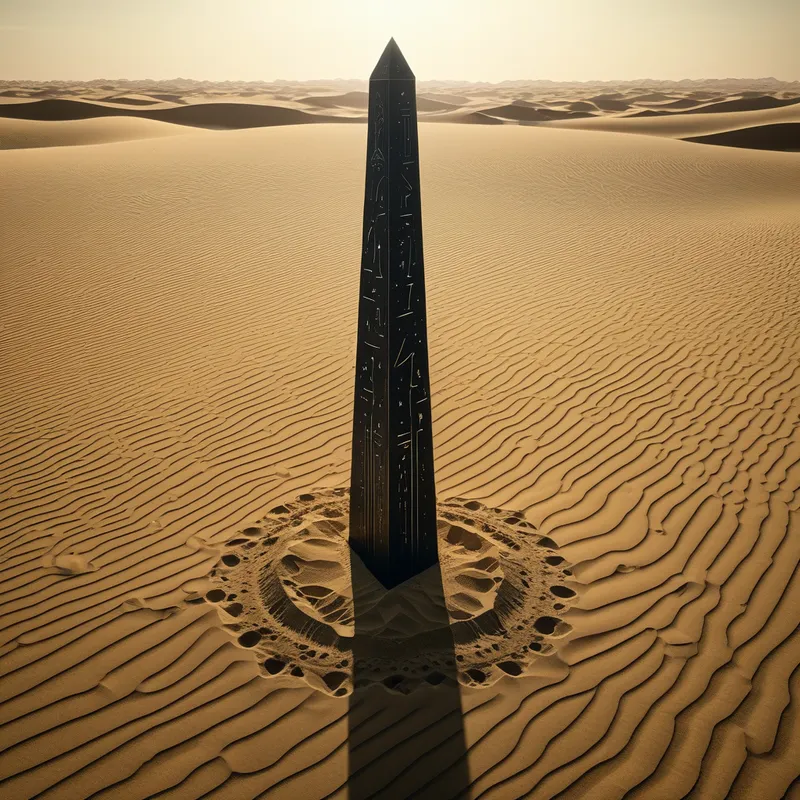
The alchemical process mirrored here is that of coagulatio—the making solid, followed by sublimatio—the spiritualization of matter. The myth models the full arc of individuation for the modern soul.
First, one must descend to the “quarry” of the personal and collective unconscious (nigredo, the blackening). Here, in the shadowy depths of one’s nature, lies the unshaped “granite”: core talents, buried traumas, ancestral patterns. The act of choosing to work on this stone is the beginning of albedo (whitening), the commitment to consciousness. The years of shaping are the painful, meticulous citrinitas (yellowing), where the ego labors to refine the raw material through life’s experiences, failures, and learnings.
The erection is the critical moment of rubedo (reddening), the final stage where the transformed substance is fixed in its new, exalted form. It is the integration of the work into the fabric of one’s lived reality. The electrum capstone represents the ultimate alchemical gold—not a pure, abstract spirit, but the aurum non vulgi (the gold of the philosophers), a unique and durable alloy of one’s total experience.
The modern individual’s “Obelisk of Hatshepsut” is the enduring legacy of their conscious life—not a monument to the ego, but a testament to the dialogue between the human will and the transpersonal Self. It is what remains standing, pointing meaningfully upward, long after the sands of time have shifted around its base.
Thus, the myth invites us to ask: What is the monolithic dream buried in your personal Aswan? What electrum alloy—what fusion of your inherent dualities—will you fashion to crown it? And toward what sun will you orient its unwavering shadow?
Associated Symbols
Explore related symbols from the CaleaDream lexicon: