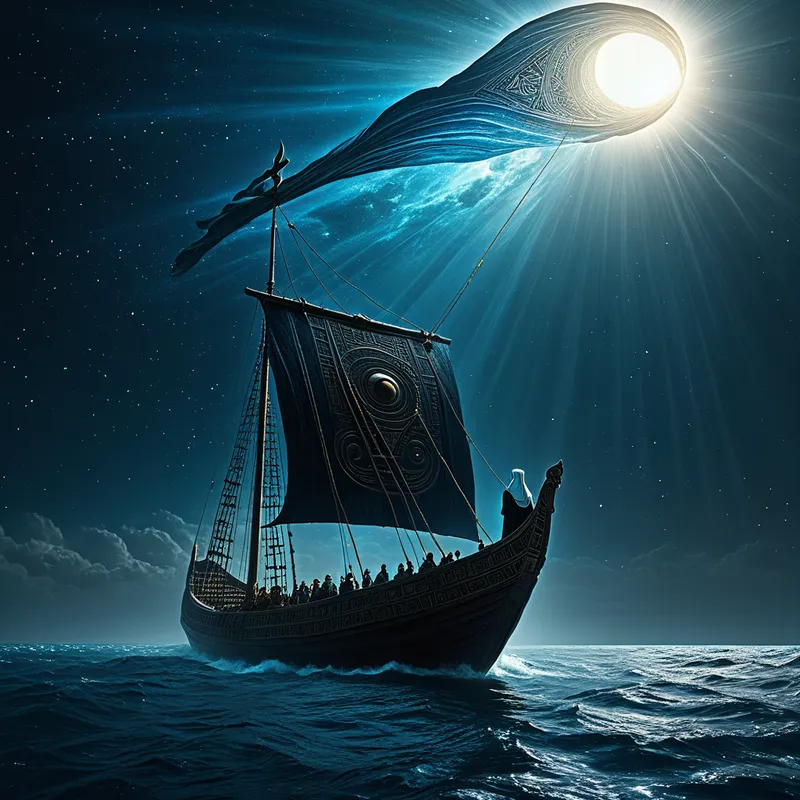
Nun Myth Meaning & Symbolism
Before gods or land, there was Nun—the dark, boundless waters of potential from which all existence first stirred into being.
The Tale of Nun
Listen. Before the first word was spoken, before the first name was known, there was only the deep. Not a sea, for a sea has shores and a sky above it. This was the Nun. A stillness so profound it was a kind of roaring silence. A darkness so complete it was the mother of all color. A cold, watery abyss that held within its boundless, patient belly every star, every mountain, every laugh, every tear that ever would be.
It was not empty. It was full—crammed with the unformed stuff of all possibilities. The potential for the hawk’s flight and the serpent’s coil slept there, tangled with the dream of stone and the whisper of wind. But they slept without distinction, without order. This was the world before the world: perfect, whole, and utterly inert.
Then, within that infinite, patient dark, a disturbance. A stirring. A desire.
It began not with a bang, but with a slow, deep turning, like a great beast shifting in its eternal slumber. From the heart of the Nun, a force gathered. The Egyptians would later call it heka, the magic of authoritative utterance. But here, at the beginning, it was a wordless will, a yearning for form. The waters themselves began to churn, not with waves, but with intention.
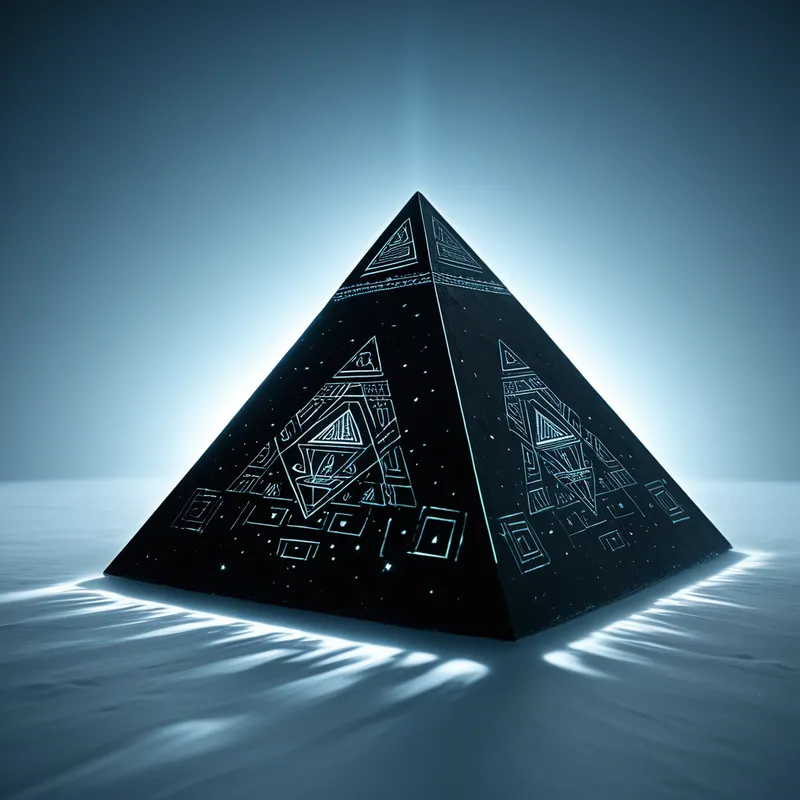
And from that churning, the first thing was lifted. Not a god, not yet. A mound. A single, hump of fertile, black earth—the Benben—breaking the perfect surface of the Nun. It was small in that vastness, yet it was everything. It was the first “here” as opposed to the endless “there.” Upon this mound, the first light dawned. It was the sun, Khepri, pushing himself into being, a golden scarab rolling his fiery ball up from the depths. With that light, the first god stood upon the mound: Atum, the “Complete One,” who contained within himself all that would follow.
The Nun did not retreat. It remained, cradling the mound, surrounding the new-born world. It had given birth to distinction, to order, to ma'at, and in doing so, it became its opposite: the chaos that defined the order, the darkness that gave meaning to the light. It was the endless, quiet mother who had released her child into being, and who would, at the end of all days, welcome it back into her silent, undifferentiated embrace.

Cultural Origins & Context
The concept of Nun is not a single story from one papyrus, but a foundational bedrock of Egyptian cosmology, appearing in texts from the Pyramid Texts (c. 2400-2300 BCE) to the later Book of the Dead. It was the necessary first premise in every creation narrative, whether from Heliopolis, Memphis, or Thebes. The priests and scribes did not speak of Nun as a myth to be believed, but as a cosmological reality to be understood—the literal, metaphysical environment from which their world emerged.
Its societal function was profound. By situating their ordered world (ma'at) within the enduring embrace of Nun (chaos or isfet), the Egyptians framed existence as a perpetual, sacred act of maintenance. The daily rising of the sun was not guaranteed; it was a victory won each dawn by the gods, a re-enactment of that first emergence from the waters. The pharaoh’s duty was to uphold this order, to keep the fertile mound of Egypt from sinking back into the formless deep. Nun was both the source of all life and the ever-present threat of dissolution, making the Egyptian worldview one of dynamic, precious balance.
Symbolic Architecture
Nun is the ultimate symbol of the unmanifest, the potential that exists before form. It is not evil, nor is it malicious. It is pure latency.
Before the self can be known, it must swim in the dark waters of what it is not.
Psychologically, Nun represents the unconscious in its most primordial state—not the personal unconscious of repressed memories, but the collective, transpersonal unconscious, the oceanic realm of archetypes and possibilities that precedes individual consciousness. It is the mental space before thought coalesces into language, before feeling resolves into nameable emotion. The Benben mound, then, is the birth of the ego, the first island of “I” that distinguishes itself from the undifferentiated “all.” The light of Khepri is the dawn of awareness, of illuminating consciousness.
The myth tells us that order (ma'at) is not the default state of the universe; it is a hard-won achievement born from chaos. The creative act, whether of a god, a king, or an individual, is always an act of drawing form from the formless, of making distinctions in a field of infinite potential.
The Dreamer's Resonance
When the energy of Nun stirs in modern dreams, it rarely appears as an Egyptian god. It manifests as the dreamer finding themselves in vast, dark bodies of water—oceans, lakes, or endless swimming pools at night. There is a profound somatic sense of weightlessness, suspension, and deep quiet. One may feel afraid of the depth, or strangely comforted by it.
These dreams often surface during life transitions: before a creative project, at the start of therapy, after a significant loss, or when old identities are dissolving. The psyche is announcing, “You are in the Nun.” The ego’s familiar mound is temporarily submerged. The dreamer is in the psychic equivalent of the primordial state, where everything is possible but nothing is yet real. The psychological process is one of dissolution and re-potentiation. It can feel like being lost, but it is the necessary prelude to a new kind of finding. The task is not to panic and thrash toward a non-existent shore, but to tolerate the darkness, to listen in the silence for the first stirring of a new, authentic form wanting to emerge.

Alchemical Translation
The alchemical journey of individuation mirrors the myth of Nun precisely. It begins with the nigredo, the blackening, a descent into the chaotic, undifferentiated matter of the soul—our personal Nun. This is the often-painful phase of confronting the shadow, dismantling outdated personas, and facing the formless anxiety of not-knowing who one is.
The goal is not to escape the waters, but to learn the alchemy of drawing land from them.
From this fertile blackness (the Benben mound of black earth), the first light of new consciousness dawns (albedo, the whitening). This is not the borrowed light of societal expectations, but an inner sun, a Khepri born from the deep. It illuminates a new, more authentic structure of self.
The final, crucial translation is the understanding that Nun is not left behind. The mature, individuated self does not stand isolated on a dry island. It understands that it is perpetually emerging from and in relationship with the creative chaos. The unconscious is not conquered; it is recognized as the eternal source. The goal is to build a self so grounded that it can stand on its mound, project its light, and yet look with respect into the surrounding depths, knowing that from those very depths came its own substance and that to them, in time, it will return—not as a defeat, but as a completion of the cycle. We are not just the mound; we are the entire process—the waters, the stirring, the rising land, and the light.
Associated Symbols
Explore related symbols from the CaleaDream lexicon: