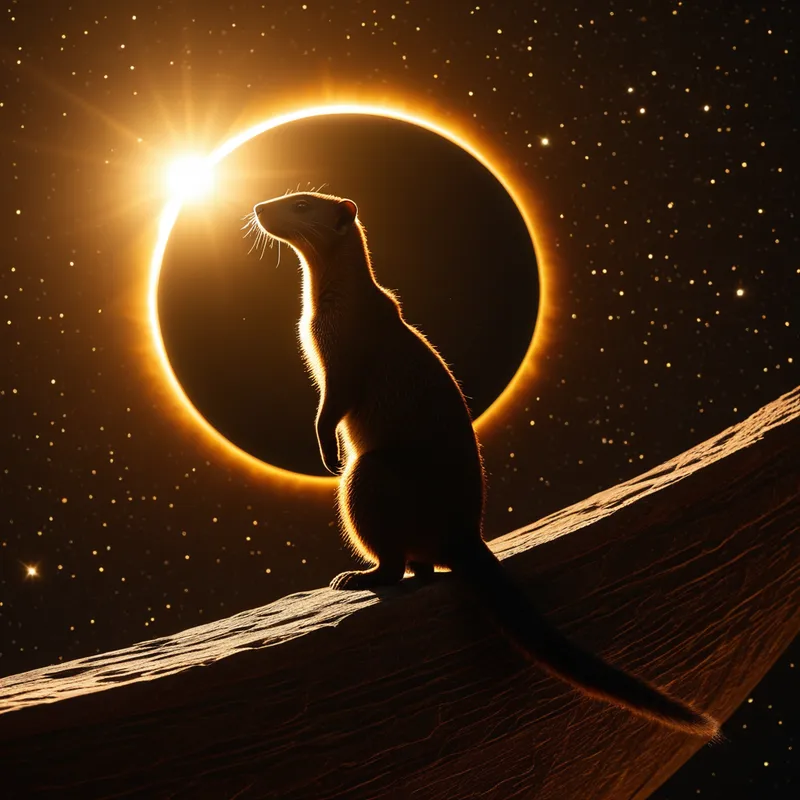
Mongoose as sacred to Ra Myth Meaning & Symbolism
The mongoose, a fierce solar guardian, battles the cosmic serpent of chaos to protect the sun god Ra's sacred journey through the underworld.
The Tale of Mongoose as sacred to Ra
Hear now, and listen well, to the tale of the silent guardian, the golden-furred fury who sails the black waters where stars go to drown.
Each night, as the last crimson light of Ra vanishes from the world of men, a greater journey begins. The great god enters his hidden barque, the Mesektet, and descends into the Duat. This is no peaceful voyage. The Duat is a realm of choking gloom, of inverted mountains and lakes of fire, populated by the dead and things that never lived. And in its deepest trenches, in the primordial mud before time, waits the great enemy: Apep.
Apep is not a mere beast. He is the embodiment of Isfet—the void that hungers for creation. His coils are as vast as the Nile delta, his scales blacker than a starless midnight. His purpose is singular: to halt the barque, to devour Ra, and to plunge all worlds into eternal, formless chaos. The gods aboard the vessel—Thoth, Sekhmet, the mighty Horus—stand ready with spells and spears. But the first line of defense is neither god nor giant.
It is a small, sleek shape with eyes like chips of amber. The mongoose.
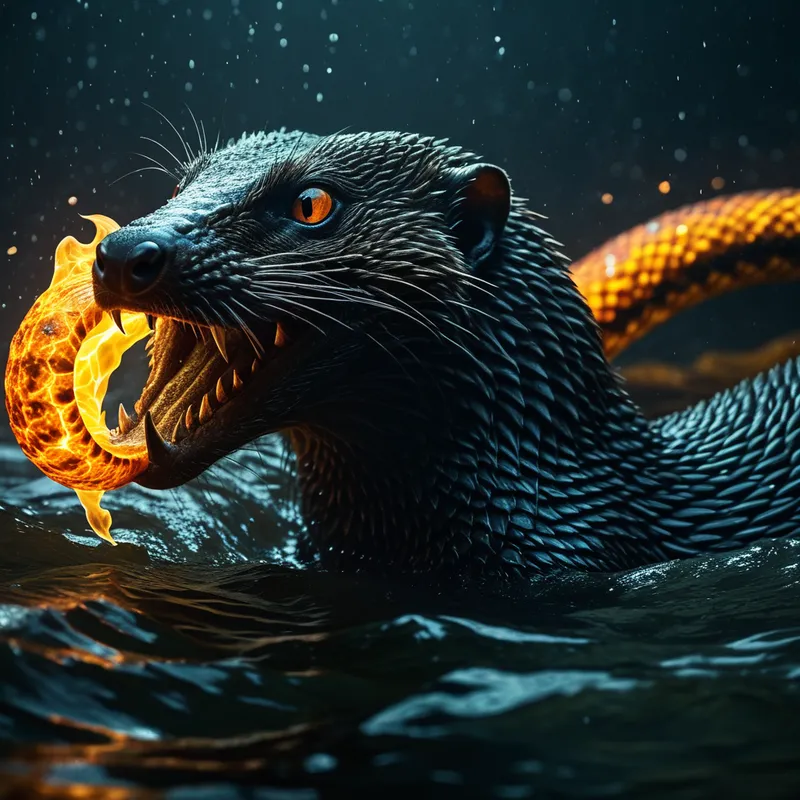
As the Mesektet glides into the seventh and most perilous hour of the night, the waters grow thick and silent. A pressure builds, a malevolent presence that makes the very planks of the barque groan. Then, the waters erupt. Apep rises, a mountain of scaled hatred, his maw opening like a cave to the abyss, poised to swallow the solar disc whole.
And from the prow, a streak of gold launches into the air. Not with a roar, but with a fierce, chittering cry. The mongoose—Ichneumon to the Greeks—meets the serpent not with brute force, but with impossible speed and preternatural cunning. It dances along the monstrous coils, a dart of solar fury against the infinite dark. Its teeth, small but sharp as obsidian flakes, seek not to crush, but to pierce the vital spots. It is the embodiment of Ra's own vigilant, attacking spirit. The battle is a whirl of chaos and order, a silent, desperate struggle witnessed only by the gods and the dead. The mongoose does not slay Apep—for chaos can never be fully destroyed, only held at bay—but it wounds him, harries him, breaks his concentration. It protects the sacred barque, ensuring Ra survives to be reborn at dawn. As the first hint of light stains the eastern horizon, the mongoose, its fur matted but glowing with an inner light, returns to its post, a silent sentinel once more. The sun rises because the mongoose stood its ground.
Cultural Origins & Context
This myth was not a single, codified story like those of Greece, but a vital theological concept woven into the fabric of Egyptian cosmic understanding. It finds its home in the Amduat and other funerary texts that decorated tomb walls of pharaohs in the New Kingdom. These were not books for the living, but maps and guides for the dead, who hoped to join Ra's crew in his eternal battle.
The mongoose's role was told by priests in temple precincts and implied in the animal's veneration. The Egyptian mongoose (Herpestes ichneumon) was a common sight along the Nile, celebrated for its skill in killing venomous snakes and raiding crocodile eggs. This observable, earthly prowess was projected onto the cosmic scale. The creature became a living symbol of the sun god's protective power, a demigod in fur. Its deification was practical theology: the world's daily salvation depended on this small animal's eternal vigilance in the unseen realm. It modeled the Pharaoh's own duty—to be the earthly mongoose, defending the land of Egypt (Kemet) from the chaos of foreign lands and internal disorder.
Symbolic Architecture
The mongoose is a masterclass in symbolic paradox. It is a terrestrial animal tasked with a celestial duty, a small creature confronting an infinite foe. This is its first lesson: power is not a function of size, but of essence and position.
The guardian does not need to be larger than the threat, only more agile, more focused, and standing precisely where the threat aims to strike.
Psychologically, the mongoose represents the conscious, discerning ego in its healthiest, most heroic form. It is not the totality of the psyche (that is Ra, the Self), but a specialized faculty of the Self. Its attributes are vigilance, swift intelligence, and targeted aggression. It does not wage a war of annihilation—that would be the inflation of the ego claiming to destroy the unconscious—but a war of containment. The serpent Apep symbolizes the undifferentiated, devouring chaos of the unconscious when it rises in its raw, destructive form—blind rage, paralyzing fear, or annihilating depression.
The mongoose’s battle is thus the ego's necessary struggle to maintain a coherent consciousness (the solar barque) against periodic floods from the chaotic depths. Its sacredness to Ra signifies that this discerning, fighting spirit is not separate from the Self, but an essential, active expression of it.
The Dreamer's Resonance
When the mongoose archetype stirs in the modern dreamer, it often manifests in dreams of confronting a looming, serpentine, or engulfing threat. You may dream of a shadowy figure at the door, a rising flood, or indeed, a giant snake. The unique element is the presence of a small, fast, intelligent animal—a weasel, a ferret, a cat—that attacks the threat not with overwhelming force, but with strategic bites.
Somatically, this can correlate to a feeling of tight vigilance in the body—a clenched jaw, a readiness in the calves, a hyper-alertness. Psychologically, the dreamer is in a phase where a long-ignored chaotic element from the personal or collective unconscious (a repressed trauma, a shadow aspect, a compulsive behavior) is threatening to "swallow the sun"—to eclipse consciousness and plunge the psyche into disorder. The mongoose's appearance is a signal from the Self: the ego has the innate tools, the "sacred" mandate, to engage. The dream is a rehearsal for the conscious, disciplined confrontation required to protect one's psychic integrity.

Alchemical Translation
The alchemical process mirrored here is not the grand Magnum Opus, but the crucial, recurring stage of separatio and vigilant defense. In the vessel of the psyche (the barque), the conscious principle (mongoose) must continually separate itself from, and defend against, the massa confusa (Apep) to allow the transformative journey of the Self (Ra) to proceed.
For the individual on the path of individuation, the myth models a critical attitude. We are not meant to passively float through the night-sea of the unconscious. We are meant to be active crew members.
Individuation is not a peaceful cruise; it is a sacred patrol. The ego's task is not to become the sun, but to protect the space in which the sun can perform its necessary death and rebirth.
The "alchemical translation" is the daily practice of vigilance—the mindfulness that spots the first coil of a negative thought pattern, the disciplined action that "bites" a habit of procrastination before it engulfs the day, the courage that faces a difficult conversation instead of letting resentment fester into chaos. By engaging strategically and courageously with our personal "serpents," we do not eliminate the unconscious. Instead, we honor the mongoose within: we perform our sacred duty to the greater Self, ensuring our inner sun has a protected vessel in which to travel, transform, and ultimately, rise again. We become, in our small, fierce way, sacred to the Ra within us all.
Associated Symbols
Explore related symbols from the CaleaDream lexicon: