Moko Myth Meaning & Symbolism
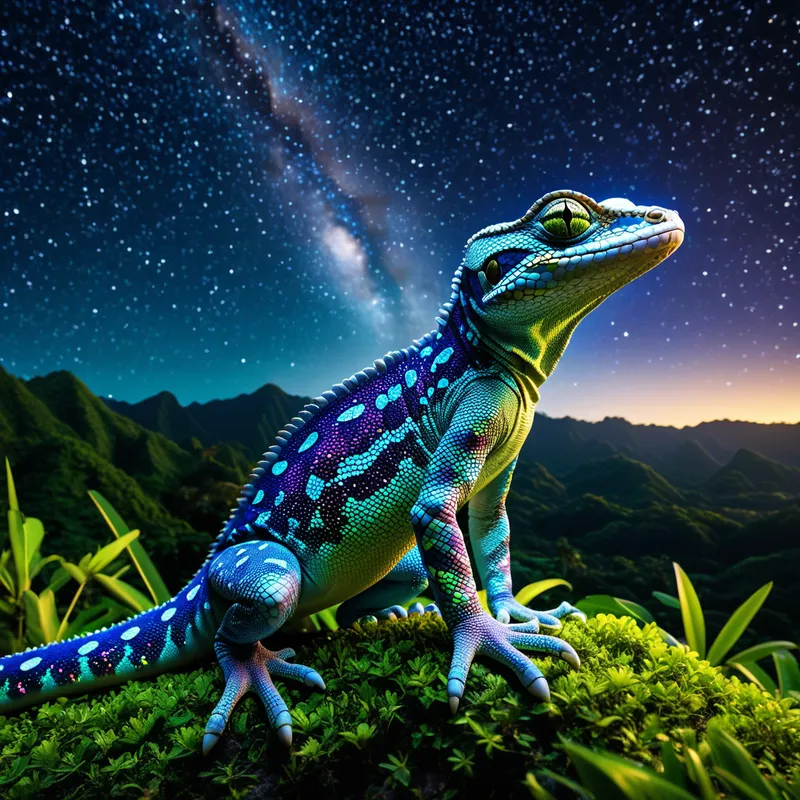
The myth of Moko, the great guardian lizard, embodies the primal wisdom of the land, the protection of ancestral memory, and the deep, instinctual psyche.
The Tale of Moko
Listen, and let the smoke of the fire carry this story into your bones. In the time before time, when the world was still soft from the breath of the gods, the islands slept in the great, dark ocean. They were jewels, but jewels unprotected. The winds could howl and tear at their green flesh; the sea could rise in fury and gnaw at their shores. And from the deep places, shadows with no name could creep onto the sand.
The people flourished, but their flourishing was a tender shoot. They knew the songs of the fish and the paths of the stars, but they felt the vulnerability of their home, a speck in the endless blue. They prayed to Ranginui and Papatūānuku, to Tangaroa, and to Tāne Mahuta. "Give us a kaitiaki," they whispered into the night, "a guardian for our whenua, our land."
And the land itself heard. From the warm, volcanic stone, from the secret moisture of the ferns, from the silent watchfulness of the ancient forests, a spirit gathered itself. It did not descend from the sky but emerged from the very soul of the earth. It was the spirit of resilience, of clinging life, of silent, patient watching. It took form not as a bird or a fish, but as the creature that moves between worlds: the moko.
But this was no ordinary lizard. It grew, scaled by scaled, into a being of immense and gentle power. Its skin was a living map of the land—forest greens, volcanic blacks, the creamy white of coral sand. Its eyes held the calm depth of still pools in hidden caves. It was Moko, the Great Guardian.
The people saw it first at the edge of the forest, a stillness that was more profound than shadow. They felt no fear, only a deep, settling calm. When the storm winds screamed, Moko would place its great body against the cliffs, and the stone would hold firm. When strange canoes appeared on the horizon with unknown intent, a low, resonant hum would emanate from the hills—Moko's warning—and the people would be ready. It did not fight their battles; it made their home a fortress of spirit. It was the embodied tapu—the sacred prohibition and power—of the place itself.
Children would sometimes find a single, luminous scale left on a path, a talisman of safety. Elders would speak of seeing its wise, unblinking eye watching from the canopy during sacred rites. Moko became the silent partner in the covenant between the people and the land, the physical heart of their mana and their turangawaewae—their place to stand. It asked for no altars, only recognition. Its presence was a reminder: you are not alone here. You are protected. You belong.
Cultural Origins & Context
The figure of Moko, the great lizard or gecko, is woven into the oral traditions across the Polynesian triangle, from Hawai'i (as moʻo) to Aotearoa (New Zealand). These are not mere animal tales but pūrākau—cosmological narratives that encode history, ethics, and ecological knowledge. The stories were the province of the tohunga, recited in the whare wānanga (house of learning) to initiates.
The societal function was multifaceted. Practically, stories of powerful, territory-guarding moko served as natural "keep out" signs for rival groups, imbuing certain valleys or springs with a protective dread. Spiritually, they articulated a fundamental tenet of Polynesian worldview: that the natural world is animate and intelligent. A rock, a tree, a lizard could be a kaitiaki, an ancestral guardian. Moko myths taught that protection is not always aggressive; it is often the deep, abiding, and watchful presence of the land itself, a manifestation of ancestral care that pre-dates human arrival. The myth reinforced the sacred duty of humans to be, in turn, guardians of the guardian—to live in a way that honors that covenant.
Symbolic Architecture
At its core, Moko symbolizes the autochthonous psyche—the part of the soul that is native to the place of your being, both literally and metaphorically. It is not a spirit that comes from afar to save you; it is the innate, instinctual wisdom that emerges when you are in right relationship with your own foundation.
The guardian does not reside in the sky of ideals, but in the earth of the body and the roots of memory.
The lizard, a creature that clings to surfaces, regenerates its tail, and is acutely sensitive to vibration, becomes the perfect symbol for this. It represents:
- Instinctual Awareness: Its sensitivity to the slightest tremor—a literal and psychological early-warning system for disturbance.
- Regeneration & Resilience: The ability to lose a part of oneself (a tail, an old identity) and grow it back, transformed.
- The Boundary-Dweller: It exists at the threshold between forest and clearing, rock and air, the conscious world and the unseen. It is the guardian of the threshold itself.
- Ancestral Memory: Its ancient, reptilian lineage connects it to deep time. Moko is the memory of the land, the accumulated wisdom of all that has happened in a place, now focused into a protective form.
Psychologically, Moko represents the Self (in the Jungian sense) in its role as the protective, organizing center of the psyche. It is not the heroic ego, but the deeper, wiser intelligence that arranges defenses, integrates trauma, and maintains psychic homeostasis, often operating just below the threshold of consciousness.
The Dreamer's Resonance
When the pattern of the Moko myth stirs in modern dreams, it often signals a process of seeking or establishing psychic safety and rootedness. The dreamer may be navigating a profound transition, feeling exposed in a new environment, or grappling with a loss of cultural or personal identity.
To dream of a large, calm lizard or gecko—especially one that is observing, not threatening—can be the psyche's way of activating this guardian archetype. Somatic sensations might accompany this: a feeling of being "grounded," a sudden calm in the chest, or a heightened sensitivity to one's environment upon waking. The dream is not presenting a solution from outside, but revealing an internal resource that has been there all along. It says, "You have a native resilience. You belong to your own life. The deep, instinctual parts of you are watching over this process." Conversely, dreams of a threatened or absent guardian lizard may point to feelings of vulnerability, a disconnection from one's roots, or a violation of personal boundaries that the conscious mind has overlooked.
Alchemical Translation
The individuation process modeled by Moko is not one of heroic conquest, but of sacred recognition and integration. The modern individual's "journey" is often inward and downward, into the "land" of their own unconscious and embodied history.
The first step is the feeling of vulnerability—the "unprotected shore" of the psyche. We call out for help, often looking to external saviors, ideologies, or possessions. The alchemical work begins when we stop looking upward and start listening inward, to the ancient, slow wisdom of the body and the instinctual self. This is the "emergence" of Moko from the volcanic rock of our deepest nature.
The transmutation occurs when we shift from seeking a guardian to realizing we are the land that the guardian protects, and in that realization, we become whole.
To integrate the Moko is to consciously assume the role of the kaitiaki for our own inner world. It means developing that watchful, patient, non-reactive awareness—the "lizard on the wall" consciousness that sees everything without immediate judgment. It means honoring the ancestral memory within us—our personal and collective history—not as a burden, but as the foundational soil from which our resilience grows. It is the process of making our psyche a sacred place (tapu) by setting boundaries (the lizard's territory), listening to our instinctual warnings (its sensitivity to vibration), and trusting in our capacity to regenerate after loss.
Ultimately, the myth teaches that true power and protection come not from building higher walls, but from deepening roots. It is the alchemy of turning vulnerability into sacred ground, and in that ground, discovering the ancient, silent guardian that was always there, waiting to be acknowledged.
Associated Symbols
Explore related symbols from the CaleaDream lexicon: