Miriam's Song Myth Meaning & Symbolism
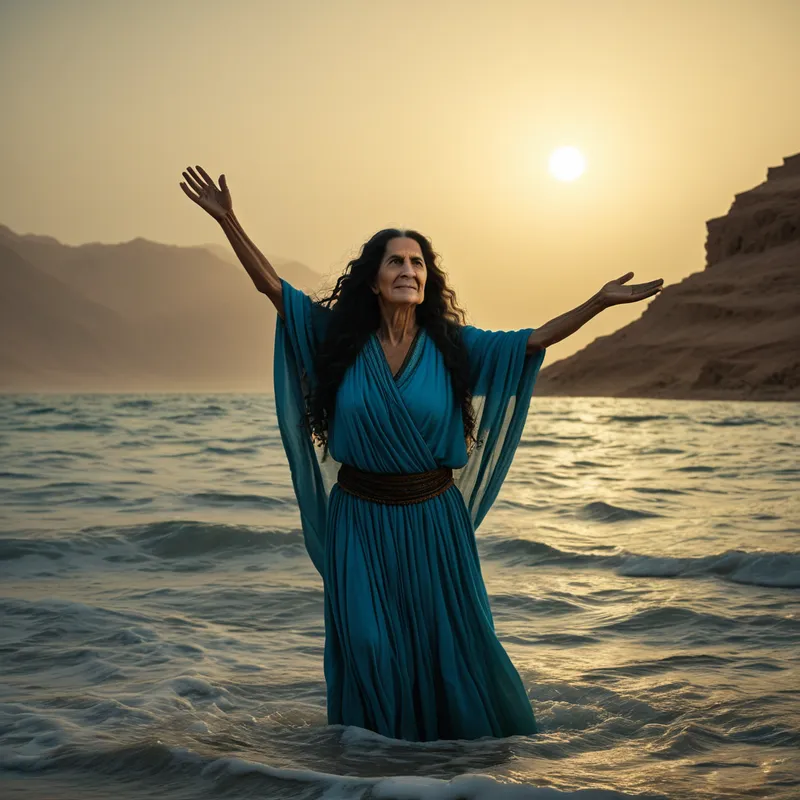
After the Red Sea's parting, the prophet Miriam leads the women in a wild, percussive song of freedom, turning collective trauma into ecstatic praise.
The Tale of Miriam's Song
Listen. The air still tastes of salt and terror.
For a night and a day, the world had been a corridor of impossible walls. The Sea of Reeds stood heaped up like mountains of green glass on their right and on their left, a roaring, suspended tomb for the chariots of Pharaoh. The people had stumbled through that dripping canyon, mud sucking at their feet, children wailing, the thunder of collapsing water echoing in their bones. They did not believe they would live. They walked because there was no other direction.
Then, the last of them—the slow, the old, the burdened—collapsed onto the eastern shore. And the sound began. Not a sound of silence, but a sound of release. A groaning, deep as the earth, as the piled waters lost their ruach, their animating breath. With a roar that dwarfed thunder, the walls fell in. The sea rushed back into its bed, churning with the wreckage of empire.
A stunned silence followed. The kind of silence that is not empty, but full—crammed with the ghosts of fear and the shocking, vacant space where death had been. The people stood, trembling, looking at their hands, at each other, strangers in the light of a new day.
It was then that Moses, his staff still raised, began to sing. A song of victory to YHWH. The men gathered, their voices a hesitant, then roaring, chorus. But the song was heavy, formal, a monument of words.
Miriam watched. Miriam, the prophet, who had watched over the basket in the Nile. She did not gather the men. She turned to the women—the ones who had hidden their infants, who had taken the leavening from Egypt in their kneading bowls, whose bodies still ached from the labor of the bricks and the flight. In their eyes, she saw not just relief, but a wild, untamed energy. The trauma of the corridor was not just in their minds; it was in their limbs, in the clench of their jaws, in the rhythm of their frightened hearts.
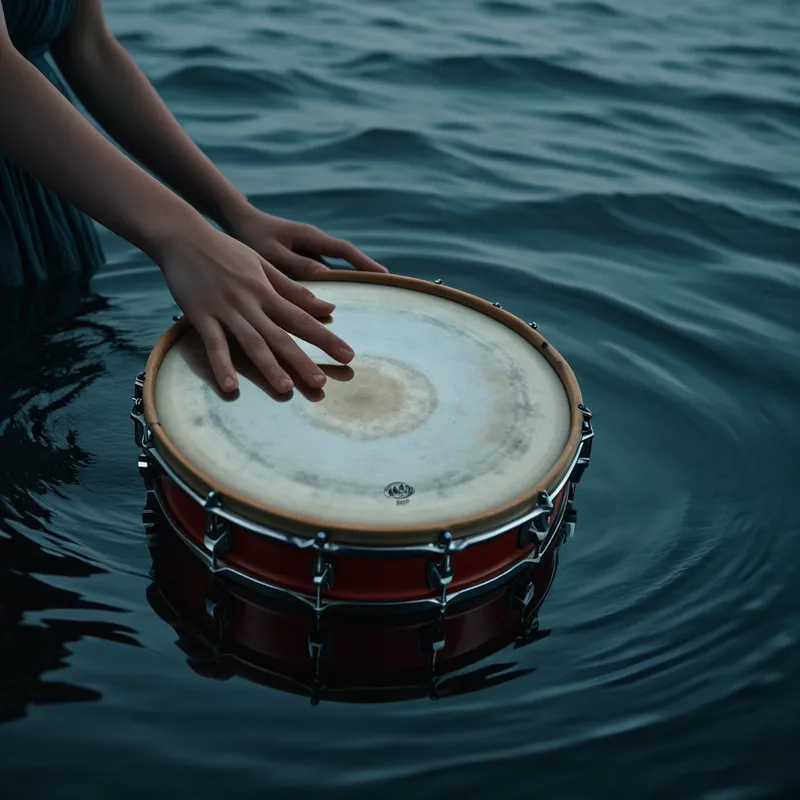
She reached for a timbrel. No one had packed timbrels for fleeing slavery. Yet, she had one. Perhaps she had carried it through the sea, the one item of joy deemed essential. She struck the skin. A sharp, clear thrum cut through the men’s hymn.
She did not sing Moses’s words. She sang a single, spiraling refrain, ancient and new. “Sing to YHWH, for he has triumphed gloriously; the horse and his rider he has thrown into the sea.” Her voice was not pretty; it was a raw, commanding cry. She struck the drum again, a heartbeat for the people. And the women understood.
They found their own timbrels, from where, no one knew. They formed a circle around her. They did not just sing; their feet began to move, stamping on the shore, feeling the solid, delivered earth. They danced. Not a graceful dance, but a shaking loose, a pounding out of the terror, a physical vomiting of the nightmare onto the sand. The drumming grew faster, the dancing more furious, the singing a ecstatic, repetitive roar. They were not celebrating a distant victory. They were becoming the victory. In the circle of stamping feet and flying hair and pounding hands, the corridor of fear was finally, physically, left behind.
Cultural Origins & Context
The Song of Miriam, found in Exodus 15:20-21, is a fragment of what is likely one of the oldest layers of the Biblical text. Scholars often posit that the brief, rhythmic verse attributed to Miriam predates the longer, more complex “Song of the Sea” sung by Moses and the men. Its form is antiphonal—a lead singer (Miriam) calls out the line, and the chorus (the women) responds. This is the structure of primal, participatory worship.
In the ancient Near Eastern context, the timbrel or frame drum was intimately associated with women’s celebratory and ritual music. This was not a performance for an audience; it was a somatic, communal act. The myth’s preservation, albeit brief, points to a powerful tradition of women’s leadership in early Israelite cultic and prophetic practice. Miriam is named a neviah, a prophetess, a title of immense authority. Her song served a critical societal function: it was the mechanism of collective integration. The official, male-led song memorialized the event. Miriam’s dance metabolized it, allowing the trauma of liberation—which is also a trauma—to move through the communal body and be transformed into a foundational memory of ecstatic deliverance.
Symbolic Architecture
Miriam’s Song is not merely celebration; it is the birth of a people’s soul from the womb of collective experience. The key symbols form a potent architecture of psychic rebirth.
The Sea represents the unconscious itself—chaotic, overwhelming, holding both the means of death (the Egyptians) and the path to life (the corridor). To cross it is to undergo a mandatory, terrifying ego-death.
The Opposite Shore is the new conscious standpoint, but it is initially a place of shock and dissociation. The people are free, but they are not yet alive in their freedom.
The true miracle is not the parting of the waters, but the finding of the song on the other side.
Miriam, the Prophetess, symbolizes the archetypal function that connects the unconscious event to conscious life. She is the personified instinct for meaning-making. She does not analyze; she acts out the meaning somatically.
The Timbrel is the central symbol of transformation. It is the instrument that turns chaotic vibration (the roar of the water, the trembling of the body) into rhythm. Rhythm is the first ordering principle. It creates a container—the beat—within which chaos can be safely expressed and organized.
The Dance is the alchemical process itself. It is the literal enactment of the inner change. By moving their bodies in joy, the women are rewriting their somatic memory. The trauma is not erased; it is danced through, its energy captured and redirected into celebration.

The Dreamer's Resonance
When this myth appears in modern dreams, it rarely manifests as a Biblical scene. Instead, the dreamer may experience:
- Finding an ancient or simple musical instrument (a drum, a rusted bell, a single flute) in a place of devastation or stark transition.
- A compelling need to move or dance in a context where it is inappropriate, following a nightmare or a dream of narrow escape.
- Leading or being part of a circle of women engaged in wordless, rhythmic activity, feeling a powerful, non-verbal understanding.
- A body of water receding to reveal not treasure, but a flat, empty space where one feels an urgent, creative impulse.
Psychologically, this dream pattern signals that a profound transition has occurred in the dreamer’s life—a survival, an escape from a “Pharaonic” oppression (a job, a relationship, an inner critic)—but the psyche remains in shock. The ego has reached the “other shore,” but the nervous system is still trapped in the corridor. The dream is presenting the Miriam-archetype, the instinctual call to complete the transition somatically. The process underway is the conversion of traumatic energy into life force. The dream is a prescription: You have survived. Now you must dance. You must find your timbrel and turn the trembling into rhythm.

Alchemical Translation
The individuation process modeled by Miriam’s Song is not about the heroic struggle (that is Moses’s part). It is about the essential, often overlooked, phase of integration. Many individuals successfully cross their Red Sea—they leave the abusive situation, quit the soul-crushing job, break the addictive pattern—only to find themselves depressed, anxious, or disconnected on the “other side.” The liberation feels hollow. This is because the victory is only cognitive. The deeper, somatic psyche is still stranded in the old terror.
Individuation requires not just the act of crossing, but the ritual of welcoming the parts that crossed.
Miriam’s alchemy is one of embodied translation. Her method is threefold:
- Recognition of the Somatic Residue: She looks past the official story of victory and sees the unprocessed shock in the bodies of the women. The first step is to acknowledge that fear and freedom can coexist.
- Activation of the Instinctual Container (The Timbrel): She does not begin with words or analysis. She begins with rhythm. In our process, this is any practice that regulates the nervous system and creates a “beat”—breathwork, mindful walking, repetitive crafting, or literal drumming. It creates a safe, bounded space for the chaos to emerge.
- Communal, Ecstatic Expression (The Dance): The energy is not to be quietly meditated away; it is to be spent in a joyous, physical expression that includes others. This translates as finding a community (or creating an inner chorus) with whom the new, raw identity can be celebrated in action—not just discussed. It is the act of “shaking the dust of Egypt from your feet” through movement, art, or play.
The ultimate transmutation is this: the very energy of oppression (the fear, the tension, the compressed rage of the slave) becomes the fuel for the dance of the free. The Pharaoh, the oppressor, is not just defeated intellectually; his psychic energy is captured, thrown into the sea, and its dissolution becomes the rhythm of the new song. Miriam teaches that freedom is not a state you arrive at, but a song you must learn to sing with your whole, trembling, and finally, joyous body.
Associated Symbols
Explore related symbols from the CaleaDream lexicon: