Mihrab Myth Meaning & Symbolism
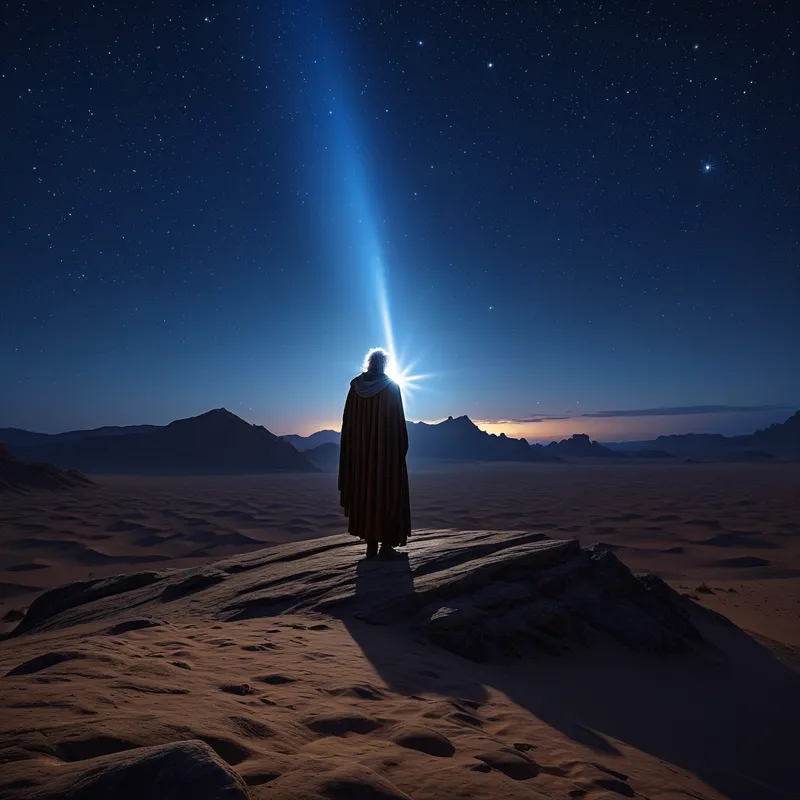
A king, guided by a celestial light, discovers the sacred direction of prayer, forging a spiritual axis for the world.
The Tale of Mihrab
Listen, and let the sands of time part. In the age when kings were shepherds of men’s souls, there ruled a monarch named Tubba. His kingdom was vast, his justice renowned, yet a profound disquiet stirred in his heart. The heavens above were a scroll of brilliant stars, and the earth below a tapestry of his dominion, but between them—a silence. A question hung in the desert air, thicker than the midday heat: How does a king, how does a people, speak to the Divine? Where does the human cry meet the listening ear of the cosmos?
Tubba’s nights were spent on the highest plateau, his eyes scouring the constellations, seeking a sign. The priests chanted to idols of stone, but their words fell back to earth, unanswered. The people’s prayers were scattered to the four winds, lost like dust devils in the endless expanse. Then, on a night when the moon was a sliver and the Milky Way a spilled river of diamonds, it came. Not a voice, but a light. A single, unwavering beam, pure as polished silver, descended from the fathomless black. It did not touch him. It passed him by, a silent spear of illumination, and struck a specific, unremarkable point on the barren rock face of the mountain.
His heart hammered against his ribs. Was this a trick of the eye? A star falling? He waited. The next night, and the next, the celestial visitor returned. Always to the same spot. A silent, persistent pointing. A divine finger tracing a coordinate on the map of the world.
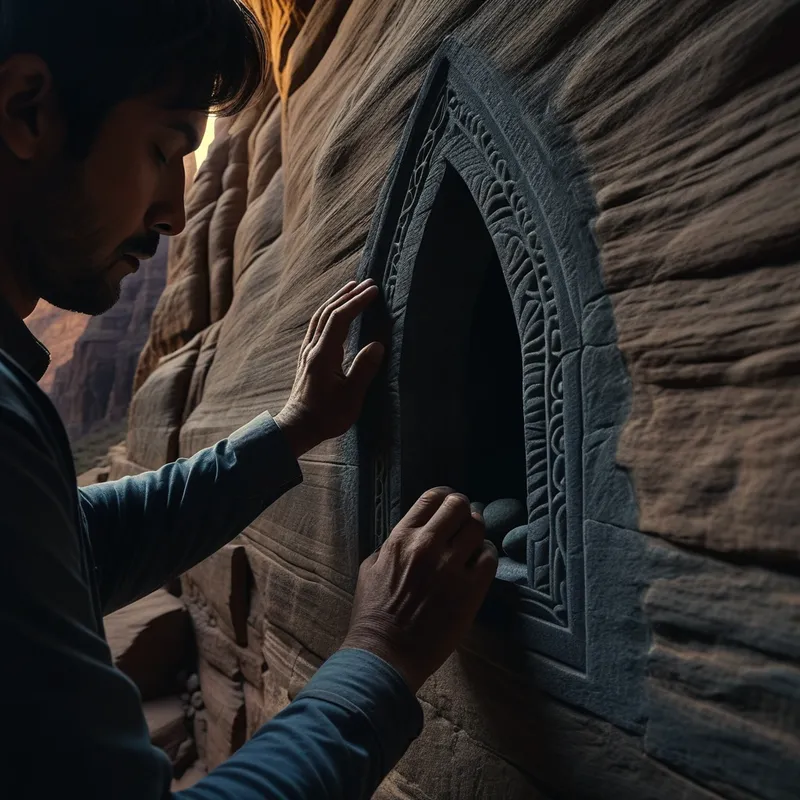
Driven by a awe that bordered on terror, Tubba summoned his masons. “Here,” he said, his voice trembling with certainty, pointing to the spot still humming with memory of the light. “Hollow the stone. Make a niche.” With great reverence, they carved into the living rock, creating a cavity, a receptacle. When the work was done, Tubba himself took the most sacred object he possessed—a dark, smooth stone, kissed by generations of pilgrims—and placed it within the new-made hollow.
That night, the light returned. It did not strike the rock. It entered the niche. It filled the cavity with a radiance that did not blaze, but dwelled. It was no longer a pointing, but a presence. A destination. Tubba fell to his knees, not in submission, but in recognition. The scattered prayers of his people now had a harbor. The silent cries had a direction. He had been given not an answer, but an axis. He named the niche Mihrab. The place where heaven touched earth, and the human gaze found its pole star.
Cultural Origins & Context
The story of Tubba and the Mihrab is not a central pillar of Islamic doctrine, but a resonant echo from the Jahiliyyah, refined and retold within the Islamic historical and mystical imagination. It is found within commentaries, historical chronicles, and the rich soil of Hadith literature. Scholars and storytellers passed it down as an qissa, a narrative that explains the origin of a sacred practice—the orientation of prayer (qibla).
Its societal function was profound. In a faith where physical orientation in prayer is a fundamental act of unity, the myth of Mihrab provides a pre-Islamic, almost primordial, validation of this need. It suggests that the quest for qibla is not a new injunction, but an ancient, archetypal human longing for spiritual orientation. The myth bridges the gap between the pre-Islamic past and the Islamic present, portraying the recognition of sacred direction as a timeless truth, revealed to a righteous seeker long before the final revelation. It is a tale that sanctifies the very concept of "focus" in the spiritual life.
Symbolic Architecture
The Mihrab is far more than an architectural feature; it is a master symbol of the psyche's deepest operation. It represents the transformation of void into vessel, of question into container.
The Mihrab is the psychic architecture that makes revelation possible. It is the carved-out space within the self that waits, empty and receptive, for the descent of meaning.
Tubba, the king-sage, embodies the conscious ego in its highest function: not as a tyrannical ruler, but as a perceptive steward. His disquiet is the soul's anxiety in a universe without apparent address. The celestial light is the numinous, the Self (in Jungian terms) or the Divine, which cannot be grasped or commanded, only followed. The critical moment is not the beam's appearance, but Tubba’s act of carving the niche. This is the work of consciousness—taking the raw, overwhelming impact of the numinous and giving it a form, a location within the structures of one’s life and community. The placed stone signifies tradition, the human element that meets the divine gift, creating a stable point of contact—the axis mundi for an individual or a civilization.
The Dreamer's Resonance
When this myth stirs in the modern unconscious, it rarely appears as a literal king or a stone niche. It manifests somatically and symbolically. One might dream of a room in their house they’d forgotten, a blank wall that suddenly feels intensely significant. Or a beam of light in a dream that illuminates a single, mundane object—a chair, a book on a shelf—investing it with inexplicable gravity. The core somatic experience is one of magnetic pull. The dreamer feels drawn, physically and emotionally, toward a specific point in the dreamscape.
This is the psyche signaling a need for orientation. The dreamer is likely at a crossroads, feeling spiritually or psychologically "scattered." The dream-Mihrab is the unconscious highlighting the potential point of focus. The anxiety in the dream mirrors Tubba’s disquiet; the pull toward the spot is the guiding light. The psychological process is one of soul-level navigation. The dream is asking: "Where is your center? What is your true qibla? Around what principle must you now organize your inner life?" The work upon waking is to identify what in one’s waking life that "spot" corresponds to—a relationship, a vocation, a creative pursuit, a moral stance—and begin the conscious work of "carving the niche," creating dedicated space and attention for it.
Alchemical Translation
The alchemy of the Mihrab myth models the individuation process with elegant precision. It begins with the nigredo, the blackening: Tubba’s disquiet, the feeling of spiritual lostness, the prayers disappearing into the void. This is the necessary despair that shatters complacency.
The celestial light is the albedo, the whitening—a moment of pure, unintegrated insight from the Self. The danger here is in merely marveling at the light. The transformative work is the citrinitas, the yellowing: the hard, conscious labor of carving the niche. This is the ego’s collaboration with the Self. It is the discipline of daily practice, the structuring of one’s environment and time to align with the received insight. It is building the ritual around the revelation.
Individuation is not merely receiving light; it is the lifelong craftsmanship of building a home for it within the ordinary stone of one's existence.
Finally, the rubedo, the reddening, is achieved when the light dwells within the human-made form. The stone is in the niche; the divine orientation is now embodied in a human tradition, a personal code, a lived philosophy. The scattered psyche is unified around this central axis. The individual becomes their own muezzin and their own worshipper, oriented toward an inner qibla that grants coherence to all outer actions. The myth concludes not with an end, but with an establishment: a permanent, stable direction for the soul’s journey, forged from the marriage of divine pointer and human response.
Associated Symbols
Explore related symbols from the CaleaDream lexicon: