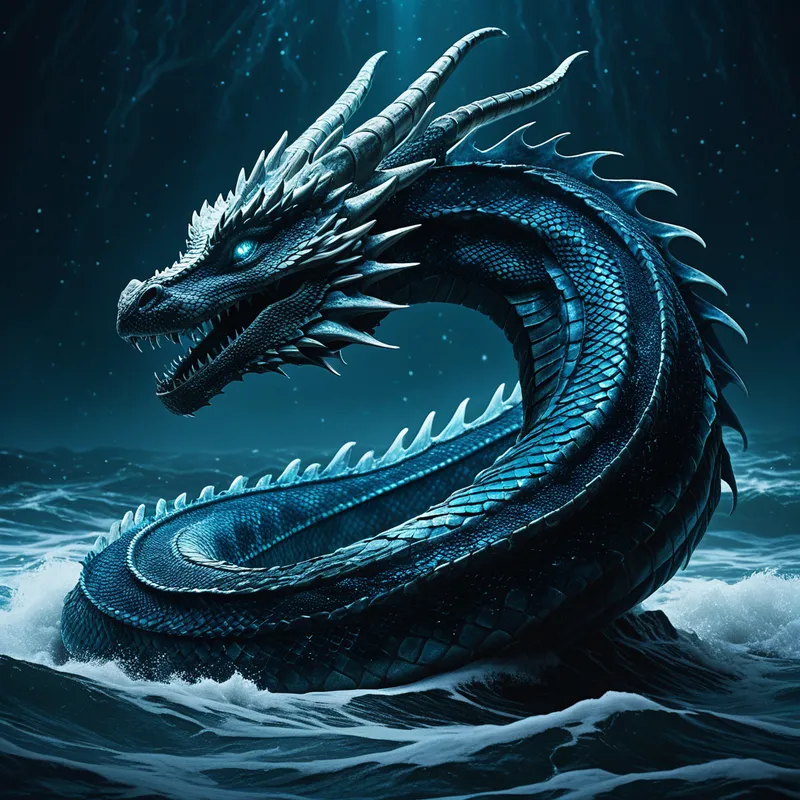
Tiamat Myth Meaning & Symbolism
The primordial mother of all, a dragon of saltwater chaos, is slain by a new order of gods, birthing the structured world from her fragmented body.
The Tale of Tiamat
In the beginning, there was no name for heaven above, nor earth below. There was only Apsu and Tiamat. They were the first parents, their waters mingling in a silent, dark, and boundless deep. From their union, the first generations were born: Lahmu and Lahamu, then Anshar and Kishar, and from them, the sky god Anu. And the younger gods were loud. They danced in the belly of the deep, their light and movement a terrible clamor in the eternal quiet.
Apsu, the sweet water, could not rest. “Their ways are loathsome to me!” he cried to Tiamat. “By day I find no relief, by night no sleep. I will destroy them, that we may have quiet again!” But Tiamat, the salt water, the great mother-dragon, roared in dismay. “Shall we destroy what we have made? Their ways are indeed cruel, but let us be patient.” Yet Apsu would not be swayed. He plotted their end.
But the plot was heard. The clever god Ea, he who knows all arts, cast a mighty spell of sleep upon Apsu. He stripped Apsu of his crown and mantle of radiance, and slew him. Upon the still body of the first father, Ea built his shining temple, the abode of the gods. And in that temple, with his consort Damkina, he begat a son. This son was born with four eyes to see all, four ears to hear all. Flames flickered from his lips. They named him Marduk, and his splendor was terrifying.
In her watery abyss, Tiamat writhed in grief and fury. The murder of her consort was an unbearable wound. The younger gods had severed the first bond. From her own essence, she birthed a monstrous legion: serpent-demons with venom for blood, Mushussu-dragons, lion-demons, scorpion-men, and Umu-hounds. She made Kingu their general, and placed the Tablets of Destiny upon his breast, making him the ruler of her host. The roar of her army shook the foundations of the gods' temple.
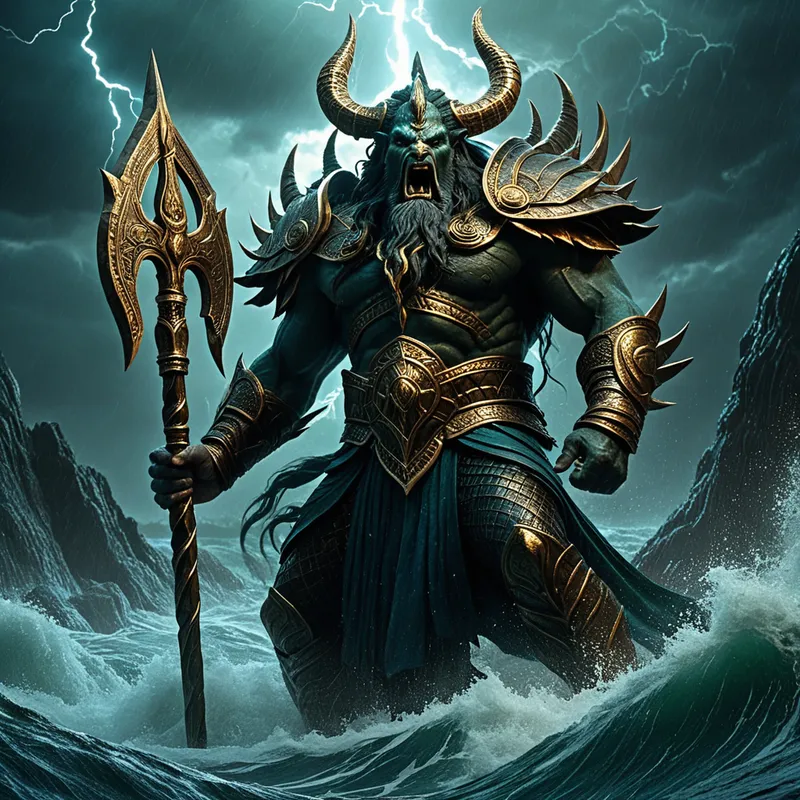
Panic seized the younger gods. Anshar sent Anu to face her, but he returned in fear. He sent Ea, but he too retreated. Then, they turned to the radiant, fearsome Marduk. “If we make you king, if we vest our power in you alone, will you go forth as our champion?” Marduk’s eyes blazed. “I will go. But my word shall be law, unalterable. What I create shall not be changed.” The gods feasted, they drank, they placed their own sovereignty into Marduk’s hands. They gave him a bow, a mace, lightning bolts, and a net to hold chaos.
Marduk mounted his storm-chariot, drawn by four devastating winds. He advanced upon the primal deep. He called Tiamat to single combat, his voice a challenge that split the silence. She did not hesitate. She opened her jaws, a gateway to the void. As she gaped to swallow him, Marduk drove the Evil Wind into her belly, distending her, holding her maw agape. He shot an arrow that pierced her heart and split her inward parts. He stood upon her lifeless body and smashed her skull with his mace. He captured Kingu and took the Tablets of Destiny.
Then, the artisan-god set to work. He split Tiamat’s carcass like a shell-fish. From one half, he raised the vault of heaven, posting guards so her waters could not escape. From the other half, he fashioned the earth. From her eyes, he made the sources of the Tigris and Euphrates. From her spittle, he made the clouds, the rain, the mist. From her roaring, he made the thunder. He took the bones of her monstrous host and set them at the gates of the world, as warnings. From the blood of Kingu, he mixed clay and, with the help of Ea, fashioned the first humans, to serve the gods. Order was built from the very flesh of chaos. The world was made.
Cultural Origins & Context
This epic, known as the Enuma Elish, was recited not as mere entertainment, but as a sacred, political, and cosmological text. Its primary surviving version is Babylonian, likely composed or codified in the second millennium BCE to elevate the city-god Marduk to the head of the pantheon, mirroring Babylon’s own political ascendancy. It was performed during the Akitu festival, a ritual re-enactment of this cosmic victory that reaffirmed the king’s divine mandate and the stability of the cosmos for another year.
The myth functioned as a foundational narrative. It explained the origin of the world from a state of undifferentiated potential (Tiamat and Apsu) to a state of differentiated, hierarchical order. It justified the gods’ authority and humanity’s servile role. To hear the Enuma Elish was to participate in the maintenance of cosmic and social order, a reminder that civilization itself is a hard-won structure erected upon and sustained by the constant containment of primal, chaotic forces.
Symbolic Architecture
Tiamat is not merely a monster to be slain. She is the primordial matrix, the undifferentiated state of being that precedes all form. She is the unconscious in its rawest, most creative and most destructive aspect—the source of all life and the potential for its dissolution.
To confront Tiamat is to confront the Mother before she is named, the womb that is also a tomb, the creative potential that feels like annihilating chaos.
Marduk represents the emerging principle of consciousness, differentiation, and order. His weapons—the winds, the net, the arrow—are the tools of intellect, strategy, and focused will. The battle is not between good and evil, but between two necessary cosmic principles: the unified, potential-filled deep and the differentiating, structuring mind. The creation of the world from Tiamat’s body signifies that all manifest reality, all structure and beauty, is born from the sacrifice and transformation of that primal unity. Chaos is not destroyed; it is organized. The monstrous legions are not eradicated but stationed at the gates, becoming the defined boundaries and necessary tensions of the known world.
The Dreamer's Resonance
When this myth stirs in the modern psyche, it may manifest in dreams of overwhelming, formless emotions—a tidal wave of grief, a rising flood of rage, a sense of being swallowed by a vast, dark, maternal void. One might dream of fighting a serpent or dragon in deep water, or of a chaotic, monstrous host invading an orderly home.
These dreams signal a profound somatic and psychological process: the ego-structure is being challenged by contents of the unconscious that feel alien and threatening. The dreamer is experiencing their own inner Tiamat—a surge of unlived life, repressed instinct, or unprocessed trauma that threatens to dissolve their current sense of self. It is the psyche’s demand for a more comprehensive order, one that can accommodate these powerful, chaotic energies rather than deny them. The terror is real, for it is the terror of psychic death preceding rebirth.
Alchemical Translation
The individuation process mirrors the Enuma Elish. Initially, the conscious personality (the younger gods) exists within, and is nourished by, the unconscious (the primal parents). A crisis occurs when consciousness’s activity becomes so disruptive that the unconscious reacts, not with nourishment, but with a terrifying, regressive pull (Apsu’s plot, Tiamat’s rage). The old, simple containment must break.
The alchemical work is not to slay the dragon, but to perform the sacred, creative dismemberment: to differentiate the raw substance of one’s chaos into the usable elements of a richer, more resilient self.
The ego must become like Marduk—not a tyrant, but a conscious, responsible ruler. It must gather its resources (the “weapons” of insight, discipline, and courage) and face the chaotic, creative power within. The victory is the act of conscious differentiation: separating the flood of anxiety into specific fears, the oceanic grief into specific losses, the formless rage into specific boundaries that need to be set. From the “body” of this conquered chaos, the dreamer builds their world anew: their values (the heavens), their grounded reality (the earth), their creative flow (the rivers), and their vital energy (the storms). The monsters become gatekeepers—the acknowledged anxieties, wounds, and shadows that define the borders of the integrated self, no longer enemies but essential parts of the whole. One does not live in the chaos, but one knows the world is made of it.
Associated Symbols
Explore related symbols from the CaleaDream lexicon: