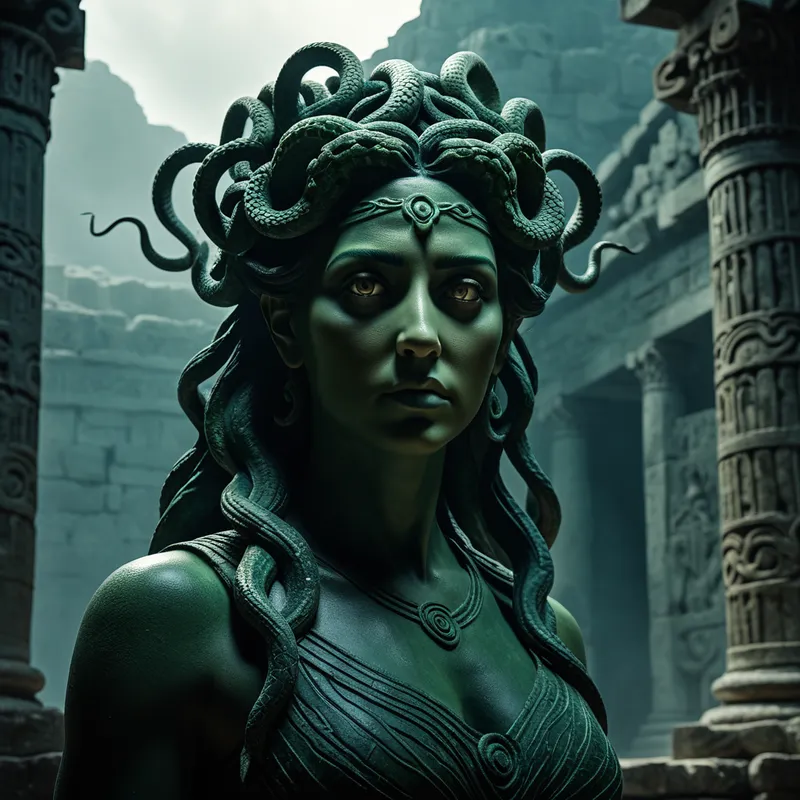
Medusa's Gaze Myth Meaning & Symbolism
A priestess cursed by Athena, her gaze turns men to stone. Perseus, guided by gods, beholds her reflection and severs her head, claiming her potent, paradoxical power.
The Tale of Medusa's Gaze
Hear now a tale not of Olympus’s bright peaks, but of a darkness born from light, of a beauty forged into terror. It begins in the sun-drenched temples of Athena, where a priestess named Medusa served with a devotion that rivaled the goddess’s own. Her hair was said to catch the light like a river of dark silk, her form a hymn to mortal grace. But in the salt-sprayed temple of Poseidon, a storm gathered. The Earth-Shaker, lord of the deep, beheld her and was consumed by a wave of desire no temple wall could hold back.
What happened in that sacred space is told in whispers: an act of violation, a profanation of a sanctuary. The priestess, in her own holy place, faced the god’s relentless advance. And it was to Athena she should have been able to turn. But the goddess’s gaze, when it fell upon her ravaged priestess, did not see a victim in need of solace. She saw a sanctuary defiled, a sacred vow broken. A cold, divine logic settled in Athena’s grey eyes. Not upon the god, her powerful uncle, would punishment fall, but upon the mortal vessel of the transgression.
The curse descended not as fire, but as a terrible, creeping transformation. Medusa’s sigh became a hiss. The dark river of her hair coiled and writhed, becoming a nest of live, venomous serpents. Her skin, once warm, took on the pallor of weathered marble. But the true horror lay in her eyes. Where once were windows to a soul, now resided a petrifying power. To meet Medusa's Gaze was to be forever arrested—life and consciousness trapped within unfeeling stone, a monument to one’s final moment of terror.
Cast out, she fled to the ends of the world, to a cave on the shores of the Oceanus. There, in the perpetual twilight, she dwelt with her two immortal Gorgon sisters, Stheno and Euryale, whose monstrous forms were theirs from birth. Her cave floor was a garden of statues—heroes, adventurers, and beasts caught in agonized, eternal poses, their faces frozen in the instant they beheld her.
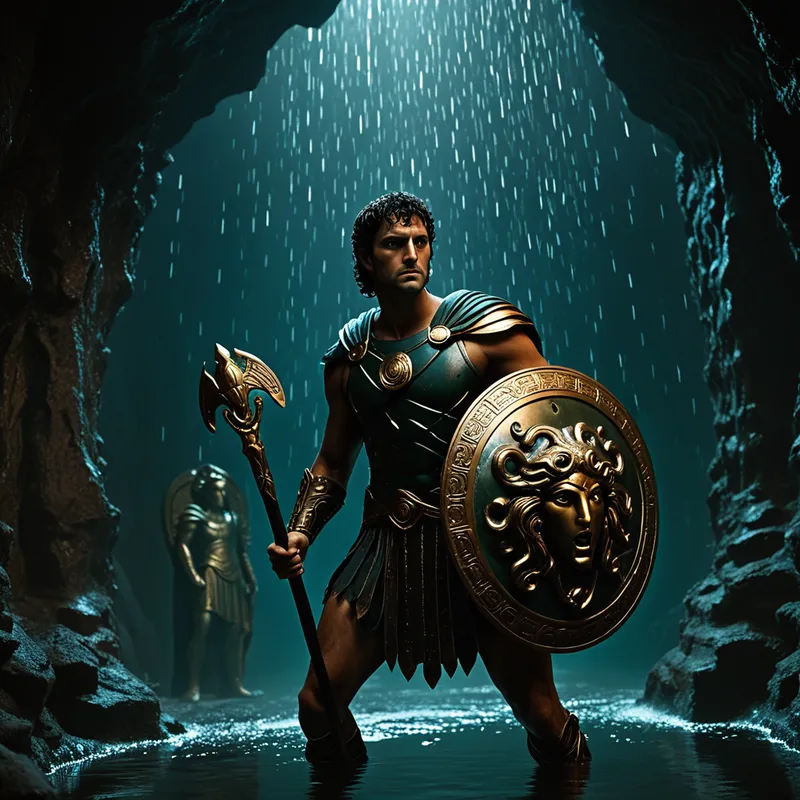
The tale then turns to a young man named Perseus, set an impossible task by a tyrant: bring back the head of the Gorgon. Alone, he would have perished. But the gods, in their complex designs, equipped him. From the nymphs, he received winged sandals, a helmet of darkness from Hades, and a magical sack. Most crucially, Athena herself offered a shield of polished bronze, brighter than any mirror.
Guided by the gods and his own cunning, Perseus found the cavern. He did not brave the darkness head-on. Instead, he moved backwards, a ghost in Hades’ helm, his eyes fixed not on the horror before him, but on the horror reflected in the shield’s flawless surface. In that cold, metallic mirror, he saw her: the sleeping Gorgon. He saw the serpents stir. As her eyes began to open in the reflection, his hand, guided by Athena’s will, struck. There was a sound like shearing rock, and a gasp that was not human. From the severed neck sprang the winged horse Pegasus and the giant Chrysaor.
Perseus seized the head, its eyes still potent, and fled. The Gorgon’s power, born of a curse, was now a weapon in the hero’s sack, a paradox sealed in a divine pouch.
Cultural Origins & Context
The myth of Medusa is woven from deep, pre-Olympian threads. Scholars like Jane Ellen Harrison suggest the Gorgoneion—the grotesque face of a Gorgon—originated as an apotropaic (warding-off) symbol, a face so terrifying it would frighten away evil itself. This primal, protective mask predates the elegant anthropomorphism of the Olympians and points to an ancient, chthonic (earth/underworld) power associated with the cycle of life, death, and awe.
The canonical version we know was crystallized in the 8th century BCE by the poet Hesiod in his Theogony. Here, Medusa is firmly placed as one of three Gorgons, a mortal monster born from sea deities. Later, the Roman poet Ovid, in his Metamorphoses, gave us the tragic backstory of the beautiful priestess violated and cursed, a narrative that deeply resonates with later psychological interpretations. The myth was not static scripture but a living story, sculpted on temple pediments (like the Temple of Artemis in Corfu), painted on vases, and recited by bards, serving as a lesson on divine caprice, the perils of hubris, and the proper, indirect way to confront overwhelming terror.
Symbolic Architecture
Medusa is not merely a monster; she is a complex symbol of the ultimate taboo, the unbearable sight. Her gaze represents the full, unmediated confrontation with that which we cannot psychologically integrate—the traumatic, the horrifying, the aspects of reality (and of ourselves) that, if seen directly, would halt our psychic development entirely.
The petrification is not death, but a cessation of becoming. It is the ego freezing solid in the face of the Shadow.
Her transformation from priestess to monster symbolizes the brutal alchemy of unresolved trauma. An experience of profound violation (by Poseidon) and betrayal (by Athena) is not processed but is instead turned inward, morphing the victim’s identity into something perceived as monstrous, both to herself and to the world. The serpents in her hair connect her to ancient chthonic wisdom and the life force, but here it is a frenzied, defensive, and dangerous wisdom.
Perseus’s strategy is the myth’s masterstroke of psychological instruction. He does not “face his fears” head-on. He approaches indirectly, using reflection—the polished shield of Athena (symbolizing conscious intellect and strategy). The hero’s journey here is one of seeing without being destroyed by sight. He must acknowledge the terrifying reality (see it in the reflection) without letting his conscious self be identified with and frozen by it.
The Dreamer's Resonance
When the pattern of Medusa’s Gaze appears in modern dreams, it rarely manifests as a literal snake-haired woman. Instead, the dreamer may encounter a person, a situation, or even a part of themselves whose direct acknowledgment feels paralyzing. One might dream of turning to stone, of being unable to move or speak in a crucial moment, or of seeing a loved one’s face become cold and statuesque.
Somatically, this echoes the freeze response in trauma—a total physiological and psychological shutdown. The dream is signaling a confrontation with a psychic content so charged that the ego’s instinct is to petrify, to become inert, rather than to engage. The “Gorgon” in the dream could represent a repressed memory, a forbidden desire, a towering rage (often culturally coded as “monstrous” in women), or a truth about one’s life that feels too devastating to behold directly. The dream presents the dilemma: to remain frozen in avoidance, or to find the “reflective shield” that allows for indirect approach and integration.
Alchemical Translation
The myth models the individuation process—the journey toward psychic wholeness—as a perilous operation of seeing rightly. The initial state is one of identification with a cursed, fragmented self-image (Medusa in her cave, surrounded by the stony projections of others’ fears). The heroic task is not to slay this aspect, but to reclaim its power through conscious relationship.
Perseus’s journey is the ego, armed with the gifts of the Self (the guiding gods), learning to approach the terrifying content of the personal and collective unconscious (the Shadow, represented by Medusa) not with brute force, but with reflective consciousness. The severing of the head is a violent but necessary act of differentiation—separating the paralyzing effect of the complex (the petrifying gaze) from the potent energy contained within it.
The ultimate goal is not to discard the Gorgon’s head, but to carry it in the magical sack. The integrated power of the once-terrifying complex now serves a new purpose.
This is the alchemical translation: the curse becomes a tool. The power that once turned the world to stone—that is, that made reality rigid, fixed, and dead—is transformed. When used consciously (as Perseus later uses the head to defeat his enemies), it represents the ability to “freeze” compulsive behaviors, to solidify insights, or to confront external threats with the formidable power of a once-repressed truth. The birth of Pegasus from her blood is the final symbol: from the sacrifice of the old, cursed form springs the transcendent, creative spirit. The integrated Self gains the capacity for flight, rising above the petrified landscape with wisdom hard-won from the depths.
Associated Symbols
Explore related symbols from the CaleaDream lexicon: