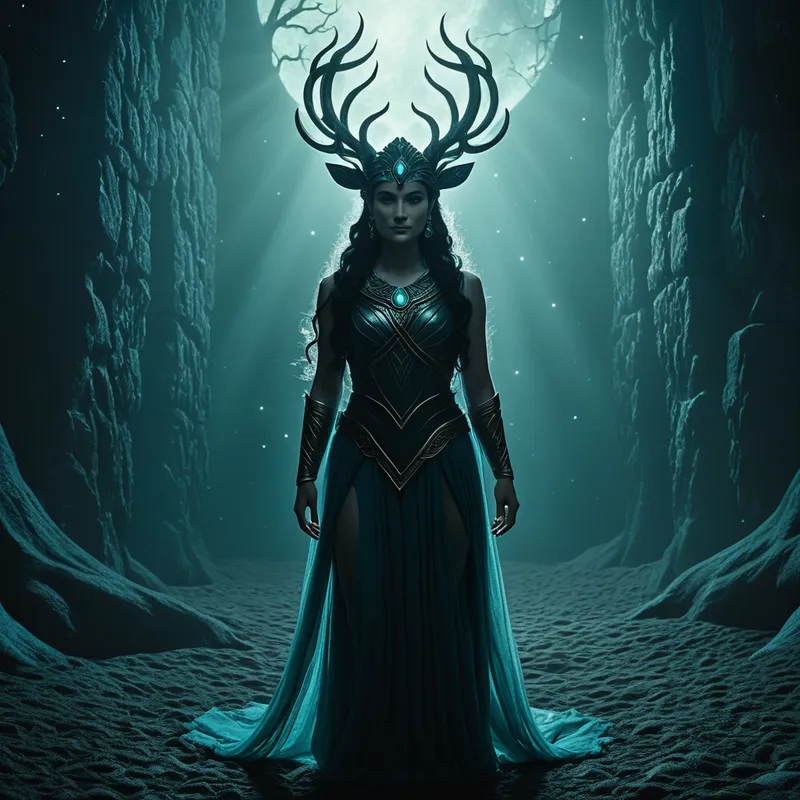
Mazu Sea Goddess
A revered Taoist sea goddess who safeguards sailors and fishermen, embodying compassion and divine protection across maritime cultures.
The Tale of Mazu Sea Goddess
In the warm, salt-tinged air of Meizhou Island, during the Song Dynasty, a child was born who did not cry. She was named Lin Mo, and from her first breath, she carried a profound stillness, an inner light that seemed to listen to rhythms deeper than the crashing waves. As a girl, she would not play with dolls of silk, but would sit on the rocky shores, her gaze fixed on the horizon where the sky married the sea. She learned the language of the tides, the warning whispers of the wind, and the secret prayers of the fishermen’s wives.
Her legend truly begins not with a grand birth, but with a quiet, terrifying vision. One afternoon, as her father and brothers were far out upon the rolling deep, Lin Mo fell into a trance at her loom. Her spirit, untethered, flew across the waves. She saw their vessel—a tiny shell of wood against an immense, rising fury. A storm, born from the dragon’s belly of the ocean, was about to swallow them whole. In her trance, she reached out, her spiritual hands gripping the mast, her will becoming a bulwark against the wind. At home, her body was rigid, her hands clenched as if holding ropes. Her mother, shaken, tried to rouse her, breaking her concentration for a fatal moment.
Lin Mo awoke with a gasp, tears mingling with the salt spray of her vision. “I had them,” she whispered, her voice hollow with grief. “I had saved Father and one brother, but you shook me… I lost the other.” Days later, the news washed ashore with the wreckage. Her father and one brother returned, speaking of a miraculous force that had guided them, a presence that vanished as suddenly as it came. The other was lost to the sea. This event, woven from familial love and tragic interruption, became the crucible of her divinity. Her power was real, but it existed in the fragile space between the human and the numinous, vulnerable to the well-intentioned touch of the mundane world.
Lin Mo’s life was one of continual service, a channel for this profound compassion. She healed the sick, foretold storms, and became the unseen guardian of every boat that dared the horizon. She never married, her betrothal being to the sea itself and all who traveled upon it. Her mortal end is told not as a death, but as an ascension. On a day when the air shimmered with potential, she climbed to the mountain peak of her island. A celestial melody descended, and a rainbow bridge of mist and light appeared. She stepped upon it, and before the weeping eyes of her villagers, she transformed—not vanishing, but expanding. Her spirit merged with the very element she sought to calm. She became the shen of the sea, the goddess Mazu.
Now, when typhoons brew and sailors face the abyss, they call not to a distant, indifferent deity, but to a sister who once walked among them. They see her not in wrath, but in the sudden calming of the waves, the break in the clouds revealing a guiding star, or the mysterious log that carries a shipwrecked man to shore. She is the answered prayer in the teeth of the gale, the embodiment of hope that refuses to drown.
Cultural Origins & Context
Mazu’s veneration blossomed from the fertile ground of Southern Chinese coastal life, a world perpetually balanced between bounty and peril. Her origins are distinctly posthumous; she was a deified human, a Tudigong of the waves. This is crucial. She was not a primordial creator from cosmic chaos, but a response to a very human, very immediate need. Her cult grew with the Song Dynasty’s maritime expansion, traveling along trade routes like spiritual ballast in the holds of merchant junks.
She represents a beautiful syncretism at the heart of Chinese spiritual practice. While formally adopted into the Taoist pantheon and later acknowledged by Imperial decree, her worship is fundamentally folk. Temples to Mazu, from bustling ports in Fujian to distant shores in Southeast Asia, are less like austere halls of dogma and more like bustling homes for a beloved, powerful ancestor. She exists in the space where Taoist Dao meets communal necessity, where philosophical principles are given a face, a name, and a history of tangible miracles. She is a bridge between the high philosophies of the literati and the visceral, salt-stained faith of the fisherman.
Symbolic Architecture
Mazu’s myth is a profound map of the psyche’s relationship with the uncontrollable. The sea is the ultimate symbol of the unconscious—vast, life-giving, yet capable of terrifying, annihilating fury. The sailor is the conscious ego, venturing out from the safe shore (the known self) into these depths. Mazu is the mediating function, the Self in its protective, guiding aspect. She is the inner compass that activates in crisis, the intuition that knows the hidden path through emotional or psychic storms.
Her tragic failure to save one brother during her trance is not a flaw, but a profound psychological truth. It illustrates that even divine intervention, whether from an external goddess or an internal saving grace, operates within a framework of limitation and earthly consequence. Salvation is often partial; healing comes with the scar.
Mazu does not conquer the sea; she understands it. Her power is not of domination, but of resonant harmony. She is the psyche’s ability to find a pattern of safety within chaos, not by stopping the storm, but by revealing the hidden channel through it.
Her celibacy and early ascension signify a total dedication of the personal to the transpersonal. Her human attachments are sublimated into a universal, archetypal care. She becomes the Mother who is not bound to a single child, but to all her children upon the waters.
The Dreamer's Resonance
To encounter Mazu in a dream, or to feel her resonance in one’s life, is to touch the archetypal Caregiver in its most potent form. She appears when we are emotionally or spiritually adrift, when we feel overwhelmed by forces larger than ourselves—be it grief, anxiety, or a life transition that feels like a voyage into unknown, treacherous waters. She is the inner voice that says, “Steady,” the inexplicable calm that descends in the midst of panic, the helping hand that appears from an unexpected quarter.
She calls not for worship, but for trust. To resonate with Mazu is to cultivate a faith that is active and relational. It is the faith of the sailor who, despite all evidence of the sea’s danger, still prepares his boat and sets his sail, holding within his heart the knowledge of a compassionate witness. She represents the hope that we are not alone in our struggles, that the universe is not merely indifferent matter, but contains within it a principle of merciful attention.

Alchemical Translation
The alchemy of Mazu is the transformation of personal empathy into a structural, sustaining power. In the vessel of her life, the base metal of human compassion—the love for her family—was subjected to the fire of tragic limitation and the water of profound service. Through this process, it was transmuted into the gold of universal guardianship. Her ascension is the final stage: the volatilization of the spirit, where the individual essence becomes a pervasive principle, available to all who call upon it with sincere need.
Psychologically, this is the process of integrating the Caregiver archetype so fully that it becomes a cornerstone of the personality, not as a source of martyrdom, but as a source of boundless, wise compassion that starts with the self and extends outward. Mazu’s journey mirrors the path from ego-bound caring to a care that is an expression of the aligned Self.
Her talismans and red lanterns are not mere superstition; they are psychological anchors. They are focal points that concentrate the mind’s intention, drawing upon the internalized image of the protector to stabilize the psyche in the face of fear. The ritual is the outer enactment of an inner alignment.
She teaches that true protection is not a wall that keeps danger out, but a navigational wisdom that knows how to move with and through danger. It is the alchemy of fear into vigilant respect, and of respect into a guiding, saving grace.
Associated Symbols
Explore related symbols from the CaleaDream lexicon:
- Ocean — The primordial unconscious, vast, life-giving, and perilous, representing the unknown depths of the psyche and emotion that Mazu helps to navigate.
- Goddess — The divine feminine principle manifest as compassionate protector and mediator, embodying nurturing power without domination.
- Amulet of Protection — A concentrated object of faith that serves as a tangible anchor for the psyche, channeling the belief in guardianship into a focal point against fear.
- Tapestry of Faith — The interconnected weave of stories, rituals, and community belief that sustains and gives form to the divine, as seen in Mazu’s widespread cult.
- Bridge — A connector between realms; Mazu herself is a bridge between the human and the divine, the storm and the calm, mortality and deification.
- Mother — The archetypal nurturer and source of unconditional, protective love, expanded beyond biology to encompass all who are in need of safekeeping.
- Ritual — The prescribed action, like lighting incense or carrying a lantern, that aligns the individual consciousness with the archetypal pattern of protection and salvation.
- Dream — The state of trance-vision from which Mazu operated, representing the psyche’s capacity to transcend physical limits and access guiding knowledge.
- Light — The break in the storm clouds, the guiding star, or the lantern in the temple; the symbol of hope, clarity, and divine presence in darkness and chaos.
- Journey — The essential voyage across perilous waters, both literal and metaphorical, for which Mazu’s guardianship is invoked.
- Destiny — The fulfillment of a profound purpose, as seen in Mazu’s life path from gifted child to universal savior, aligning personal fate with a cosmic role.