Lion of Babylon Myth Meaning & Symbolism
A mythic guardian embodying divine authority, the Lion of Babylon represents the eternal struggle to impose sacred order upon the primal forces of chaos.
The Tale of Lion of Babylon
Hear now, and let the dust of ages settle upon your tongue. Before the first brick of Babylon was laid, there was only the abzu—the sweet-water deep—and the tiamat—the salt-water chaos. From their mingling, the gods were born. But the younger gods stirred the heart of the primordial mother, Tiamat, to rage. She birthed an army of monsters: serpents with venom for blood, scorpion-men, and raging storms with teeth.
The council of gods trembled. None could face her. Their light guttered like a lamp in a desert wind. Until one stood. Marduk, the son of Ea, whose eyes could see the end of all things. He demanded a price: unchallenged kingship over all the gods. Desperate, they agreed. They clothed him in seven winds, placed a mighty bow in his hand, and filled him with the terrifying radiance of their collective sovereignty.
The battle shook the foundations of the world. Marduk rode his storm-chariot into the gaping maw of chaos. He ensnared Tiamat in his net, drove the evil wind into her belly to distend her, and with a single, world-cleaving arrow, he split her monstrous form. From one half, he raised the vault of heaven; from the other, he anchored the earth. He set the stars in their courses, regulated the moon, and from the blood of Kingu, her general, he fashioned humankind to serve the gods.
But order is a garden that must forever be tended. The memory of chaos, of the roaring, formless deep, lingered at the edge of creation like a beast in the shadows. So, from the very essence of his hard-won kingship, from the power that subdued the dragon of the sea, Marduk fashioned a guardian. Not a god, but a symbol made flesh in stone and spirit: the Lion.
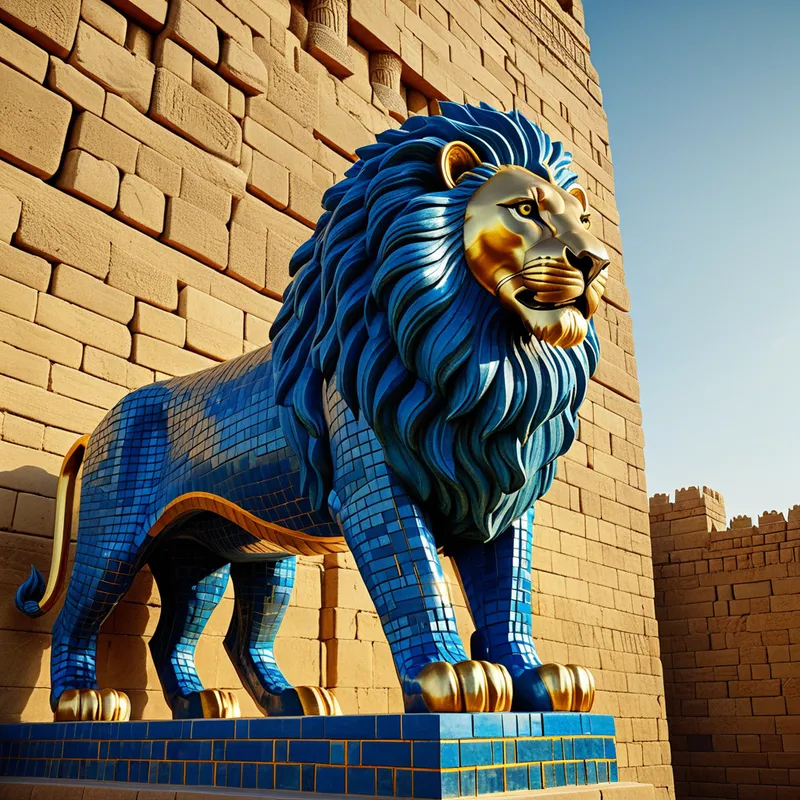
This Lion was set upon the walls of the city he loved most—Babylon, the "Gate of the God." It was carved into the processional way, glazed in the sacred blue of lapis and the gold of the sun. It did not sleep. Its eyes, forged in the kilns of divine will, watched the four directions. Its silent roar was the vibration of law; its poised stance, the eternal readiness of sovereignty. It was the promise made manifest: that the king who ruled from this city did so with the authority of Marduk himself, and that the civilized world, the mātu, would be protected from the ever-encroaching ergitu—the howling wilderness of disorder.
Cultural Origins & Context
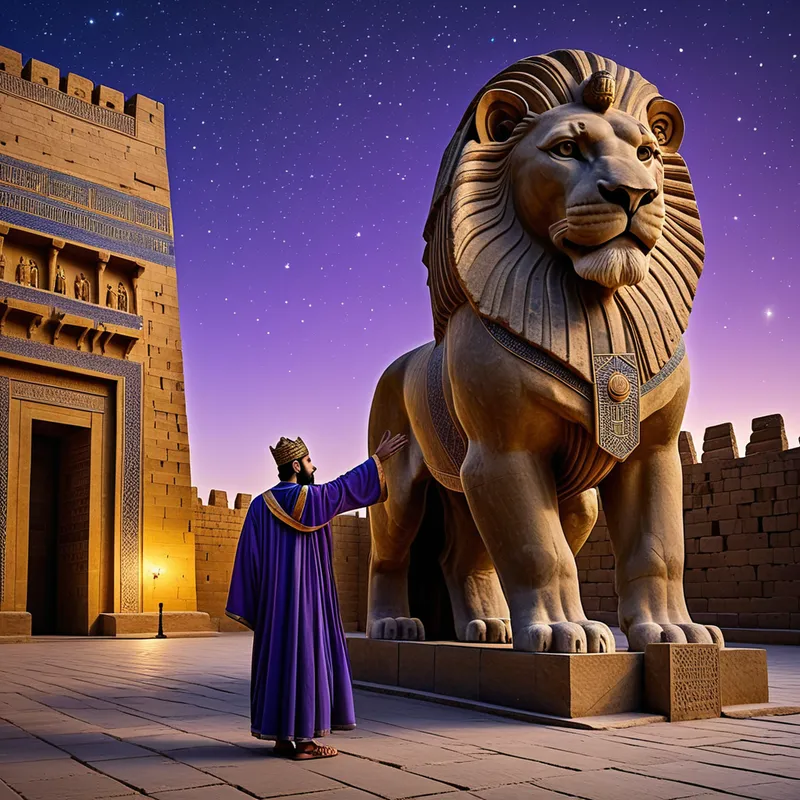
The Lion of Babylon is not a singular character from one epic, but a profound symbolic entity woven into the very fabric of Mesopotamian, and specifically Babylonian, imperial identity. Its image proliferated during the reign of Nebuchadnezzar II (c. 605–562 BCE), a period of immense architectural and cultural revival. The lion adorned the Ishtar Gate and the Processional Way, the sacred path used during the Akitu festival.
This was statecraft as mythology. The lion was the animal of the goddess Ishtar, a deity of both fertility and terrifying warfare, thus embodying the dual nature of sovereignty: the power to nurture and the power to destroy. By placing her lion alongside the symbols of Marduk (the mušḫuššu dragon) and Adad (the bull), the king visually asserted that Babylon was under the direct protection of the divine assembly. The mythic narrative it referenced was the Enūma Eliš, recited during the Akitu. The lion was a silent, permanent participant in this ritual, a reminder that the king's duty—and by extension, society's order—was a continuous re-enactment of Marduk's primordial victory.
Symbolic Architecture
At its core, the Lion of Babylon symbolizes the imposition and maintenance of sacred order (the Babylonian concept of me, the divine decrees of civilization) over the ever-present threat of chaos (personified as Tiamat and her hordes).
The lion does not create the city; it is the city's will to exist made ferocious and tangible.
Psychologically, it represents the archetype of the ruler in its most mature form: not a tyrant, but a protective, ordering principle within the psyche. It is the force that says "this, and not that." It establishes boundaries, enforces values, and guards the integrity of the conscious self (the "city") from inundation by undifferentiated, unconscious contents (the "wilderness" or "chaotic sea"). The lion is not the wild beast; it is the wild beast harnessed into the service of structure. Its power is immense, but it is channeled, focused, and placed on a pedestal—literally and symbolically—as a guardian.
The lion also embodies divine right and legitimacy. To stand under its gaze was to be within the realm of cosmic law. In the individual, this translates to the hard-won sense of inner authority, the right to one's own sovereignty of thought, feeling, and action, earned only after a profound inner conflict with one's own chaotic, primal nature.
The Dreamer's Resonance
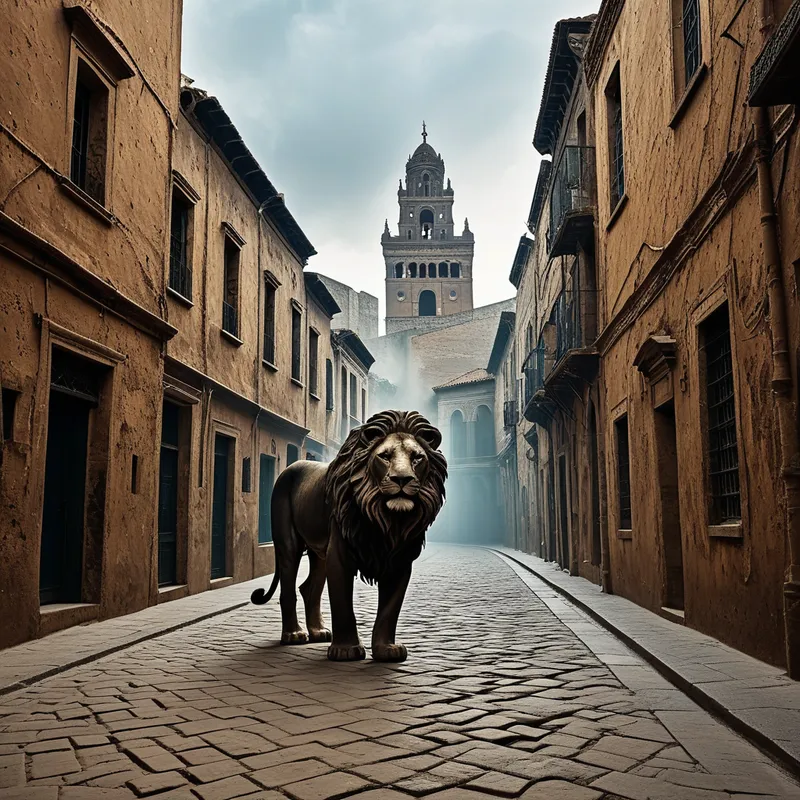
When the Lion of Babylon pads into the modern dreamscape, it rarely arrives with the pageantry of a procession. It appears in liminal spaces: at the edge of a familiar neighborhood that suddenly becomes ancient, or standing immobile yet alive in the corner of a contemporary office. Its presence is somatic—a low vibration in the chest, a feeling of being watched by an immense, silent intelligence.
This dream signals a critical phase in boundary-work. The dreamer is likely confronting a situation of psychological or moral chaos—a relationship without respect, a professional life lacking structure, an inner world flooded with anxiety or unruly impulses. The lion represents the nascent, or perhaps neglected, faculty of inner sovereignty rising from the depths. Its stillness is not passivity, but supreme readiness. Its gaze asks the dreamer: What are you willing to protect? What territory of your soul have you left undefended?
To dream of a passive or sleeping lion may indicate a relinquishment of this authority. To dream of a lion under attack, or its pedestal crumbling, speaks to a crisis of legitimacy, where the dreamer's own ruling principles are being challenged from within or without. The lion’s appearance calls for a conscious, courageous assessment of one's personal laws and the strength of one's psychological borders.
Alchemical Translation
The journey of the Lion of Babylon within the psyche is the alchemical process of coagulation—the bringing together of diffuse, powerful elements into a solid, enduring form. The primal, raw power of the instinctual self (the wild lion) must be encountered, engaged, and ultimately transmuted into a guardian of the conscious personality.
Individuation is not the slaying of one's inner dragon, but the construction of a city worthy of its guardian, and the summoning of the will to place that guardian on the walls.
First comes the recognition of the inner Tiamat—the chaotic, creative, often destructive swirl of unintegrated emotions, shadows, and potentials. This is the nigredo, the blackening. The battle with it is the inward struggle for self-definition, the Marduk-like act of saying "I am this, and I am not that." Victory in this battle yields the "matter" of the self: clarified values, acknowledged boundaries, a sense of purpose.
From this refined material, the Lion is fashioned. This is the albedo, the whitening, where the conquered chaos is not discarded but reshaped into a vigilant, beautiful form. The lion is the transformed chaos, now in service to the order it once threatened. The final stage, the rubedo or reddening, is the lifelong maintenance: walking the Processional Way of one's daily life, under the gaze of this inner guardian, continually renewing the commitment to one's own sovereign truth. The Lion of Babylon teaches that order is not a static condition, but a dynamic, ferocious act of love for the civilization of the soul.
Associated Symbols
Explore related symbols from the CaleaDream lexicon: