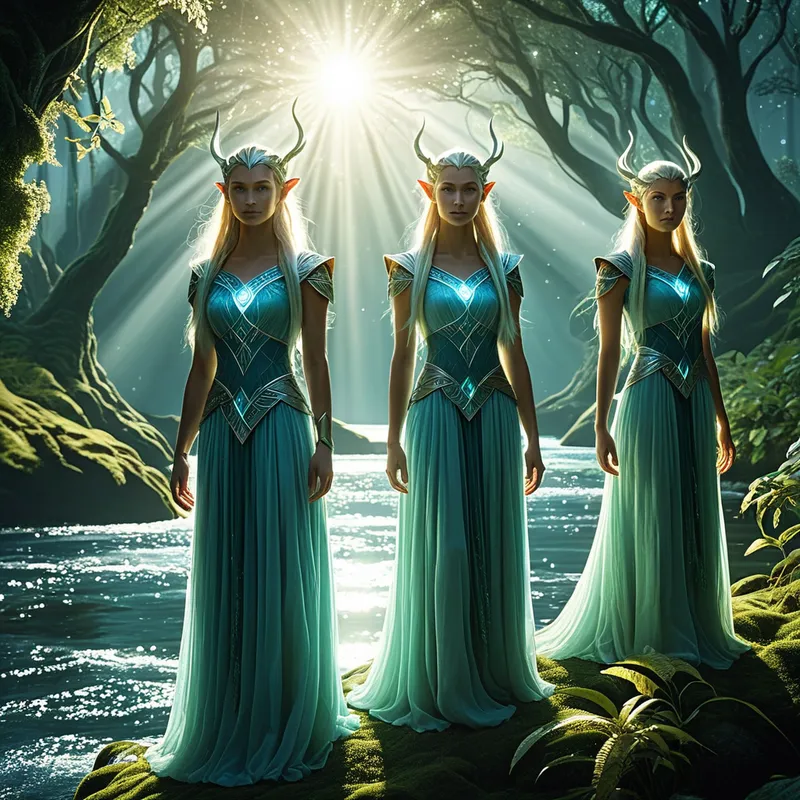
Light Elves Myth Meaning & Symbolism
Radiant beings dwelling in Alfheim, the Light Elves embody the luminous, conscious spirit and the soul's potential for beauty, order, and inspired creation.
The Tale of Light Elves
Listen, and let the fire’s crackle carry you beyond the smoke-hole of this hall, beyond the known lands of Midgard, to a place spoken of in whispers by the skalds. It is a realm not of earth, nor of the gods’ high seat, but of a light that is born, not burned. They call it Alfheim, and it was a gift.
In the time before time’s full reckoning, when the Ginnungagap had just been bridged by the flesh of the giant Ymir, the gods were parceling out the worlds. Odin All-Father looked upon his kin, the quick-tongued and beautiful Freyr, who rode the golden-bristled boar and whose smile could thaw the deepest frost. Freyr’s spirit was not one of conquest or thunder, but of fertile peace and shining prosperity. To honor this essence, Odin did not grant him a fortress of stone, but a kingdom of essence. "To you, Freyr," spoke the One-Eyed, "I give Alfheim, the homeland of the Light Elves, to rule and to cherish. Let your light be their sun, and their light be your glory."
And so, Freyr became the lord of that luminous land. Picture it, if you can: a world where the grass is not merely green, but sings with a soft emerald hum. Where rivers flow not with water, but with liquid crystal, catching a sun that never truly sets, only deepens into a perpetual, golden twilight. The air itself is honeyed with the scent of blooming light. Here dwell the Ljósálfar.
They are taller than men and fairer than any earthly dream, but their beauty is not of feature alone—it is of being. Their skin holds a radiance like the moon on a clear winter’s night, and their eyes are pools of starlight. They do not toil or fight as mortals do. Their work is the work of light itself. With a touch, they guide the growth of trees into spiraling, harmonious forms. With a whisper, they coax color from the air, painting the skies with hues that have no name in the tongues of Midgard. Their song is the subtle frequency that keeps the stones of their realm in perfect, resonant order. They are the tender curators of beauty, the silent composers of a visible harmony.
Their only conflict is not with sword or spear, but with the creeping shadow of entropy, the dullness that seeks to dim all things. It is said that at the farthest, most fragile edges of Alfheim, where it brushes against other, darker realms, the Light Elves stand vigil. They do not battle; they illuminate. Their presence is a ward, their very essence a cleansing fire that scatters formless gloom, not through destruction, but by offering a more compelling reality—one of order, clarity, and radiant peace. They are the unwavering flame that defines the darkness simply by being, eternally, what they are.

Cultural Origins & Context
The luminous, yet elusive, figures of the Ljósálfar reach us through a fragmented, poetic lens. Our primary source is the Prose Edda of Snorri Sturluson, a Christian scholar writing centuries after the Viking Age, attempting to preserve a fading pagan worldview. Snorri, in Gylfaginning, makes the critical distinction that sets these beings apart: "There is one place that is called Alfheim. There live the folk called light-elves. But dark-elves live down in the earth, and they are unlike them in appearance, and even more unlike them in nature."
This was not a detailed folk tradition told around every hearth, but a concept belonging to the higher, more abstract strata of Norse cosmology. It was knowledge for the skalds and the wise, woven into the complex tapestry of the Yggdrasil and its Nine Worlds. The myth served a societal function less of moral instruction (like the tales of Thor’s battles) and more of cosmological mapping. It answered a profound human question: if there are beings of brute matter (giants), conscious struggle (humans), and divine power (gods), then where does pure, conscious beauty reside? Where does the impulse for order, harmony, and radiant inspiration come from? Alfheim and its elves provided that locus. They represented a fundamental principle in the Norse universe: that luminosity, in both a literal and spiritual sense, was a native force in creation, as real as rock or frost.
Symbolic Architecture
The Light Elves are not merely "pretty fairies." They are profound psychological symbols. They represent the principle of consciousness itself in its most refined, untarnished state—the lumen naturae, the light of nature, that shines when the psyche is ordered and aligned.
They are the archetypal force of the spirit that seeks not to possess, but to illuminate; not to conquer, but to compose.
Their realm, Alfheim, gifted to Freyr (a god of fertility and peace), symbolizes the marriage of generative, life-affirming energy (Freyr) with conscious, ordering intelligence (the Elves). This union produces not raw life, but beautiful life. Psychologically, they symbolize the ego’s highest potential when it serves the Self—not as a warrior, but as a curator and a channel. They are the faculty that takes the raw, chaotic material of the unconscious (the primal lands of the giants) and shapes it into meaningful, luminous form: art, music, scientific elegance, acts of pure kindness, any creation that carries the hallmark of inspired clarity. Their opposition to "dark elves" and formless shadows represents the eternal psychic process of differentiation—consciousness distinguishing itself from the undifferentiated murk of the unconscious, bringing light to what was hidden.
The Dreamer's Resonance
When the motif of the Light Elf glimmers in the modern dreamscape, it rarely appears as a literal, Tolkien-esque figure. Its manifestation is more subtle and somatic. One might dream of discovering a room in their house filled with a calm, white-golden light they never knew was there. Or of holding a small, self-luminous object—a stone, a seed—that fills them with profound peace. The dream body itself may feel lighter, or the dreamer may see their own hands or heart-space glowing with a clean, internal radiance.
These are dreams of psychic integration and the awakening of conscious potential. The dreamer is likely in a process where a previously unconscious strength, talent, or aspect of their personality is becoming "lit up"—made available to consciousness. The somatic feeling of lightness or inner glow points to a release of energy previously bound in shadow or confusion. It is the psyche’s way of signaling that a phase of inner chaos or struggle is giving way to a new capacity for clarity, creative expression, or spiritual poise. The Light Elf pattern emerges not during the battle, but in the moment of resolution and composition that follows.
Alchemical Translation
The journey toward the Light Elf within is the alchemical stage of albedo, the whitening, following the initial blackening (nigredo) of confrontation with the shadow. It is the process of psychic transmutation where the raw material of one’s experiences and suffering is washed clean, ordered, and illuminated.
The individual does not become a Light Elf; they become the realm of Alfheim. They create an inner space where luminous consciousness can dwell and create.
This begins with the "gift of Freyr"—an acceptance of one’s own life-affirming, generative nature. One must claim their own Freyr, their capacity for peace, pleasure, and growth, not as guilt-inducing indulgence but as a sacred principle. Upon this foundation, the work of the Ljósálfar begins: the meticulous, patient work of inner ordering. This is the practice of taking the chaotic memories, conflicting emotions, and scattered drives and, through reflection, art, therapy, or meditation, arranging them into a coherent narrative. It is finding the harmony in one’s own history. The "vigil at the borders" is the ongoing discipline of mindfulness, where one uses the light of awareness to dispel the formless shadows of rumination, fear, or old, disintegrating patterns.
The ultimate triumph of this myth is not a slain dragon, but a sustained state of inspired, conscious creation. The individuated person, in this light, becomes a vessel through which the impersonal beauty of the cosmos can express itself personally. They rule their own Alfheim, a self illuminated from within, capable of bringing not noise, but music; not conflict, but composition; not more darkness into the world, but a unique and necessary point of light.
Associated Symbols
Explore related symbols from the CaleaDream lexicon: