The Alchemy of Light: A Somatic Summons from the Depths
The Somatic Echo
It begins not as an image, but as a pressure behind the eyes. A subtle, internal dawn that strains against the closed lids. The body knows light before the mind perceives it—a warmth spreading from the sternum, a tingling along the spine as if each vertebra is a dormant filament awaiting a current. There is a pull in the solar plexus, a gravitational yearning toward a source not yet seen. This is the somatic echo: the visceral, pre-verbal recognition of illumination as a force that reorganizes the internal landscape. It is the feeling of a long-held tension preparing to dissolve, not into nothingness, but into a new and more coherent pattern. The breath shallows, then deepens, in anticipation of a revelation that is as much physiological as it is psychological. You are being oriented, not by sight, but by a fundamental magnetic shift within the cellular dark.
The Dreamer's Log
The dreamer stands on a rain-slicked street at midnight, the city a symphony of reflected neon and shadow. They fumble with a cracked smartphone, its screen a spiderweb of black lines. Desperately, they try to turn on the flashlight, but the device is dead. In a moment of surrender, they drop it. As it hits the asphalt, the cracks begin to glow from within, not with electric blue, but with a soft, fungal bioluminescence—a primordial light that reveals the intricate map of the breakage itself, turning the failure into a luminous, living chart.
This is the alchemical moment: when the sought-after, external tool fails, the internal, broken places become the source of a more ancient and guiding illumination.

The False Lead
The dream of light is not a simple promise of clarity, nor a spiritual reward for good behavior. To interpret it as mere "enlightenment" or "a positive sign" is to commit a profound error of literalism, to confuse the sun with the process of photosynthesis. This light is not here to eliminate shadow, but to engage with it. It is not the end of confusion, but the beginning of a new kind of seeing—one that includes the seer in the field of vision. The terror or awe it evokes is not a bug in the system; it is the system recognizing a voltage it was not built to handle. This is not about luck, good or bad. It is about capacity. The light does not announce that the work is done; it illuminates the precise contours of the work that must now begin.
Psychological Architecture
To dream of light is to receive a summons from the deepest strata of the psyche, where the Shadow holds court. The light arrives not as a gentle dawn, but as a surgical beam, pinpointing exiled fragments of the self—the grief we buried, the rage we silenced, the brilliance we feared would make us a target. In the language of internal family systems, these are the parts frozen in time, guarding their pain in perpetual darkness. The light is the psyche's own immune response, a non-negotiable demand for reintegration.
This is the core of the individuation process: a voluntary descent into the illuminated shadow. It is not an exorcism, but an adoption. You are asked to behold the orphaned aspects not as monsters, but as neglected children of your own consciousness, each holding a piece of your wholeness hostage. The light provides the brutal, necessary visibility. The warmth it carries is the heat of transformation—the calcinatio of alchemy—where the identity you thought was solid (the "I am this, not that") is burned away, not to ash, but to a finer, more essential substance: the conscious witness who can hold both light and dark without identifying exclusively with either.
Mythic Resonance
Consider the Gnostic myth of the Pistis Sophia, a figure of luminous wisdom who, in her yearning for the ultimate source of light, plunges into the chaotic depths of matter. She becomes entangled, trapped in the very darkness she sought to illuminate. Her redemption does not come from a rescue from above, but from the sending of a "Light-Spark" into the depth, a fragment of the original source that descends to meet her in her captivity. The light does not pull her out; it teaches her to recognize her own luminous nature within the entanglement. Similarly, in the Navajo cosmology, First Man and First Woman do not emerge into a world of light, but patiently assemble the world from dark materials in the first four underworlds, guided only by inner knowing and the faint glow of precious stones. The sun itself is created last, as a consequence and crown of that foundational work in the dark. The light is not the precondition, but the revelation of the structure built in its absence.
Symbolic Nodes
- A Single Bulb Flickering in a Vast Space: The fragile, conscious ego confronting the enormity of the unconscious.
- Light Refracting Through a Prism or Cracked Glass: The fragmentation of a singular truth into the spectrum of your own complex, contradictory perspectives.
- Bioluminescence in Deep Water: Wisdom that originates in the emotional and instinctual depths, not the rational surface.
- A Flashlight Beam Cutting a Swath in Perfect Darkness: The focused, directed application of consciousness to a specific repressed memory or feeling.
- A Room Where the Light Switch No Longer Works: The failure of old, mechanistic methods of consciousness (willpower, analysis) to manage the emerging psychic energy.
- The Sun or Moon Seen Through Heavy Fog: The known archetypal force (Self, Anima/Animus) obscured by the unprocessed material of life, yet palpably present.
Archetypal Resonance
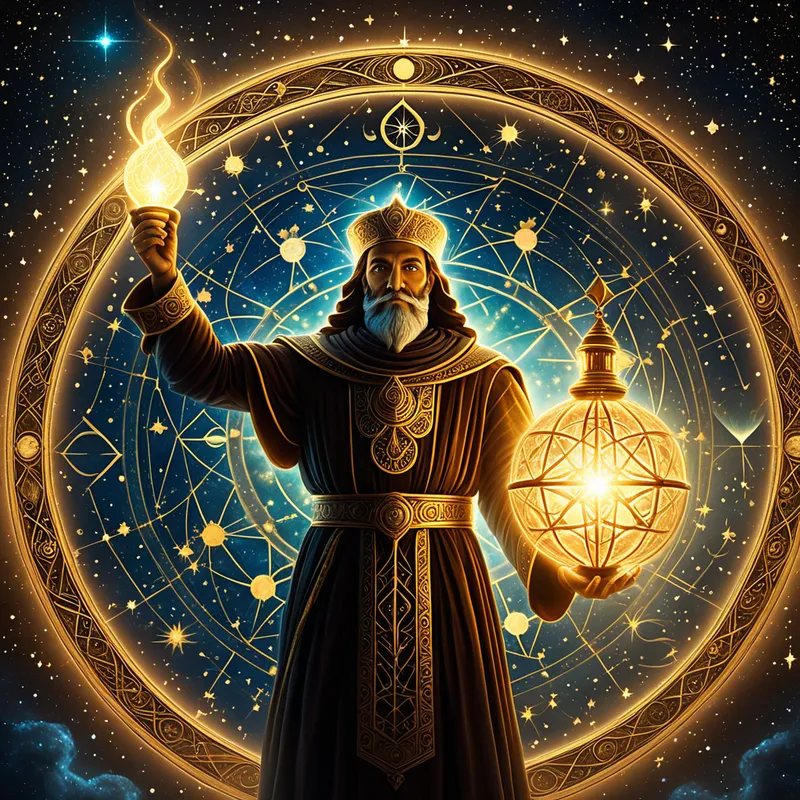
The core energy of the light dream resonates most powerfully with The Magician Archetype. The Magician is the archetype of conscious transformation, the knower of the hidden principles that govern reality. In its mature form, it is not about power over, but alignment with. The somatic echo—the magnetic pull, the internal dawn—is the Magician's energy stirring, sensing the latent potential within the psyche's raw materials. The light in the dream is the Arcanum, the secret tool or formula, manifesting. It is the archetype activating to perform the ultimate alchemy: turning the lead of shadow material (fear, trauma, ignorance) into the gold of integrated consciousness. The terror and awe are appropriate; one is in the presence of the archetypal force that mediates between the divine spark and the earthly vessel, and its work is one of profound, irreversible change.
The Alchemical Process
The transmutation here is Solutio—the alchemical stage of dissolution, but by the medium of light, not water. The intense psychological pressure is the unbearable exposure. To stand in this dream-light is to have every defense, every rationalization, every polished persona rendered transparent. It is the heat of being truly seen, first by yourself. The grief and terror arise from the dissolution of the familiar forms you mistook for your self. The "I" that was afraid, the "I" that was ashamed, the "I" that was superior—these solid identities begin to liquefy under this radiance.
The sovereignty that emerges is not a heavier, more armored crown. It is the sovereignty of the lighthouse keeper. You do not become the blinding beam itself, but the steady structure that houses it. You learn to tend the light, to clean the lens of perception, to endure the storms that would obscure it. Your authority comes from having witnessed what the light reveals without turning away, and from committing to its maintenance. The transformed self is the one who can consciously project this illuminating awareness outward and inward, navigating by it, because they have allowed it to dissolve everything that was not essential.

The Integration Protocol
Question 1: In the moment the light appeared in the dream, what was the immediate, visceral feeling in your body (e.g., relief, dread, warmth, paralysis)? Where exactly did you feel it?
Question 2: If the light in your dream could speak, not in words, but in a single, direct imperative aimed at your current waking life, what would that command be?
Question 3: What one thought, memory, or aspect of yourself have you been most actively keeping in the shadows recently? How might the dream-light be attempting to make you familiar with it?
Action 1 (Somatic Grounding): For three minutes upon waking, before any thought, place your hands over your closed eyes. Do not seek the dream image. Instead, feel for the residual somatic echo—the warmth, the pressure, the tingling. Breathe into that sensation in your body, giving it space without demanding a story.
Action 2 (Creative Transcription): Using only non-dominant hand, draw the light from your dream not as an object, but as a force field. Use colors, shapes, and lines to map its pressure, its reach, and the nature of the shadows it casts. Let the drawing be messy and intuitive, not representational.
Action 3 (Ritual of Orienting): Before sleep, light a single candle in a dark room. Sit with it. Instead of staring into the flame, notice what objects in the room it chooses to illuminate, and what it leaves in darkness. For one minute, practice shifting your identity from the one who lit the candle to the quality of the illumination itself. Blow it out, and carry the afterimage into the dark.
Final Validation
To be visited by this light is to be tasked with a formidable and sacred labor. The disorientation is real. The fear of what it shows you is valid. This is not a gentle process; it is the psyche's own intense restructuring. Yet, this very difficulty is the measure of the transformation at hand. You are not being shown this light because you are broken, but because your wholeness is insisting on a more coherent form. The light is not an external judge, but the awakening of your own internal faculty of sovereign perception. It calls you not to purity, but to profound and conscious relationship—with all that you are, and all that you see.