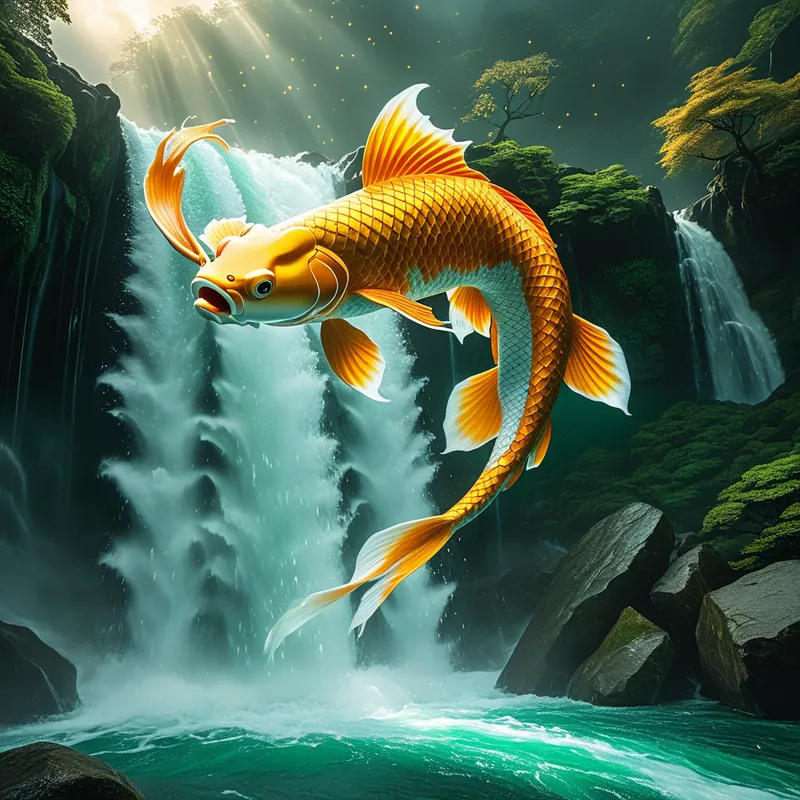
Koi Myth Meaning & Symbolism
A tale of a humble fish whose unwavering spirit in swimming against a mighty waterfall is rewarded with a miraculous transformation into a celestial dragon.
The Tale of the Koi
Listen, and hear a tale not of gods, but of spirit. In the ancient, mist-wrapped mountains where rivers are born from the tears of the earth, there flowed a river of purest jade. Its waters were home to a shimmering multitude—the Koi. They were beautiful, yes, with scales like polished coins of bronze, gold, and snow. But they were just fish, bound to the river’s will, dreaming only of the next morsel in the silt.
Yet, among them, a whisper lived. It spoke of a place far upstream, where the river did not flow but fell. A place where water became thunder and mist became cloud—the Dragon Gate. It was said that any Koi who could find this sacred cataract, who could summon the fury to swim against its crushing, white-hearted descent, and who could, through sheer will, leap from the boiling foam at its base to the serene pool at its summit… would be transformed. They would cease to be a creature of the stream and become a sovereign of the sky: a Ryū, a dragon.
Many scoffed. The current was strong, the journey long, and the promise seemed a fancy for fools. But a few held the whisper in their hearts. One, in particular, a Koi with scales the color of a deep, stubborn sunset, felt the call not as a thought, but as a pull in its very blood. Turning its head from the easy downstream drift, it began to swim.
The journey was an ordeal of stone and current. It passed through gorges where the sun was a stranger, and over shallows where predatory shadows lurked. Its fins grew tired, its scales were scraped by rocks, and the relentless push of the water was a constant weight upon its soul. Other travelers turned back, their spirit broken by the endless effort. But the sunset Koi pressed on, driven by a vision of the summit it had never seen.
Finally, the sound reached it—a deep, roaring hum that vibrated through the water long before the sight. The river narrowed, the banks climbed into cliffs, and there it was: the Dragon Gate. A sheer wall of falling heaven, a tumult of white fury that crashed into a churning cauldron below. The air was thick with a cool, stinging mist. To look upon it was to know impossibility.
Without hesitation, the Koi gathered its last reserves. It swam into the maelstrom at the waterfall’s foot, a tiny speck of color in a world of violent white. The current slammed it down, again and again. It used every muscle, every ounce of will, not to swim forward, but simply to hold its place against the drowning force. Then, finding a moment’s purchase on a hidden rock, it coiled its body and leapt.
It was thrown back, battered. It tried again. And again. For years, some tales say, it attempted the impossible leap. Its scales lost their luster, its body bore the marks of a thousand failures. Just as exhaustion threatened to finally claim it, surrendering it to the downstream fate it had long refused, it felt a strange surge—not from its weary muscles, but from the very essence of its perseverance. With a final, silent cry of effort, it launched itself one more time into the spray.
This time, it did not fall back. It broke through the curtain of water, past the point of impact, and soared into the clear, quiet air above the cascade. As it crested the summit and fell into the tranquil, heavenly pool, a bolt of celestial fire struck the water. Where there had been a fish, there now coiled a magnificent dragon. Scales became gleaming armor, fins became flowing mane and whiskers, and its spirit, tested and proven, commanded the clouds. It roared, a sound of thunder and triumph, and ascended into the sky from whence the river ultimately came.

Cultural Origins & Context
The legend of the Koi and the Dragon Gate is a moral folktale with roots in Chinese mythology that were deeply adopted and adapted into Japanese culture, likely during periods of cultural exchange. It is not a Shintō Kojiki myth of primordial gods, but a later, human-centric parable. It was passed down orally and through art—on woodblock prints, painted on screens, and carved into temple eaves—becoming a ubiquitous symbol.
Its societal function was multifaceted. For the samurai, the Koi represented gaman (perseverance) and nintai, the unwavering spirit needed to face certain death with honor. In popular culture, it became an emblem of aspiration, especially for academic success; passing the arduous imperial examinations was metaphorically "leaping the Dragon Gate." During the May Kodomo no Hi festival, Koinobori streamers fly, each representing a family member swimming upward against life’s currents. The myth served as a cultural engine, instilling the values of ambition, resilience, and the belief that profound change is earned through relentless effort.
Symbolic Architecture
At its core, the myth is a perfect map of the heroic journey applied not to a human, but to the essence of striving itself. The Koi represents the latent potential within a constrained form—the soul in its mundane, instinctual state. The river is the predictable flow of fate, convention, and unconscious life. To turn upstream is the first act of consciousness, the decision to seek a different destiny.
The waterfall is not an obstacle, but the crucible. It is the concentrated pressure of reality against the will to become.
The repeated failure is not punishment, but alchemical repetition. Each attempt burns away a layer of the "mere fish" identity, forging a spirit pure enough to enact its own metamorphosis. The transformation into the dragon is not a reward given, but a new state of being revealed. The dragon is the integrated Self—the Koi that has realized its innate, sovereign power. It gains mastery over the elements (water and sky), symbolizing a consciousness that can navigate both the depths of the unconscious (the river) and the heights of spirit (the heavens).
The Dreamer's Resonance
When this myth stirs in the modern psyche, it often manifests in dreams of swimming upstream, of climbing impossible slopes, or of being a small creature in a vast, powerful current. The somatic feeling is one of profound effort, of muscles burning in sleep. Psychologically, this signals a critical phase of individuation.
The dreamer is the Koi. The "waterfall" may be a career challenge, a creative block, the arduous path of healing, or any situation requiring sustained will against a powerful counter-force. The dream does not promise immediate success; instead, it validates the struggle itself as sacred and necessary. To dream of being battered by the current but still pushing is a profound message from the unconscious: You are in the process. The weariness is part of the transformation. The moment of transformation in the dream may be absent, hinting the dreamer is still in the testing phase, or it may appear as a sudden shift in perspective—looking down from a great height, or feeling scales become wings.

Alchemical Translation
The myth of the Koi is a manual for psychic transmutation. It models the entire arc of turning leaden fate into golden destiny.
First, there is The Turn (Nigredo). This is the darkening, the conscious decision to leave the comfortable, downstream drift of the persona and accepted life. It is often precipitated by a sense of meaninglessness or a call that cannot be ignored. It is the beginning of the nigredo, where one confronts the shadow of one's own limitations.
Second, The Crucible of Repetition (Albedo). The endless leaping is the albedo, the purification. Here, intention is tested by reality. Every failure washes away an illusion—the illusion of quick success, of external rescue, of being special without effort. What remains is the whitened, essential core of one's will: the sheer, stubborn fact of continuing.
The dragon is not waiting at the top of the waterfall. It is forged in the relentless act of the leap.
Finally, The Revelation (Rubedo). The transformation is the rubedo, the culmination. It is not that one becomes something entirely new, but that the persistent application of effort reveals what was always latent. The integrated Self (the dragon) was always the true shape of the persevering spirit (the Koi). For the modern individual, this translates to any profound, hard-won integration: finding one's authentic voice after years of silence, achieving mastery in a craft after endless practice, or attaining a hard-earned peace after a long inner conflict. The myth teaches that wholeness is not a gift, but a triumph. The gate is always there, and the waterfall's roar is the call to become.
Associated Symbols
Explore related symbols from the CaleaDream lexicon: