
Juha the Wise Fool Myth Meaning & Symbolism
A paradoxical folk hero whose foolish actions and riddling tales expose societal hypocrisy and illuminate the hidden wisdom of the simple heart.
The Tale of Juha the Wise Fool
Listen, and let the dust of the old caravan roads settle in your mind. In the spaces between the call to prayer and the clamor of the souk, there lived a man—or perhaps a force—named Juha. His home was not a house of stone, but the winding alleyways of understanding, his throne a stubborn donkey he often rode facing its tail.
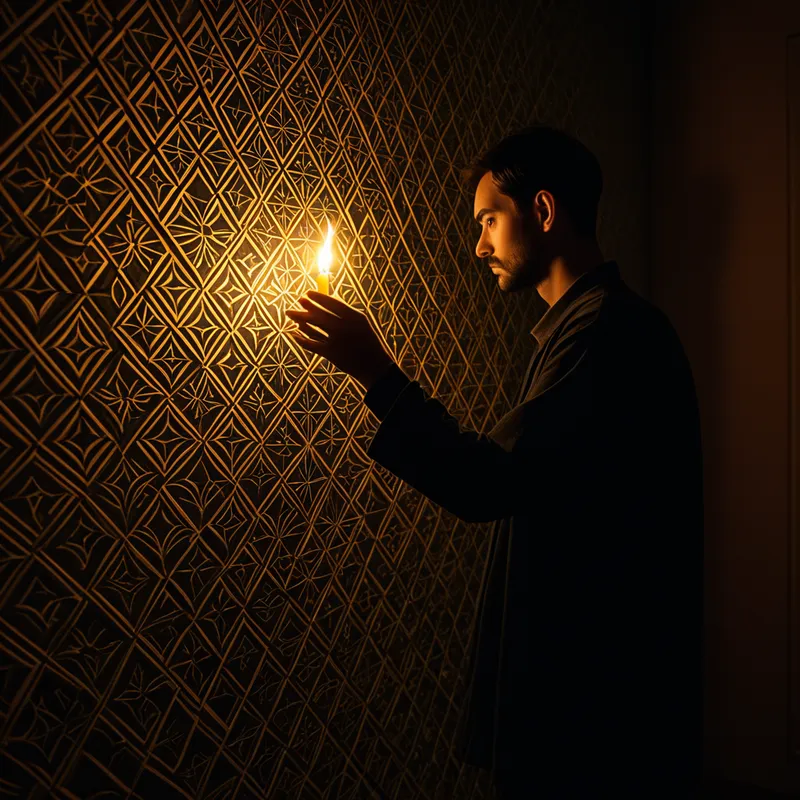
One day, the townspeople found Juha on his hands and knees beneath the flickering lamp of a street vendor. “What do you seek, old fool?” they laughed. “I have lost the key to my house,” Juha muttered, his brow furrowed in exaggerated concentration. The crowd gathered, their laughter growing. “But Juha,” cried a merchant, “you are far from your door! The key would be lost at your threshold, not here in the market square!” Juha sat back on his heels, his eyes glinting like polished coins in the lamplight. “Ah,” he said, his voice a dry whisper that cut the laughter short. “But the light is better here.”
On another occasion, the Qadi, a man of severe dignity and unquestioned law, summoned Juha. “They say you are a fool, yet they hang on your words. Explain this paradox.” Juha simply asked for a cup of water. When it was brought, he held it high. “Is this cup half full or half empty, O Wise Judge?” The Qadi scoffed. “It is merely a cup of water. The question is meaningless.” Juha drank it slowly, then placed the empty cup before the judge. “Now it is empty. But is it more empty than it was full? Or was its fullness merely the promise of this emptiness?” The Qadi, frustrated, dismissed him. As Juha left, he turned and said softly, “You see? You ask for an explanation of a fool, but become troubled by the questions of a cup. Who is the fool here?”
His most famous tale is of the borrowed pot. Juha asked his neighbor for a large cooking pot. A week later, he returned it, along with a small pot inside. “What is this?” asked the neighbor. “Your pot gave birth,” Juha explained with utter sincerity. The neighbor, though confused, accepted the gift. Months later, Juha asked to borrow the large pot again. This time, he did not return it. When the neighbor demanded its return, Juha’s face fell into tragic lines. “I have grave news,” he whispered. “Your pot… has died.” The neighbor erupted. “A pot cannot die!” To which Juha merely nodded, his expression one of pure, innocent logic. “If a pot can give birth, should it not also be able to die?”
Cultural Origins & Context
Juha is not a singular figure, but a fluid archetype woven into the fabric of Islamic folk culture from North Africa through the Middle East and into Central Asia. Known also as Nasreddin Hodja, Goha, or Effendi, his stories migrated with caravans and were traded in coffee houses, told by storytellers (hakawatis) to uproarious laughter and thoughtful silence. He exists in the liminal space between the mosque’s formal theology and the home’s practical wisdom.
His tales were never scripture, but social scripture. They functioned as a pressure valve in hierarchical societies, allowing the common person, through Juha’s absurdity, to critique the pompous, the greedy, and the rigidly dogmatic without direct confrontation. He is the embodiment of the folk tradition that runs parallel to scholarly Fiqh, reminding all that divine wisdom (Hikmah) can speak through the mouth of a seeming simpleton as clearly as through a learned tome. He represents the voice of the street, the wisdom of experience over theory, and the enduring human need to laugh at power and at oneself.
Symbolic Architecture
Juha is the living embodiment of the koan. He is not merely a clown, but the Sacred Clown, whose purpose is to invert reality so that its hidden seams become visible.
The Wise Fool does not possess knowledge; he creates the empty space—the bewildered silence—in which true understanding can be born.
His backwards ride on the donkey is a master symbol. It represents the conscious reversal of assumed direction. Society moves forward; Juha checks the path already traveled. It asks: Are we progressing, or merely fleeing? His actions are a form of alchemical mortificatio, reducing complex social pretenses to their absurd, base elements. The borrowed pot story is not about deceit, but a literal enactment of metaphorical thinking to expose greed and illogic. When he searches for the lost key where the light is good, he holds a mirror to our own propensity to look for solutions only in comfortable, illuminated places, ignoring the shadowed areas where the problem actually resides.
Psychologically, Juha represents the Trickster archetype in service to the Self. He is the function of the psyche that dismantles the persona (the mask of social adaptation) and pokes holes in the inflation of the ego, especially the spiritual or intellectual ego. He is the necessary chaos that precedes new order.
The Dreamer's Resonance
When the spirit of Juha visits a modern dream, he rarely appears as an old man with a turban. He manifests as the dream’s inherent absurdity. He is the feeling of being in an important meeting naked, or of desperately trying to solve a puzzle where the pieces keep changing shape. This is not nonsense; it is the psyche’s Juha-moment.
To dream of such paradoxical, frustrating scenarios is often a somatic signal that the dreamer’s conscious attitude has become too rigid, too identified with a single role—the capable professional, the perfect parent, the enlightened seeker. The Juha-energy rises from the unconscious to stage an intervention. The psychological process is one of ego-relativization. The laughter or frustration in the dream is the initial resistance to having one’s self-seriousness punctured. The dream invites the dreamer to engage with the absurdity, to ask, “Where in my life am I searching for the key under the lamppost simply because the light is better there?” It is an invitation to embrace a more flexible, paradoxical, and less literal relationship with one’s own life story.

Alchemical Translation
The individuation journey is not a straight path of accumulating wisdom; it is a spiral where one must continually encounter and integrate one’s own foolishness. Juha models this alchemical process perfectly.
The first stage is Calcinatio—the burning away of pretension through the fire of absurdity and public ridicule (Juha being laughed at). The ego’s grandiose structures are scorched. Then comes Solutio—dissolution in the waters of paradox (the cup that is both full and empty). Fixed identities and beliefs are flooded, rendered fluid. Next is Coagulatio—the re-forming of a new substance. This is the moment after Juha’s riddle, when the laughter dies and a new, more nuanced thought crystallizes in the silence of his audience.
The ultimate transmutation is not from fool into sage, but into the one who can hold both fool and sage within a single, compassionate awareness.
Juha’s final lesson is the Unio Mentalis, the union of opposites. He is the union of wise and fool. For the modern individual, the alchemical goal is not to eradicate one’s foolish, shadowy, or paradoxical aspects, but to grant them a seat at the table. It is to develop a “Juha-consciousness”: the ability to step sideways from the linear narrative of achievement and self-improvement, to ride one’s own life backwards for a moment, and to see the journey from a perspective that illuminates its inherent, holy irony. The gold produced is not certainty, but a resilient, humorous wisdom that can embrace contradiction without falling apart.
Associated Symbols
Explore related symbols from the CaleaDream lexicon:
- Fool — The archetypal embodiment of beginnings, divine madness, and the wisdom that comes from stepping outside convention, perfectly encapsulating Juha's paradoxical nature.
- Mirror — Juha’s tales act as mirrors held up to society and the individual, reflecting back not their image, but their hidden contradictions and hypocrisies.
- Key — Represents the search for solutions and understanding, often humorously misplaced, as in the tale of searching where the light is good rather than where the key was lost.
- Cup — Symbolizes the vessel of consciousness and the paradoxical nature of perception, as explored in Juha's question of whether it is half full or half empty.
- Donkey — The humble, stubborn beast of burden upon which Juha rides backwards, representing the grounding of spirit in matter and the reversal of conventional direction.
- Mask — Juha himself is a mask worn by the culture, allowing taboo truths to be spoken; he also reveals the masks worn by the pompous and powerful.
- Shadow — Juha personifies the trickster aspect of the personal and collective shadow, the part that undermines pride and exposes what is consciously denied.
- Trickster — The foundational archetype Juha embodies, the divine agent of chaos, change, and revelation through subversion and humor.
- Paradox — The very substance of Juha's being and teachings, representing the coexistence of contradictory truths that point to a higher, unifying reality.
- Laughter — The transformative force unleashed by Juha, a sacred sound that can dismantle rigid structures and open the heart to new understanding.