The Somatic Echo of a Fractured World
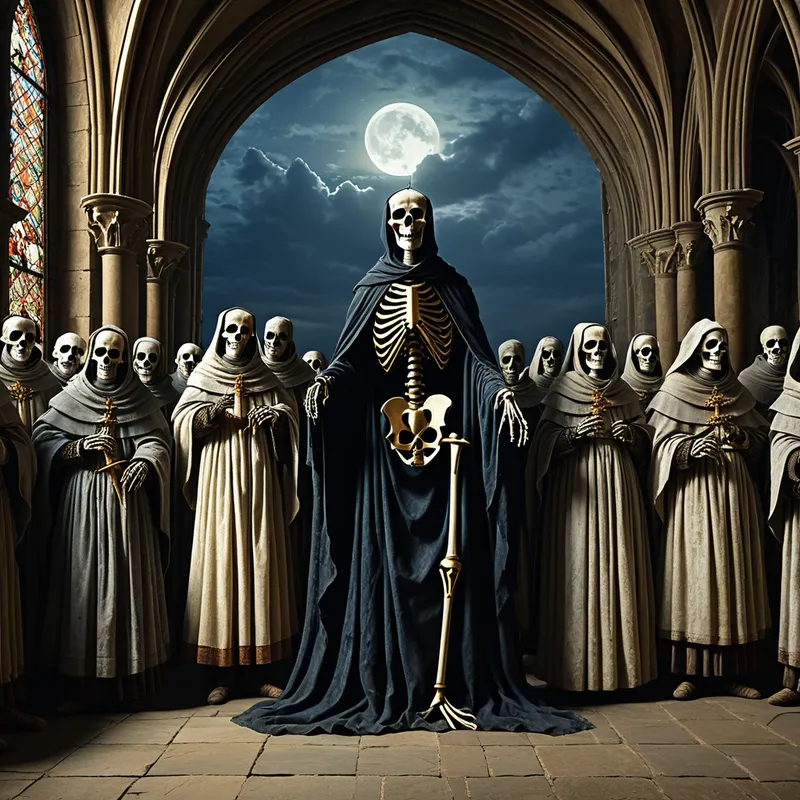
It begins not as a thought, but as a pressure. A low-grade hum in the bones, a subtle dissonance that vibrates behind the sternum. It is the somatic echo of a misalignment, the body’s deep knowing that the story you are living within is not the story you are made of. This is the pre-verbal ache of the Social Critique dream—a feeling of being a stranger in a familiar land, of speaking a language that everyone hears but no one understands. Your breath feels shallow, as if the collective atmosphere is thin on the truth you need to survive. Your shoulders may carry an unseen weight, the burden of unspoken agreements and polite fictions. Before the mind conjures images of crumbling institutions or masked crowds, the body registers the fracture: a silent, cellular rebellion against the architecture of the should.
The Dreamer's Log: The Empty Cage
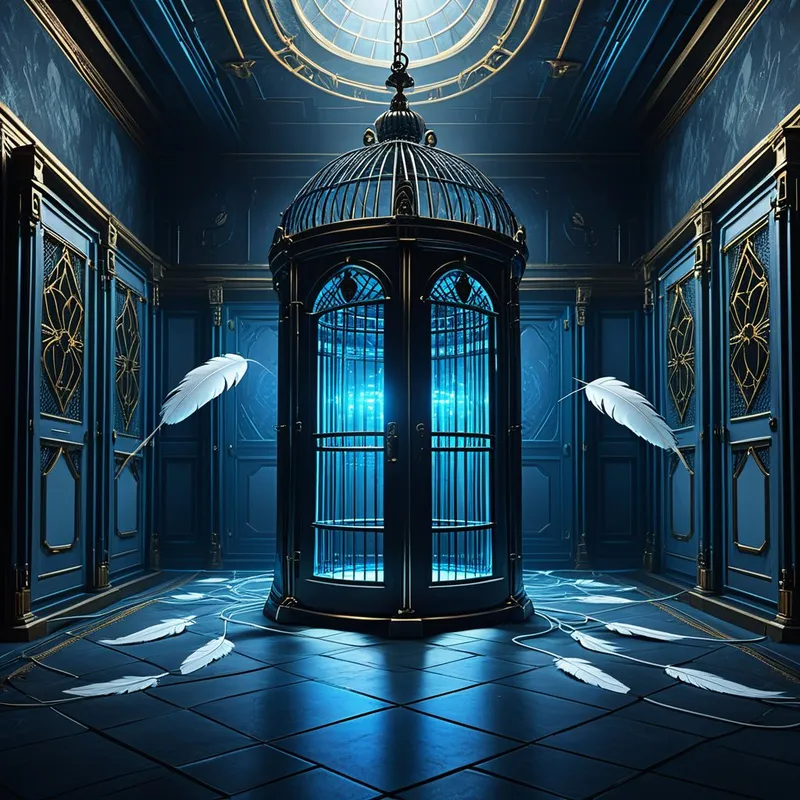
I am walking through a vast, silent data center. Rows of servers blink with cold blue light. In the center of the room, suspended from a tangled web of cables, hangs an exquisite golden birdcage. Its door is open. Inside, on a perch of polished brass, lies a single, pristine white feather. All around the cage, scattered on the floor, are hundreds of identical, featureless grey masks.
Alchemical Interpretation: The psyche reveals that the prized structure of belonging (the golden cage) is already empty, its essential nature (the feather) having departed, leaving only the hollow performance of identity (the masks) as the operating system of the world.
The False Lead: It's Not About Being Right
Do not mistake this profound internal signal for mere external judgment. This is not the dream of the cynical critic who stands apart to feel superior, nor is it the nightmare of simple social anxiety. The terror here is not of rejection, but of assimilation—of losing your unique frequency entirely to the collective hum. The grief is not for a failed society, but for the parts of your own soul you had to silence to fit within its blueprint. A Social Critique dream is not an indictment of them; it is a love letter from the exiled parts of you, the aspects of your being that the world had no room for, and that you, in turn, disowned to maintain the connection. It is the shadow of belonging, calling you home.
Psychological Architecture: Dissolving the Collective Blueprint
The deep work here is an archaeology of the self, conducted in the dark soil of the collective unconscious. You are not just an individual with a personal history; you are a vessel carrying centuries of cultural agreements, unspoken rules, and inherited traumas. The Social Critique dream initiates the process of disentanglement. It asks: Which of my thoughts are truly mine? Which of my desires were implanted? Which of my fears are heirlooms from ancestors I never met?
This is Shadow work of a higher order. You confront not only your personal repressed darkness but the collective shadow—the violence, hypocrisy, and fear that a culture buries and then projects onto "others." To individuate here is to perform a radical act of psychic surgery: to carefully cut the filaments that bind your sense of worth to external validation, your sense of safety to conformity, and your voice to the acceptable chorus. It is the terrifying, liberating process of becoming a sovereign entity, no longer a node in a network but a self-contained system with its own gravity, its own laws, its own light.
Mythic Resonance: Cassandra's Truth and Plato's Cave
We see this firmware in the agony of Cassandra, blessed with the clarity to see the coming collapse of Troy but cursed so that no one would believe her. Her myth is not about failed prophecy, but about the torment of seeing the truth within a system utterly devoted to its own illusions. The Social Critique dream often carries this Cassandra-energy—a visceral knowing that is met with the internalized dismissal of the crowd.
Similarly, the dream resonates with the prisoner in Plato's Allegory of the Cave who escapes the shackles, turns toward the fire, and then the sun. His return to tell the others is not welcomed as salvation, but met with hostility. The critique is inherent in the act of seeing itself. The dream is that moment of turning your head, feeling the ache in your neck from a lifetime of staring at shadows, and perceiving, for the first time, the machinery of the illusion. The pain is in the seeing, and the greater pain is in the knowing that you can never unsee it.
Symbolic Nodes
- Crumbling or Absurd Architecture: Buildings with impossible layouts, melting foundations, or doors that lead nowhere.
- Masks, Uniforms, Identical Crowds: The loss of individual face, the pressure of anonymity, the fear of being swallowed by the mass.
- Malfunctioning Technology: Screens showing static, phones without dial tones, vehicles that won't start—the failure of the systems designed for connection and progress.
- Silent Protests or Inaudible Speech: Screaming with no sound, holding a sign with blurred text, the profound frustration of a message that cannot be transmitted.
- Polluted or Artificial Environments: Grey skies, plastic trees, poisoned water—the desecration of the natural, organic self by synthetic collective values.
Archetypal Resonance: The Voice in the Static
At the heart of this theme pulses the energy of The Rebel Archetype. Not its Shadow Outlaw, driven by nihilistic destruction, but the pure Rebel: the necessary destroyer of what is rotten so that what is authentic may live. This archetype’s somatic echo is the fire in the gut, the clenched jaw of a truth too potent to swallow. Its alchemical potential lies in its absolute refusal. It says no to the false self so that the true self can finally say yes. The Rebel does not critique from a place of hatred for the world, but from a fierce, almost desperate love for what the world could be—and from a deeper, more sacred love for the integrity of one’s own soul. Its task is the controlled demolition of the internal prison, using the blueprint of discontent as a guide to the load-bearing walls of illusion.
The Alchemical Process: From Fracture to Foundation
The transmutation here is one of reclamation. The base metal is the grief of alienation, the terror of exile. The heat is applied through the sustained, courageous act of feeling that grief fully—not as a victim of society, but as a mourner for the parts of yourself you abandoned at its gates. The pressure is the conscious endurance of the dissonance, the decision to no longer numb the hum in your bones with the noise of the world.
In this crucible, a profound reversal occurs. The "flaw"—your sensitivity, your non-conformity, your inability to buy the story—is revealed as the philosopher's stone. The very thing that made you feel broken within the old system becomes the cornerstone of your new, internal sovereignty. The critique, once directed outward in despair, turns inward as a tool of exquisite discernment. You stop trying to fix the broken world "out there" and begin, with meticulous care, to assemble a world within that is coherent, true, and resilient. The collective shadow, once a source of terror, becomes a source of power—the raw, unvarnished truth from which you now build.

The Integration Protocol
Question 1: Where in my life do I feel a subtle, persistent pressure to pretend, to perform, or to silence a part of myself to maintain "peace" or belonging?
Question 2: If the social script I am following were a literal piece of paper, what is one sentence on it that, if I crossed it out forever, would bring me immediate relief?
Question 3: What exiled part of my own nature—a wildness, a sensitivity, a creativity—does the collective world seem to have no room for, and how have I internalized that rejection?
Action 1 (Somatic Reclamation): For one week, practice this upon waking: place a hand on your sternum. Breathe into the space beneath your palm and ask, "What do you need to feel true today?" Listen for the physical impulse, not the mental answer—a desire for silence, for movement, for a certain color, for a different route. Follow that impulse, however small.
Action 2 (Unscripted Expression): Take a large piece of paper and two drawing tools (e.g., a charcoal stick and a metallic pen). With your non-dominant hand, let the charcoal scribble, press, and smear to represent the "pressure of the collective." Feel it. Then, with your dominant hand, use the metallic pen to draw, write, or carve into that dark mass. Let it be the response of your essential self—a symbol, a word, a pattern reclaiming the space.
Action 3 (Ritual of Severance): Write down a single "rule" you live by that feels foreign and constricting (e.g., "I must be always productive," "I must not make others uncomfortable"). Speak it aloud to yourself in a mirror. Then, with deliberate ceremony, burn the paper. As it burns, say firmly, "I transfer the authority of this law from the world back to my own soul." Feel the internal shift of power.
Final Validation
This path is not for the faint of heart. To feel the fundamental fractures in the shared dream is a lonely and taxing gift. It is to walk with a constant, low-grade truth that others seem immune to. Yet, this sensitivity is not your curse; it is your compass. The despair you feel is the death throes of an identity that was never yours. The alienation is the necessary distance from which a sovereign self is forged. You are not breaking apart with the world; you are breaking free from it, molecule by molecule, to become something more dense, more real, and more radiant than any role you were ever assigned. The critique ends not in bitterness, but in a profound and unshakable peace—the peace of a self that is finally, irrevocably, at home in its own skin, ruling its own inner kingdom.