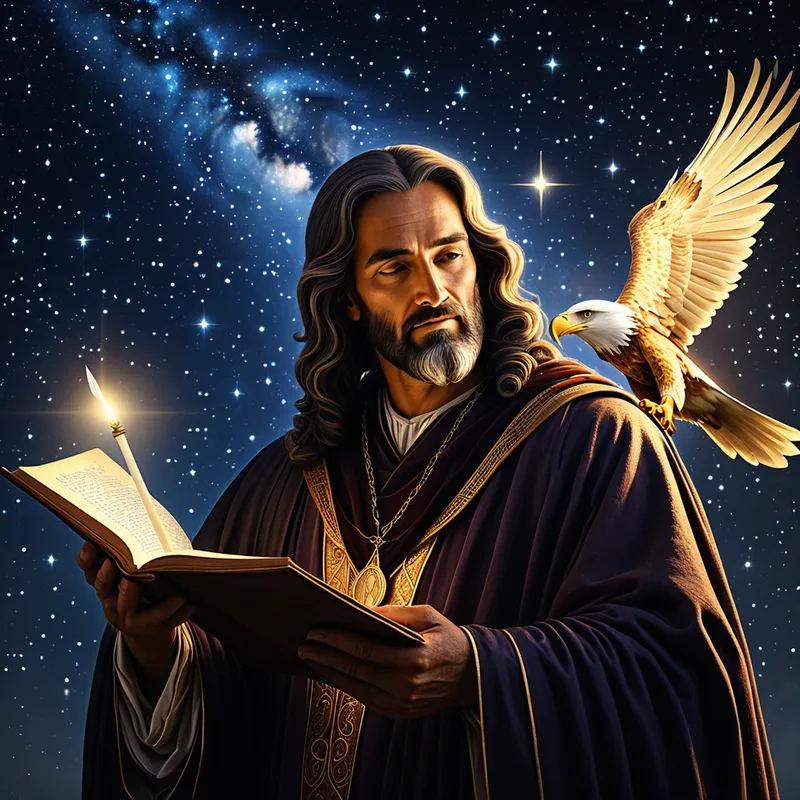
John the Evangelist Myth Meaning & Symbolism
The myth of the disciple who leaned on Christ's heart, witnessed the Crucifixion, and received the apocalyptic vision of ultimate meaning.
The Tale of John the Evangelist
Listen. In the days when the world was thick with portents and the very dust of Judea thirsted for revelation, there walked a man whose story was written not just in ink, but in fire and water, in love and terror. He was John, son of thunder, brother of James.
He was a fisherman, his hands calloused from nets and salt, his soul tuned to the rhythms of the Sea of Tiberias. But a voice from the shore called him, and the nets fell from his hands forever. He followed the rabbi from Nazareth, not as a student to a teacher, but as a friend to the heart of a mystery. At the final supper, while shadows of betrayal gathered, John did not sit across the table. He leaned. He reclined against the chest of Jesus, his ear near the heartbeat of the divine. In that intimate darkness, he heard the whisper of the coming storm.
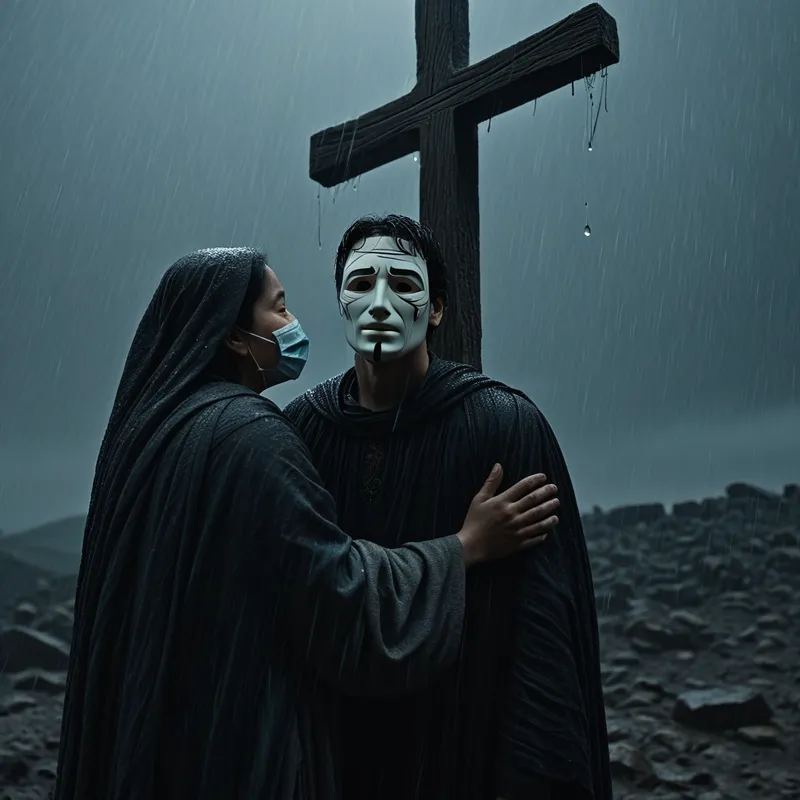
He alone of the twelve did not flee when the torches came to the garden. He followed the mob to the court of the high priest, a silent witness in a cacophony of fear. And when the world executed its god on a hill of skulls, John was there. The mother stood weeping, and the dying man from the cross looked down, his voice a rasp of ultimate care. “Woman, behold your son.” Then to John, “Behold your mother.” In that moment, the sword prophesied to pierce Mary’s soul passed also into his. He took her into his own home, the agony of witnessing becoming the foundation of a new family.
But the tale does not end at an empty tomb. Decades later, an old man, his body frail but his spirit undimmed, is exiled to Patmos for speaking of the Word. On the Lord’s Day, the veil of the world tore.
“I was in the Spirit…”
A voice like a trumpet. He turned and saw one like a son of man, his eyes like flames, his voice like the roar of waters. The seven golden lampstands. The four living creatures covered in eyes. The scroll sealed with seven seals. The great dragon, the beast from the sea, the whore of Babylon. Visions of judgment and salvation poured through him—cities of gold, rivers of life, a new heaven and a new earth. He was told, “Write what you see.” And so, the fisherman, the beloved disciple, the witness at the cross, became the scribe of the apocalypse, his hand guided by angels and terror, etching the end of all things onto parchment, completing the circle from the primal Word to the final Amen.
Cultural Origins & Context
The mythic figure of John emerges from the fertile, conflicted soil of early Christianity in the 1st century CE. It is a composite narrative, woven from several strands: the historical memory of John the Apostle, the theological voice of the Gospel of John, and the apocalyptic tradition of the Book of Revelation. These texts were not dry histories but living, breathing documents of a community defining itself against persecution and philosophical inquiry.
The story was passed down orally and textually within Christian communities, serving multiple societal functions. For early believers facing Roman persecution, the figure of John—the witness who survived the cross and outlasted exile to deliver a prophecy of ultimate victory—was a potent symbol of endurance and hope. The Gospel, with its profound Gnostic-tinged language of “the Word made flesh” and abiding love, provided a philosophical depth to counter simpler narratives. The Revelation offered a cosmic framework for earthly suffering, transforming political catastrophe into a divine drama. John became the archetypal seer, the bridge between the intimate Jesus of history and the cosmic Christ of eternity.
Symbolic Architecture
At its core, the myth of John is a profound map of consciousness evolving through the medium of love and vision.
The beloved disciple is not the one who knows the most, but the one who rests closest to the source of knowing—the heart.
John symbolizes the capacity of the human psyche to hold profound paradox. He is the witness—a passive, receptive faculty—who is then activated into the prophet. His primary symbol is the eagle, the creature that soars highest to gaze directly at the sun, representing the piercing insight of the intellect illuminated by spirit. Yet this soaring vision is grounded in the most human of experiences: friendship, grief, and filial care at the foot of the cross.
The key artifacts are the Gospel and the Revelation. The Gospel is the inward journey, the logos descending into flesh and intimate relationship. The Revelation is the outward explosion, the psyche confronting the collective shadow—the beasts, the chaos, the archetypal forces of history. John holds both. He is the vessel through which the personal love of the teacher becomes the impersonal, cosmic judgment and renewal of the universe. Psychologically, he represents the integration of the anima (receiving the mother) and the confrontation with the shadow (the apocalyptic beasts), guided by the transcendent function (the voice from the throne).
The Dreamer's Resonance
When this mythic pattern stirs in the modern dreamer, it signals a profound shift from personal psychology to transpersonal engagement. To dream of being a close witness to a central, transformative, or traumatic event—especially one involving a guiding or parental figure—echoes John at the cross. The somatic sensation is often one of being pierced: a sharp intake of breath, a weight on the chest, a feeling of sacred responsibility. The psyche is being asked to hold a truth too large for ordinary consciousness, to bear witness to an inner death or sacrifice.
Dreams of receiving a dictation, being told to “write” or “remember,” or of overwhelming, symbolic visions (complex machines, architectural wonders, terrifying beasts) resonate with the Patmos exile. This is the process of the conscious ego being overwhelmed by contents from the collective unconscious. The dreamer is not having a nightmare; they are being initiated as a scribe. The psychological process is one of reluctant prophet-hood, where a part of the self must become a channel for energies and insights that reorganize one’s entire worldview. The conflict is between the desire for a quiet, loving intimacy with the Self and the terrifying duty to articulate its most disruptive revelations.
Alchemical Translation
The alchemical journey of John models the complete opus of individuation. It begins with the nigredo, the blackening: the crucifixion, the profound confrontation with death, suffering, and betrayal. John does not look away. He incorporates the darkness, taking the mother (the related, caring function) into his own home. This is the first transmutation: grief into stewardship.
The exile to Patmos is the albedo, the whitening, a state of isolation and purification where the old identity (the apostle) is stripped away. On this barren island of the soul, the solutio—the dissolution by the spirit—occurs. “I was in the Spirit.” The rigid boundaries of the ego dissolve, and the archetypal sea of the unconscious floods in.
The Revelation is not a prediction of the world’s end, but a depiction of the psyche’s end—the catastrophic and glorious dismantling of the old world of the ego.
The writing of the scrolls is the rubedo, the reddening. The visionary experience must be made substantial, translated into the “lead” of language and form. This is the creation of the philosophical gold—the integrated consciousness. The eagle’s vision is fused with the human hand. The final stage is the coniunctio, the sacred marriage. In the myth, this is depicted as the descent of the New Jerusalem. Psychologically, it is the permanent establishment of a new relationship between the ego and the Self. The one who leaned on the heart now hears its cosmic rhythms. The witness becomes the sanctuary. For the modern individual, the myth instructs: do not fear the intimacy of the heart, nor the terror of the vision that follows. The love that receives the mother at the cross is the same strength that endures the beasts of Patmos. To be the beloved disciple is, ultimately, to become the scribe of your own apocalypse—the one who has the courage to write the end of your old world, so that the new one may begin.
Associated Symbols
Explore related symbols from the CaleaDream lexicon: