
Jangseung Guardian Totem Poles
Ancient Korean guardian totem poles that protected villages from evil spirits, blending shamanic beliefs with community identity and territorial markers.
The Tale of Jangseung Guardian Totem Poles
In the beginning, before the village had a name, there was the boundary. It was a line drawn not in the earth, but in the air where the world of people met the world of spirits. Here, in the liminal spaces where the path faded into the forest or where the stream crossed the road, the unseen could slip through. Malicious winds, hungry ghosts, and sickness-bearing miasmas would creep from the wilds toward the hearth-fires of the community. The people felt this permeable edge as a constant, low hum of vulnerability.
Then came the dream, or perhaps it was a collective remembering. The village elders, the mudang (shamans), and the master carvers gathered. From the heart of the mountain, they selected a great log of pine or zelkova, a tree that had itself stood as a silent sentinel for a century. They did not merely carve the wood; they awakened it. With chisel and adze, they called forth a face from the grain—a face of terrifying majesty. They gave it bulging, all-seeing eyes to pierce the veil of fog and night. They gave it a mouth, a gaping maw or a grimace of bared teeth, not to speak to humans, but to roar a silent challenge into the spirit world. They crowned it with a hat, sometimes a scholar’s official cap, sometimes a warrior’s helmet, investing it with the authority of both civil and martial order.
This was the Jangseung. They were always born in pairs: a male, the Cheonha-daejanggun (“Great General Under Heaven”), and a female, the Jiha-yeojanggun (“Female General of the Earth”). Together, they were planted with great ceremony at the village entrance, their feet driven deep into the Korean soil. They did not face the village, but turned their formidable gaze outward, shoulders squared against the encroaching chaos. From that moment, the boundary was no longer a line of fear, but a wall of fierce, watchful presence. The villagers would pass between them, touching their rough-hewn bodies for luck, whispering prayers for safe journeys and healthy children. The Jangseung absorbed the anxieties of the community and transmuted them into a steadfast, wooden vigilance. They were the first sight for returning travelers and the last guardians for those departing, eternal witnesses to the comings and goings of life, holding the space between safety and the unknown.
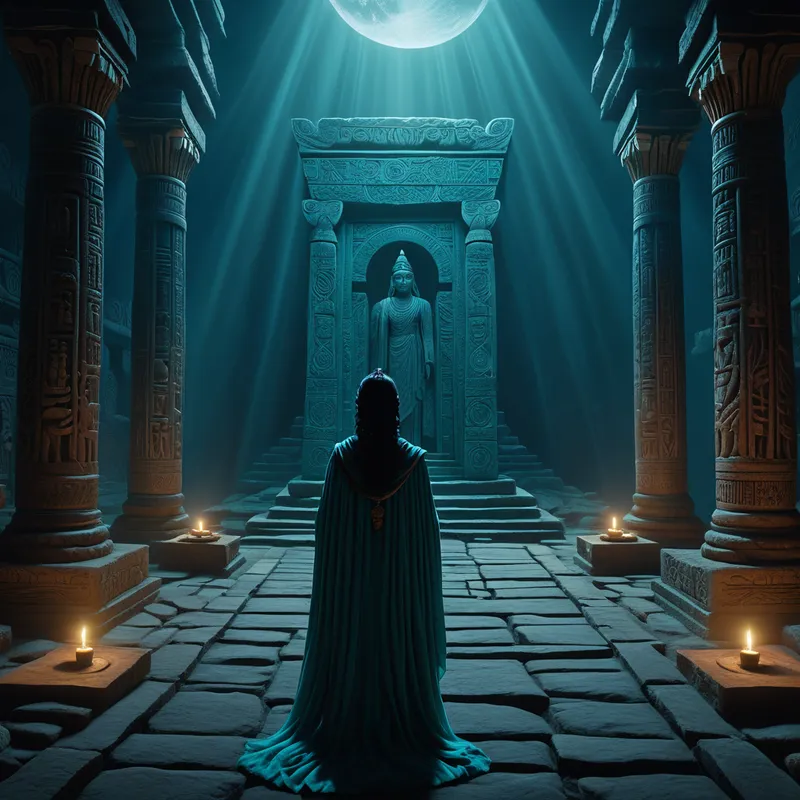
Cultural Origins & Context
The Jangseung emerges from the deep, animistic bedrock of Korean spirituality, long before the formal arrival of organized religions like Buddhism or Confucianism. Its roots are tangled with those of the Sotdae (a pole with a carved bird, often erected alongside the Jangseung) and other wooden tutelary deities, speaking to a primal Korean worldview where every mountain, stream, and grove possessed a spirit, a sin. The village was not an isolated human endeavor but a negotiated settlement within a living, spirited landscape.
This practice belongs squarely to the realm of Muism and folk belief, where the mudang acted as the intermediary who could identify spiritual threats and prescribe the proper apotropaic (evil-averting) measures. The Jangseung was such a measure—a permanent, physical shamanic act. Its function was intensely practical and communal. It served as a territorial marker, a spiritual fence post declaring “here, the village domain begins, and you malevolent forces shall not pass.” It was a focal point for collective anxiety about disease, poor harvests, and misfortune, offering a tangible entity to which these fears could be entrusted and thus neutralized.
Over centuries, the Jangseung absorbed layers of cultural influence. The stern, sometimes comical faces reflect the Korean folk aesthetic of soyang. The inscribed titles—“Great General”—hint at the hierarchical structures of later dynasties, anthropomorphizing spiritual protection with familiar, societal authority. Yet, at its core, it remained a profoundly local artifact, carved by and for a specific community, its very idiosyncrasies a testament to the unique spiritual ecology of that place.
Symbolic Architecture
The Jangseung is a masterpiece of symbolic compression. Every feature is an intentional act of psychic defense and community projection.
Its primary function is apotropaic—it turns evil away. The grotesque, exaggerated features are not meant to be beautiful to human eyes, but to be spiritually fearsome. The wide eyes see all incoming danger; the open mouth swallows or shouts down malignant influences. It is a mask of terrifying benevolence, wearing the face of the community’s collective will to survive.
The Jangseung is the village’s externalized immune system, a wooden antibody planted at the point of potential infection from the spirit world. It is the ego-boundary of the community made manifest.
The pairing into male and female generals is profoundly significant. It represents a holistic, generative protection. The male principle (Heaven, Yang) and the female principle (Earth, Yin) together create a complete circuit of defense, mirroring the ideal of balance necessary for a village’s prosperity. They are divine parents, the Caregiver archetype in its most formidable expression, whose love is not soft but fiercely defensive.
The materials matter deeply. Wood is alive, even in its carved form. It weathers, cracks, and eventually returns to the earth, mirroring the life cycle of the village itself. The Jangseung was not eternal; it was a guardian for a generation or two, after which a new one would be consecrated, linking the protective duty across time. The inscriptions often included not just titles but also blunt, shamanic commands like “Great General Under Heaven commands: All epidemic spirits, go away 100 miles!” This is the word made flesh, or rather, made wood—a spell carved into the world’s substance.

The Dreamer's Resonance
To encounter the Jangseung in the imaginal realm—in a dream or a moment of profound reflection—is to meet the archetypal Guardian at the threshold of the psyche. It stands where the ordered, known territory of the conscious self meets the wild, untamed forest of the unconscious. Its terrifying face is the face of our own healthy resistance to psychic dissolution, to the “evil spirits” of chaos, fragmentation, and overwhelming anxiety.
Psychologically, we erect Jangseungs within ourselves. These are the structures, habits, and beliefs that mark the boundary of our identity and say “this far, and no further” to intrusive thoughts, past traumas, or destabilizing emotions. A personal value, a ritual of self-care, a remembered piece of advice from an elder—these can function as inner Jangseungs. The dream image asks: What are you trying to protect? Where are your boundaries porous? Is your inner guardian robust and watchful, or weathered and neglected?
The Jangseung also embodies the paradox of the caregiver who must sometimes adopt a fearsome aspect. True protection is not always gentle; it can require a show of strength, a baring of teeth to defend the vulnerable interior. To integrate this symbol is to acknowledge that love has a defensive edge, that to care for something (a relationship, a creative project, one’s own soul) requires the capacity to say “no” and to stand firm against what would harm it.

Alchemical Translation
The alchemical process embodied by the Jangseung is coagulatio—the spirit made solid, fixed into matter. The community’s intangible fears and prayers are “coagulated” into a specific, located wooden form. This is the inverse of haunted, anxious uncertainty; it is fear named, shaped, and stationed. The guardian does not make the dangerous wilderness disappear; it creates a sacred vessel to hold the anxiety about that wilderness, thereby freeing the villagers to live within the protected space.
In psychological alchemy, the Jangseung represents the conscious erection of a temenos, a sacred precinct, within the psyche. It is the act of defining a space where the work of individuation can proceed, safe from constant invasion by unconscious contents.
Furthermore, the Jangseung performs a sacred marriage (coniunctio) at the border. The pairing of the Heavenly General and the Earthly General marries the transcendent principle of order (laws, titles, celestial authority) with the immanent principle of nourishment and grounding (the earth, the village, the body). Their union at the gateway ensures that protection is both inspired and practical, both divinely sanctioned and intimately connected to the soil of daily life. The eventual decay of the wood and its replacement is the final stage: mortificatio and renovatio—death and renewal. The protective function itself is eternal, but its forms must be periodically reborn, just as the psyche’s defenses must adapt and renew across a lifetime.
Associated Symbols
Explore related symbols from the CaleaDream lexicon:
- Guardian — The primordial archetype of protection and watchful defense, a conscious force that establishes boundaries against chaos and harm.
- Boundary — The liminal line that defines self from other, safe from wild, and order from chaos, requiring constant negotiation and protection.
- Mask — A face presented to the outer world, often possessing apotropaic power to ward off evil or to mediate between different realms of existence.
- Tree — The axis of life, stability, and connection between heaven and earth, often serving as the raw material for sacred objects and symbols of endurance.
- Door — The threshold and portal, a dynamic symbol of transition, opportunity, and the guarded passage between different states of being.
- Ritual — The prescribed, symbolic action performed to enact change, affirm community, and mediate between the human and spiritual worlds.
- Earth — The grounding, nourishing, and feminine principle, the source of materials and the realm protected by the Jangseung’s steadfast presence.
- Tradition — The living thread of knowledge, practice, and meaning passed through generations, providing a stable identity and time-tested solutions.
- Pole — A vertical axis connecting different realms, a marker of location and spiritual presence, often serving as a conduit for divine power.
- Carved Totem — An object imbued with spiritual power and identity through the transformative act of carving, making the intangible manifest in wood or stone.
- Spirit — The invisible, animating force inherent in all things, the primary actor and audience in the drama of folk belief and shamanic practice.
- Community — The collective body whose shared fears, hopes, and identity are projected onto and protected by the externalized guardian.