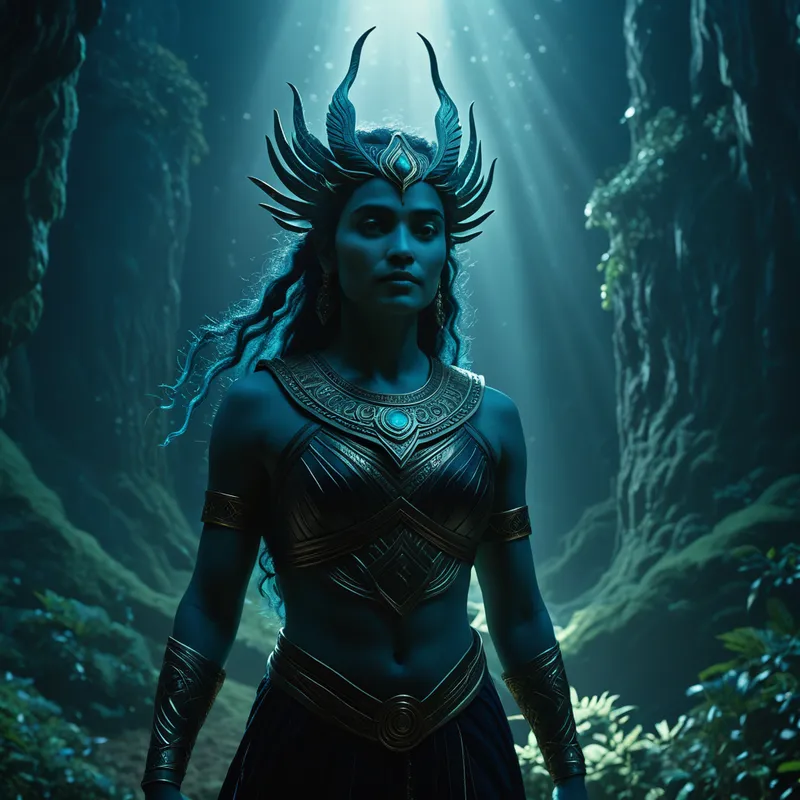
Izanagi's Purification
The Shinto creator god Izanagi purifies himself after escaping the underworld, birthing major deities like Amaterasu from his cleansing ritual.
The Tale of Izanagi's Purification
The air of the living world tasted of salt and pine, a balm after the suffocating miasma of Yomi. Izanagi-no-Mikoto stood upon the shore, his divine form still echoing with the shrieks of his forsaken wife, Izanami, and the sight of her putrefying form. He was not merely soiled; he was infected by the very essence of death, a profound pollution that threatened the order of creation itself. A great terror and a greater need seized him. He must be cleansed.
He journeyed to the river-mouth at Tachibana in Himuka, on the island of Kyushu, a place where the fresh waters of the world met the primal sea. Here, he cast off his garments, each article becoming a deity as it fell—a testament to the latent sacred power in all things, even in the discarded. But this was only the beginning. The ritual, misogi, was an act of desperate creation.
He entered the water. As he washed the defilement from his left eye, a new radiance was born. From that cleansing flowed Amaterasu-Ōmikami, the Sun Goddess, whose light filled the heavens and the earth. Her brilliance was so profound, so orderly, that Izanagi, in his joy, declared she would rule the Plain of High Heaven.
He turned to his right eye. From its purified depths emerged Tsukuyomi-no-Mikoto, the Moon God, a being of cool, reflective light and the measure of time. He was given dominion over the realms of night.
Finally, as he cleansed his nose, a force of tumultuous energy erupted. This was Susanoo-no-Mikoto, the Impetuous Male, god of storms and the sea. His power was raw, untamed, and wild, and he was set to rule the ocean plains.
But the birthing was not complete. The final, profound act of purification came as Izanagi washed his body. From the parts he cleansed, six more deities arose: from his abdomen, two; from his fundoshi (loincloth), two; from the filth he washed from his left and right legs, one each. These would become ancestral spirits, lords of the wind and the land. With this, the ritual was complete. The creator, having faced the ultimate shadow of death and decay, had performed an alchemy of the self, transforming profound pollution into the very pillars of the celestial and natural order.
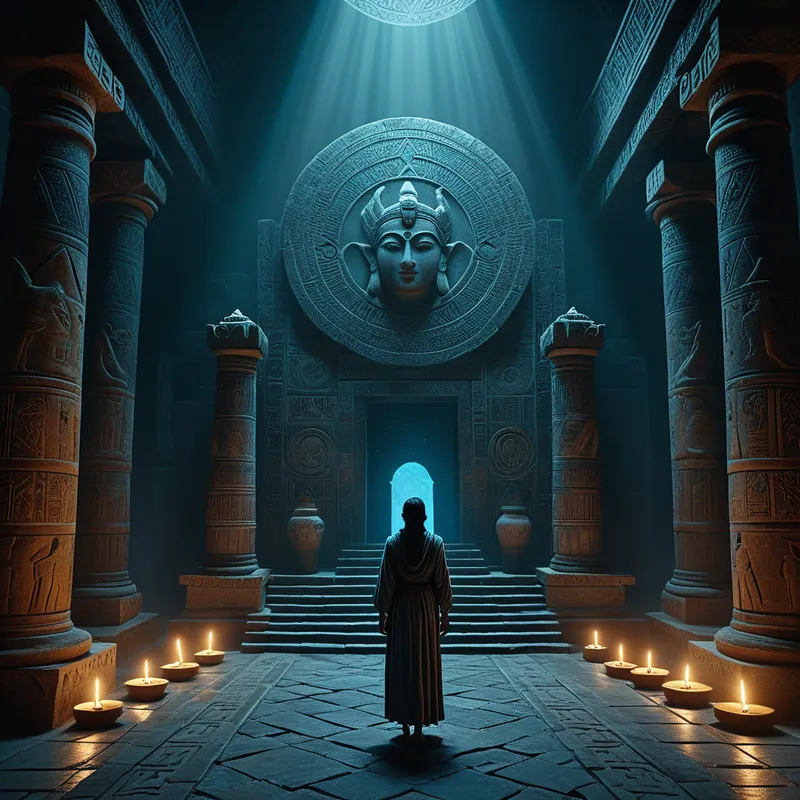
Cultural Origins & Context
The myth is recorded in Japan’s oldest chronicles, the Kojiki (712 CE) and the Nihon Shoki (720 CE). It is not a standalone story but the critical pivot in the narrative arc of the kami. Izanagi and Izanami’s union created the Japanese archipelago and many gods, but it ended in tragedy with Izanami’s death during childbirth. Izanagi’s descent to Yomi to retrieve her and his subsequent flight is a foundational story of loss, taboo, and the irrevocable separation of life and death.
The purification ritual, misogi, is the heart of Shinto practice. Kegare (impurity or pollution) is not a moral sin but a state of spiritual entropy, often associated with death, blood, and disorder. Misogi, often involving cold water ablutions under waterfalls or in rivers, is the act of restoring harae (purity) and thus harmony with the kami. Izanagi’s act is the divine prototype for this essential human practice. It establishes the principle that from the conscious, ritualized confrontation with pollution and chaos, new and potent life—even the structure of the cosmos—can emerge. The myth also solidifies the hierarchical and functional differentiation of the major kami, providing a divine mandate for the celestial order that would later be used to legitimize the imperial line, descended from Amaterasu.
Symbolic Architecture
The river-mouth is a liminal space of immense power—where fresh water (life, order) meets salt water (the primal, chaotic sea). It is the perfect threshold for a transition from death back to life, and from a singular creator into a progenitor of differentiated cosmic forces.
The act is not one of simple washing, but of parturition. The creator’s very body, scrubbed of the shadow of Yomi, becomes the womb for the universe’s governing principles. The pollution is not discarded; it is the necessary catalyst, the dark matter transformed into celestial bodies.
The order of birth is deeply significant. The left side, often associated with the impure or feminine in later ritual context, gives birth first to the supreme, pure Sun Goddess, subverting any simple dichotomy. The right yields the Moon, a complementary counterpart. Finally, the nose—the organ of breath, spirit, and instinct—releases the volatile, necessary force of Susanoo. This trinity represents the fundamental cosmic forces: the radiant, ordering principle (Amaterasu); the reflective, measuring principle (Tsukuyomi); and the dynamic, disruptive, and fertilizing principle (Susanoo). Their birth from a single act of purification shows them not as separate entities but as interrelated aspects of a restored whole.
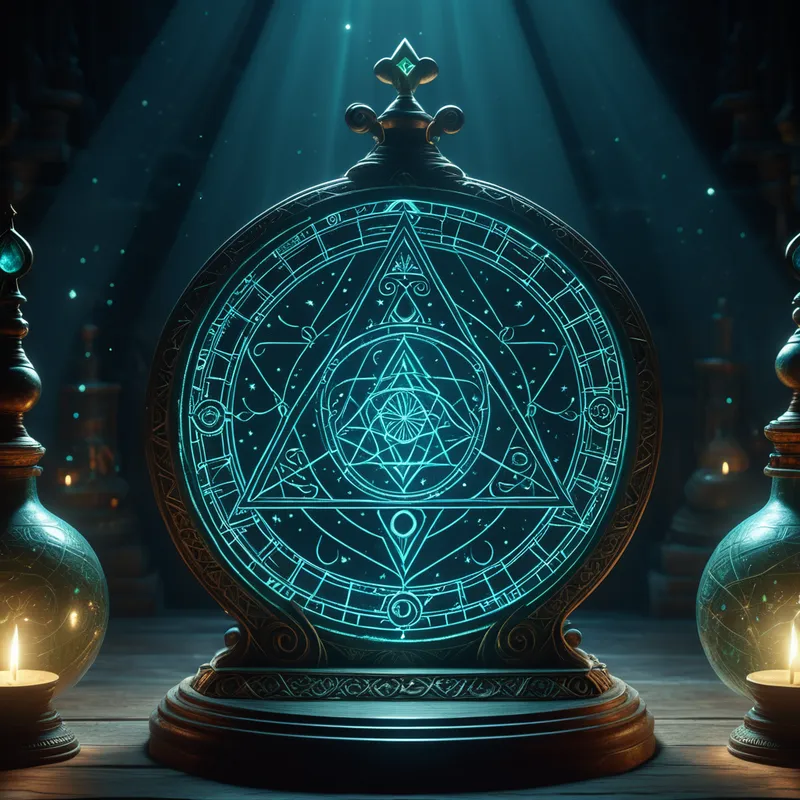
The Dreamer's Resonance
On a psychological level, Izanagi’s flight from Yomi is the ego’s traumatic escape from the unconscious depths—from a confrontation with the terrible aspect of the anima (the lost, transformed Izanami) that one is not yet strong enough to integrate. He returns not in triumph, but in a state of profound contamination, carrying the psychic residue of the underworld.
The purification ritual then becomes the essential process of sublimation. The raw, terrifying, and “polluting” psychic material gathered in the depths is not repressed, but consciously and ritually processed. The left eye, the seat of insight now clouded by death, is cleansed to birth the conscious, illuminating Self (Amaterasu). The right eye, related to external perception, gives birth to the reflective, discerning function of the psyche (Tsukuyomi). The nasal breath, the instinctual life-force, releases the powerful, often unruly energies of the libido and the creative/destructive drives (Susanoo). The dreamer does not emerge from a descent unchanged; they must engage in a rigorous, transformative practice to reconstitute their psyche at a higher order of complexity, birthing new inner authorities from the ordeal.
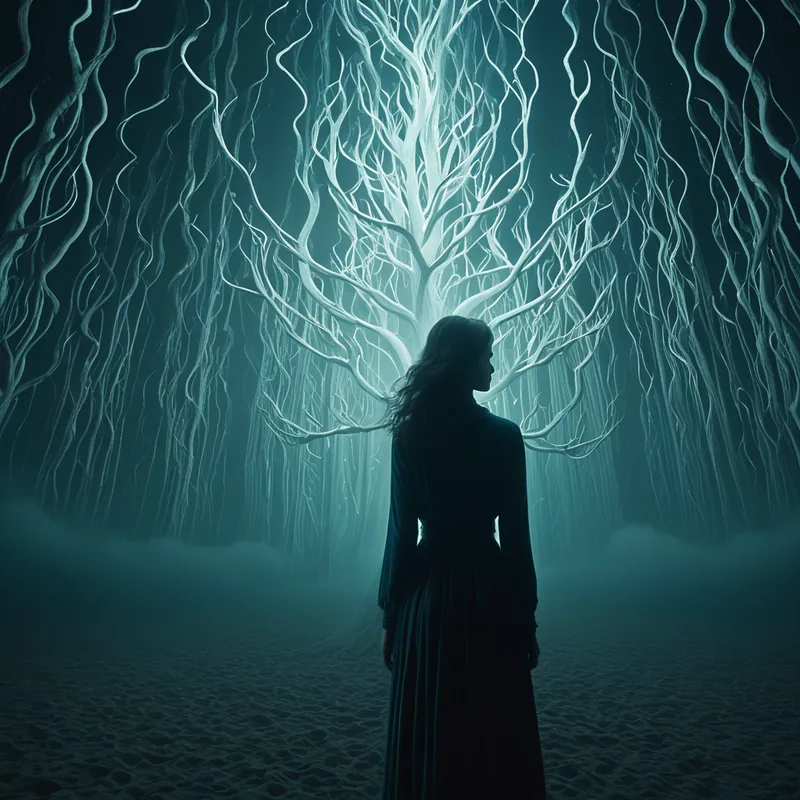
Alchemical Translation
In the alchemical opus, Izanagi’s journey is the complete cycle: the descent into the nigredo, the blackening, in the foul darkness of Yomi. His return is the beginning of the albedo, the whitening, but he is still in the state of putrefactio—carrying the rotting essence of the prima materia within him.
The river is the aqua permanens, the divine water of transformation. The act of misogi is the ablutio, the washing that separates the pure from the impure, not by rejection, but by transmutation. The creator himself is the alchemical vessel, and the heat of his ordeal is the fire that drives the process.
The three noble children are the culmination of the rubedo, the reddening, where the differentiated philosophical principles are fixed. Amaterasu is Sulphur—the active, fiery, sovereign principle. Tsukuyomi is Mercury—the fluid, mediating, spiritual principle. Susanoo is Salt—the solid, foundational, and often chaotic earthly principle. Their simultaneous birth from the purified body signifies the achievement of the lapis philosophorum, the philosopher’s stone: a fully integrated and generative consciousness, capable of projecting order (the Japanese world) and containing chaos (the sea and storms).
Associated Symbols
Explore related symbols from the CaleaDream lexicon:
- Water — The primordial medium of purification and transformation, washing away spiritual pollution to allow for rebirth and new creation.
- Sun — The radiant, ordering consciousness born from cleansing, representing sovereignty, clarity, and the illuminating principle of the cosmos.
- Moon — The reflective, measuring counterpart to the sun, born from complementary purification, governing cycles, intuition, and the unseen realms.
- River — A flowing boundary between states of being, specifically the liminal space where the pollution of death is ritually transformed into the seeds of life.
- Ritual — The prescribed, sacred action (misogi) that structures chaos, enacting a metaphysical transformation where simple washing becomes an act of cosmic parturition.
- Death — The profound pollution and shadow that acts as the necessary catalyst, the raw material from which new life and order are forged through transformative action.
- Rebirth — The core consequence of the purification, not as a return to a previous state, but as an ascent into a new order of being, populated by newly differentiated divine forces.
- Shadow — The rejected, terrifying aspect of existence (Yomi, decay) that must be encountered and integrated through ritual to achieve a complete and potent wholeness.
- Transformation Cocoon — The state of ritual immersion and cleansing, where the old, contaminated form dissolves so that a new, more complex and radiant constellation of being can emerge.
- Fires of Creation — Not literal flame, but the intense, catalyzing energy of the ordeal—the terror, the grief, and the desperate will to purify—that fuels the transmutation of defilement into deity.