Inanna's Descent to the Underworld
The Sumerian goddess Inanna journeys to the underworld, facing death and transformation in a myth about power, sacrifice, and rebirth.
The Tale of Inanna’s Descent to the Underworld
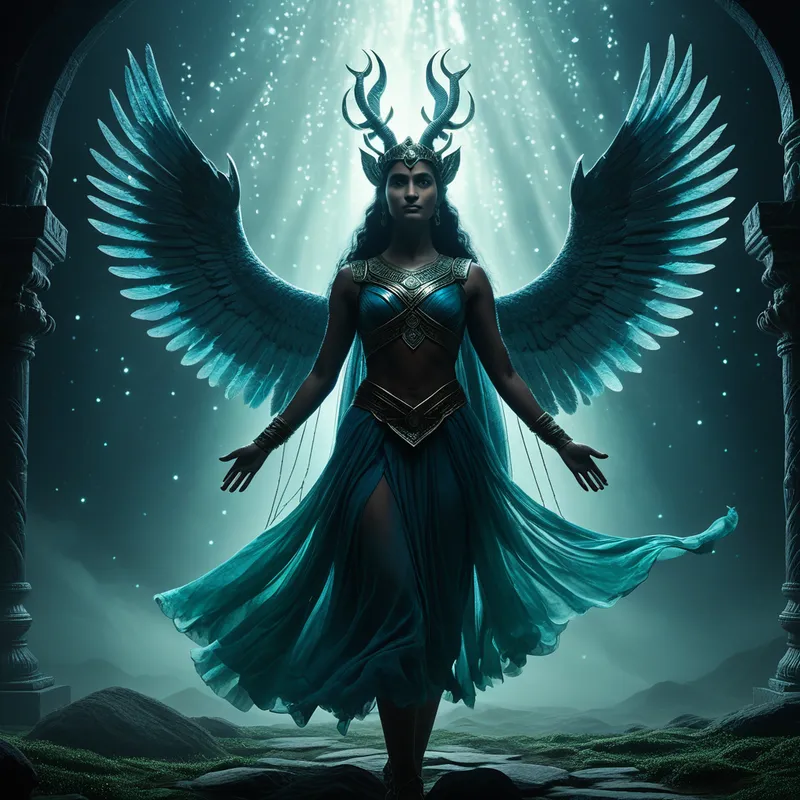
The tale begins not in darkness, but in the zenith of light. [Inanna](/myths/inanna “Myth from Sumerian culture.”/), Queen of Heaven and Earth, Lady of the Eanna, possessed all the me—the divine decrees of civilization. She held love and war, the shepherd’s crook and the throne. Yet, a profound and dangerous resolve settled in her heart. She turned her attention to the Great Below, the silent, dusty realm of her elder sister, Ereshkigal, Queen of [the Underworld](/myths/the-underworld “Myth from Greek culture.”/).
“I will descend to the [underworld](/myths/underworld “Myth from Greek culture.”/),” she declared to her faithful servant, Ninshubur. “If I do not return in three days, raise a lament. Go to the gods in their high places. Plead for my life.” She then prepared for her journey, adorning herself with the seven sacred me of her office: the shugurra crown, rod and line of lapis lazuli, a double strand of beads, the pala dress, her breastplate, a gold ring, and a lapis lazuli measuring rod. Each was a symbol of her cosmic sovereignty. Thus arrayed in the full armor of her power, she approached the first of the seven gates of the [underworld](/myths/underworld “Myth from Greek culture.”/), the Kur.
At the lapis lazuli gate, the gatekeeper, Neti, barred her way, demanding to know her purpose. “I have come to witness the funeral rites of Gugalanna, [the Bull of Heaven](/myths/the-bull-of-heaven “Myth from Babylonian culture.”/), husband to my sister Ereshkigal,” she stated, a pretext veiling a deeper, unspoken yearning. Neti, under Ereshkigal’s stern command, allowed her entry—but only at a terrible price. “You may enter,” he said, “but according to the ancient decree, you must be stripped of your regalia at each gate.”
At the first gate, her crown was removed. At the second, her rod and line. At the third, her beads. Gate by gate, the emblems of her identity were taken from her. Her dress, her breastplate, her ring, her final rod—all were surrendered. By the time she passed the seventh gate, Inanna stood naked and bowed, stripped of all titles, all protection, all the constructs of her celestial self. She entered the throne room of Ereshkigal not as a queen, but as a supplicant.
Ereshkigal, seated on her throne, saw her sister in her nakedness. The gaze of the underworld queen was the judgment. Without a word, the Annunaki, the seven judges of the underworld, fixed upon Inanna their eyes of [death](/myths/death “Myth from Tarot culture.”/). She was turned into a corpse—a piece of rotting meat—and hung upon a hook on the wall. Above, all life ceased. On earth, fertility failed. The cow did not approach the bull, the man did not approach the woman. [The world](/myths/the-world “Myth from Tarot culture.”/) above fell into a sterile stasis, mirroring the absolute stasis of the goddess in the underworld.
After three days and three nights, the loyal Ninshubur, as instructed, began her lament. She clothed herself in sackcloth and went first to [Enlil](/myths/enlil “Myth from Sumerian culture.”/) in Nippur, then to Nanna in Ur. Both gods refused, citing the immutable laws of the underworld. Finally, she went to Enki, the god of wisdom and fresh waters, in Eridu. Enki, from the silt beneath his fingernails, fashioned two asexual beings, the kurgarra and galatur. He gave them the food and [water](/myths/water “Myth from Chinese culture.”/) of life and whispered to them the strategy of empathy.
These beings descended to the underworld and found Ereshkigal in the throes of agony, crying out as a woman in childbirth. They did not confront her; they mirrored her. “You are in pain,” they groaned with her. “We are in pain.” “You are alone,” they sighed. “We are alone.” Moved by this profound, non-judgmental witness, Ereshkigal offered them a boon. They asked only for the corpse hanging on the wall. They sprinkled the food and water of life upon Inanna’s lifeless form. She stirred, she rose.
But the laws of the underworld are absolute: no one leaves without providing a substitute. Inanna ascended, flanked by a host of galla demons, pitiless enforcers of the decree. They would take someone in her place. They first approached Ninshubur, then Inanna’s sons, Shara and Lulal, all in mourning. Inanna, restored but bound by the new law of her experience, refused to let her loyal ones be taken. Finally, they arrived in Uruk, where Inanna’s husband, Dumuzi, the shepherd-king, was seated upon his throne in splendid attire, seemingly unmoved by her absence. A cold fury seized Inanna. “Take him,” she said.
Thus, Dumuzi was seized. Through the later intercession of his compassionate sister, Geshtinanna, a compromise was struck: Dumuzi would spend half the year in the underworld, and Geshtinanna the other half, allowing the shepherd-king to return to the land of the living for a time, in a cycle that mirrors the seasons of growth and decay.
Cultural Origins & Context
The myth of Inanna’s Descent is preserved on clay tablets from the early second millennium BCE, part of the rich literary tradition of Sumer. It exists not as a singular, canonical text but in several versions, the most complete being a Babylonian adaptation in the Descent of [Ishtar](/myths/ishtar “Myth from Babylonian culture.”/). Inanna (later equated with Ishtar, Astarte, and [Aphrodite](/myths/aphrodite “Myth from Global/Universal culture.”/)) was the central deity of Uruk, a city whose political and religious identity was intertwined with her cult. Her domains were vast and paradoxical: love and fertility, but also war and political power.
The underworld, ruled by Ereshkigal, was not a place of moral punishment but a dusty, dark reflection of the world above, where all souls, high and low, ate clay and drank dust. It was the ultimate equalizer. The myth likely functioned on multiple levels: as a sacred narrative explaining the seasonal cycle (the annual death and return of Dumuzi/[Tammuz](/myths/tammuz “Myth from Mesopotamian culture.”/)), as a ritual text for lamentation priests, and as a profound theological exploration of divine sovereignty. Inanna’s journey challenged the very boundaries of the cosmos, probing the relationship between the powers of life and the powers of death, and establishing a costly, intimate connection between them.
Symbolic Architecture
The myth is a masterwork of symbolic [architecture](/symbols/architecture “Symbol: Architecture in dreams often signifies structure, stability, and the framing of personal identity or life’s journey.”/). The seven gates are the seven layers of [consciousness](/symbols/consciousness “Symbol: Consciousness represents the state of awareness and perception, encompassing thoughts, feelings, and experiences.”/) or [identity](/symbols/identity “Symbol: Identity represents the sense of self, encompassing personal beliefs, cultural background, and social roles.”/) that must be shed to encounter the raw, unadorned self. Each [piece](/symbols/piece “Symbol: A ‘piece’ in dreams often symbolizes a fragment of the self or a situation that requires integration, reflection, or understanding.”/) of regalia represents a facet of the [persona](/symbols/persona “Symbol: The social mask or outward identity one presents to the world, often concealing the true self.”/)—social [role](/symbols/role “Symbol: The concept of ‘role’ in dreams often reflects one’s identity or how individuals perceive their place within various social structures.”/), [authority](/symbols/authority “Symbol: A symbol representing power structures, rules, and control, often reflecting one’s relationship with societal or personal governance.”/), [beauty](/symbols/beauty “Symbol: This symbol embodies aesthetics, harmony, and the appreciation of life’s finer qualities.”/), protection. Their removal is not a defeat but a necessary deconstruction.
The stripping of Inanna is the ultimate act of vulnerability, the precondition for any true transformation. One cannot enter the realm of the absolute with the armor of the relative.
Ereshkigal represents the repressed, terrible, and ultimately creative [aspect](/symbols/aspect “Symbol: A distinct feature, quality, or perspective of something, often representing a partial view of a larger whole.”/) of the Great [Goddess](/symbols/goddess “Symbol: The goddess symbolizes feminine power, divinity, and the nurturing aspects of life, embodying creation and wisdom.”/)—the [womb](/symbols/womb “Symbol: A symbol of origin, potential, and profound transformation, representing the beginning of life’s journey and the unconscious source of creation.”/) that is also a tomb. She is not evil; she is the [reality](/symbols/reality “Symbol: Reality signifies the state of existence and perception, often reflecting one’s understanding of truth and life experiences.”/) of [loss](/symbols/loss “Symbol: Loss often symbolizes change, grief, and transformation in dreams, representing the emotional or psychological detachment from something or someone significant.”/), [grief](/symbols/grief “Symbol: A profound emotional response to loss, often manifesting as deep sorrow, yearning, and a sense of emptiness.”/), and the unconscious ground from which all [life](/symbols/life “Symbol: The symbol of ‘Life’ represents a journey of growth, interconnectedness, and existential meaning, encompassing both the joys and challenges that define human experience.”/) springs and to which it returns. Inanna’s confrontation with her is a confrontation with the totality of the feminine divine, including its destructive, isolating [aspect](/symbols/aspect “Symbol: A distinct feature, quality, or perspective of something, often representing a partial view of a larger whole.”/).
The kurgarra and galatur, born from Enki’s wisdom (the [silt](/symbols/silt “Symbol: Fine sediment deposited by water, representing accumulation, hidden foundations, and the fertile residue of time’s passage.”/) of the [abyss](/symbols/abyss “Symbol: A profound void representing the unconscious, the unknown, or a spiritual threshold between existence and non-existence.”/)), embody the salvific power of compassionate witnessing. Their [strategy](/symbols/strategy “Symbol: A plan of action designed to achieve a long-term or overall aim, often involving competition, resource management, and foresight.”/) is not heroic force but empathic [resonance](/symbols/resonance “Symbol: A deep, sympathetic vibration or connection, often in sound or feeling, that amplifies and harmonizes across systems.”/). They heal Ereshkigal’s [isolation](/symbols/isolation “Symbol: A state of physical or emotional separation from others, often representing a need for introspection or signaling distress.”/) by sharing it, thereby gaining the power to revive Inanna. This suggests that the deepest wounds—and the deepest powers—are accessed not through conquest, but through shared suffering.
The Dreamer’s Resonance
For the modern [psyche](/myths/psyche “Myth from Greek culture.”/), Inanna’s descent is the archetypal map of a profound psychological crisis—a [dark night of the soul](/myths/dark-night-of-the-soul “Myth from Christian culture.”/). It is the experience of being called away from a life of achieved power and meaning into a depth where all that identity is rendered null. The dreamer may experience this as depression, catastrophic loss, illness, or a spiritual void. The feeling is of being stripped, hooked, and lifeless.
The myth assures us that this journey, though terrifying, is not meaningless annihilation. It is a descent to meet the exiled sister, the Ereshkigal complex within—the accumulated rage, grief, and primal power we have disowned. The return is never to the old self. Inanna returns, but she returns with the knowledge of the underworld and its unyielding laws. She returns with a shadow, represented by the galla demons. Integration is not about becoming “whole” in a sunny sense; it is about carrying the truth of [the abyss](/myths/the-abyss “Myth from Kabbalistic culture.”/) within you, and making the hard, often painful choices (the sacrifice of the Dumuzi within—the naive, entitled, pastoral aspect of [the self](/myths/the-self “Myth from Jungian culture.”/)) that such knowledge demands.

Alchemical Translation
In the alchemical vessel of the soul, Inanna’s descent is the [nigredo](/myths/nigredo “Myth from Alchemical culture.”/)—the blackening, the putrefaction. The shining, celestial queen (the raw material) must submit to total dissolution in the dark waters of the unconscious. The seven gates are the stages of this dissolution, the systematic breakdown of [the ego](/myths/the-ego “Myth from Jungian culture.”/)’s compounds.
The corpse on the hook is the prima materia at its most base state, the essential self stripped of all illusion. From this state of utter mortification, the new consciousness can be born.
Enki’s intervention represents the guiding spark of intellect or spirit (mens) that initiates the [albedo](/myths/albedo “Myth from Alchemical culture.”/), the whitening. The food and water of life are the elixirs of transformation. But the process is not complete with revival. The [rubedo](/myths/rubedo “Myth from Alchemical culture.”/), the reddening or final integration, is the return with the demons—the acceptance of the dark, binding consequences of one’s journey. The cyclical sacrifice of Dumuzi is the final formula: life now operates in a conscious rhythm between the upper and lower worlds, between engagement and withdrawal, power and surrender. The psyche no longer seeks permanent light but learns to rule the inevitable descent.
Associated Symbols
Explore related symbols from the CaleaDream lexicon:
- Underworld — The realm of the dead and the deep unconscious, a place of stripping, judgment, and essential truth where all superficial identities are dissolved.
- Door — The seven gates of the underworld, each a threshold requiring surrender and passage from one state of being to a deeper, more vulnerable one.
- Crown — The shugurra crown of sovereignty, representing the empowered [persona](/myths/persona “Myth from Greek culture.”/) and social identity that must be relinquished to enter a transformative space.
- Corpse — The state of absolute mortification and stasis, the necessary death of the old self that precedes any possibility of authentic rebirth.
- Mirror — Ereshkigal acts as the ultimate mirror, reflecting back to Inanna not her glorious image, but the naked, powerless truth of her being when all adornments are gone.
- Rebirth — The revival by the food and water of life, symbolizing the emergence of a new consciousness forged in the depths of a profound ordeal.
- Sacrifice — The inexorable law of the underworld demands a substitute; the sacrifice of Dumuzi represents the painful but necessary surrender of an innocent or entitled aspect of the self to maintain the new, hard-won equilibrium.
- Journey — The entire myth is the archetypal journey of descent, ordeal, and return, a map for the most profound and perilous of psychological voyages.
- Shadow — The galla demons that accompany Inanna upon her return, representing the integrated, inescapable knowledge of darkness and death that now accompanies the resurrected self.
- Cycle — The fate of Dumuzi, spending half the year above and half below, embodying the eternal, necessary rhythm between life and death, engagement and withdrawal, that defines an integrated existence.