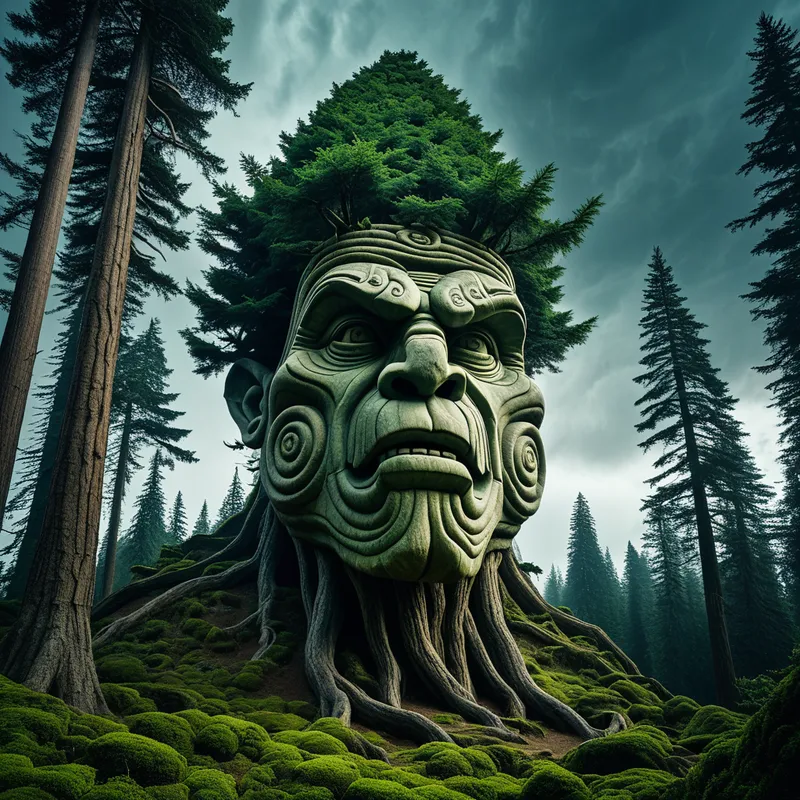
Humbaba Myth Meaning & Symbolism
The epic tale of Gilgamesh and Enkidu journeying to slay Humbaba, the monstrous guardian of the Cedar Forest, challenging the boundaries between order and wildness.
The Tale of Humbaba
Listen. The world was young, and the sun-god Shamash cast his harsh, revealing light upon the twin rivers. In the great city of Uruk, its walls built by the king’s own hands, there lived a man who was two-thirds god and one-third mortal: Gilgamesh. His strength was a storm, his will a flood, and his restless heart left his people weary. The gods, hearing their lament, fashioned from clay a counterweight, a wild man named Enkidu, whose body was shaggy with the hair of the beasts and whose spirit knew only the freedom of the steppe.
But destiny drew them together, first as rivals, then as brothers bound by a bond stronger than blood. Their shared strength, with no worthy foe to test it, became a prison of boredom. Gilgamesh’s gaze turned east, toward the rising sun, where a rumor grew like a dark tree. Beyond the seven mountain ranges, guarded by a terror that choked the breath from travelers’ lungs, stood the Cedar Forest. Its trees touched the belly of heaven, their wood fragrant and precious, and at its heart dwelt its appointed guardian.
His name was Humbaba. His roar was the flood-weapon, his breath was death, and his face was a horror woven from the coils of entrails. He was the terror of the lands, the warder set by the god Enlil himself to keep the sacred grove inviolate from the ambitions of men. To slay Humbaba and claim the cedars would be to etch their names into eternity.
The elders of Uruk pleaded, their voices like dry reeds. Enkidu, who knew the whisper of the wild, felt a cold dread. But Gilgamesh, shining with the borrowed courage of Shamash, would not be swayed. The journey was an ordeal of thirst, dust, and fear. Each night, Gilgamesh was visited by portentous dreams—of mountains falling, of bulls and thunderbirds—which Enkidu, his brother, spun into promises of victory.
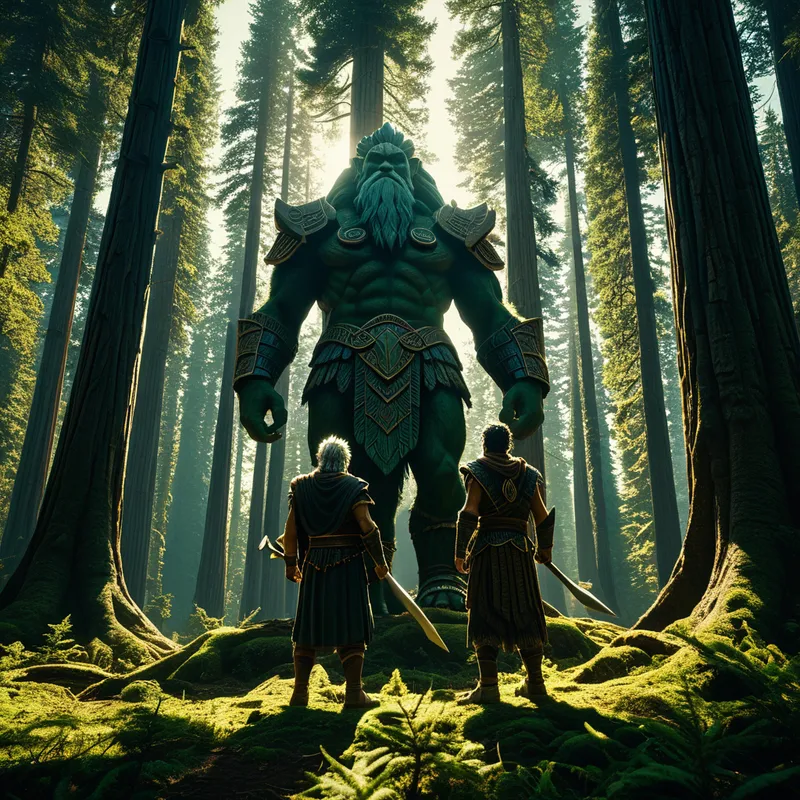
They reached the forest’s edge. The air grew cold and still, thick with the scent of resin and ancient earth. The cedars stood like pillars in a divine temple, their canopy shutting out the sun. And then, they felt him. Not a sound at first, but a pressure, a watchfulness that made the skin crawl. The very leaves seemed to hold their breath.
Humbaba emerged not with a charge, but with a presence that filled the space between the trees. His form was monstrous, his visage a labyrinth of living flesh. His voice, when it came, was not a mere roar but the sound of the earth cracking open. “Who has come?” it boomed. The heroes’ hearts hammered against their ribs. Shamash, hearing Gilgamesh’s prayer, sent eight great winds to bind the monster, blinding him and pinning him down.
As Humbaba lay immobilized, a strange shift occurred. The monster’s terrible voice softened into a plea. He offered Gilgamesh the trees as tribute, called him “master,” and begged for his life. For a moment, the forest was silent, holding the possibility of mercy. But Enkidu, fierce and pragmatic, warned his friend. “Kill him before the gods change their minds! If you do not, he will never forget your face!”
And so, with a final, desperate cry from Humbaba that cursed them both, Gilgamesh struck. The axe fell. The guardian’s head was severed. The sacred silence of the forest was shattered forever. They felled the tallest cedar, made a great gate for Uruk, and returned as conquerors. But as they floated the mighty log down the Euphrates, the blood on their hands was not just Humbaba’s; it was the stain of a sacred boundary crossed, and the gods were watching.
Cultural Origins & Context
This story forms a pivotal tablet within the Epic of Gilgamesh, a composition that evolved over a millennium, from Sumerian poems to the standardized Akkadian version found in the library of Ashurbanipal. It was not mere entertainment but a foundational text, recited by scribes and perhaps performed in ritual contexts. The epic served as a mirror for Mesopotamian civilization, exploring the tensions inherent in its world: the city versus the wilderness, human ambition versus divine law, and the search for meaning in the face of mortality.
Humbaba’s tale functioned as a profound cautionary myth. The Cedar Forest likely represented the untapped, dangerous resources of the eastern mountains (modern Lebanon), regions Mesopotamians traded with but also feared. Humbaba was not a mindless beast; he was an appointed, divine guardian. His defeat was not a simple triumph of good over evil, but a complex, morally ambiguous act of hubris. The story asked its audience: What is the cost of civilization’s advance? What sacred things must be violated to build our gates and temples? The audience, living in cities carved from that very wilderness, would have felt the resonance deeply—a pride in human achievement shadowed by a primal unease.
Symbolic Architecture
Psychologically, Humbaba is far more than a monster to be slain. He represents the ultimate Shadow—not a personal shadow, but a collective, primordial one. He is the embodied numen of the untouched wild, the psychic equivalent of all that is chaotic, untamed, and terrifyingly other beyond the ordered walls of the conscious ego (Uruk).
To confront Humbaba is to stand at the threshold of the unconscious itself, where the raw, unmediated forces of nature and psyche reside.
Gilgamesh and Enkidu represent a necessary duality in confronting this depth. Gilgamesh is the heroic ego, driven by a desire for glory and immortality (symbolized by the eternal cedar). Enkidu is the embodied instinct, the connection to the natural world who nonetheless advocates for the ruthless action of civilization. Their journey is the ego’s fateful decision to engage with the depths, armed with the “winds” of insight (Shamash’s aid) but also with brute force.
Humbaba’s grotesque face, described as coiled intestines, is a masterful symbol. It is the image of life’s messy, visceral, internal processes turned inside out. He is not ugliness for its own sake, but the unveiled truth of organic reality, hidden from polite view. His plea for mercy at the end transforms him from a mere antagonist into a tragic figure, revealing that the shadow, when engaged, often contains a wisdom or a potential for relationship that the conquering hero is too rigid to accept.

The Dreamer's Resonance
When the pattern of the Humbaba myth stirs in modern dreams, it signals a profound engagement with the personal and collective shadow. The dreamer may not see a monster with entrails for a face, but they will feel its equivalent: an overwhelming, terrifying presence associated with a forgotten place, a repressed memory, a wild emotion, or a daunting life challenge that feels “monstrous.”
The somatic experience is key: the chilling dread, the paralysis before a looming threat, the feeling of being watched by the landscape itself. This is the psyche’s signal that a major content of the unconscious is rising to the threshold of awareness. The “Cedar Forest” might appear as a dense, dark wood in the dream, a labyrinthine basement, or an immense, complex problem. The dreamer, as Gilgamesh, is being called to a journey they may not feel ready for.
The critical moment in such dreamwork is Humbaba’s plea. In the dream, this may manifest as the monster showing vulnerability, offering a gift, or speaking a surprising truth. The dream-ego’s response—whether it annihilates the presence out of fear or pauses to listen—determines the next stage of psychological development. To slay it reflexively may bring a temporary sense of victory but at the cost of deeper integration. To freeze in terror is to remain stuck. The myth, and the dream, point to the immense difficulty of holding that tension.
Alchemical Translation
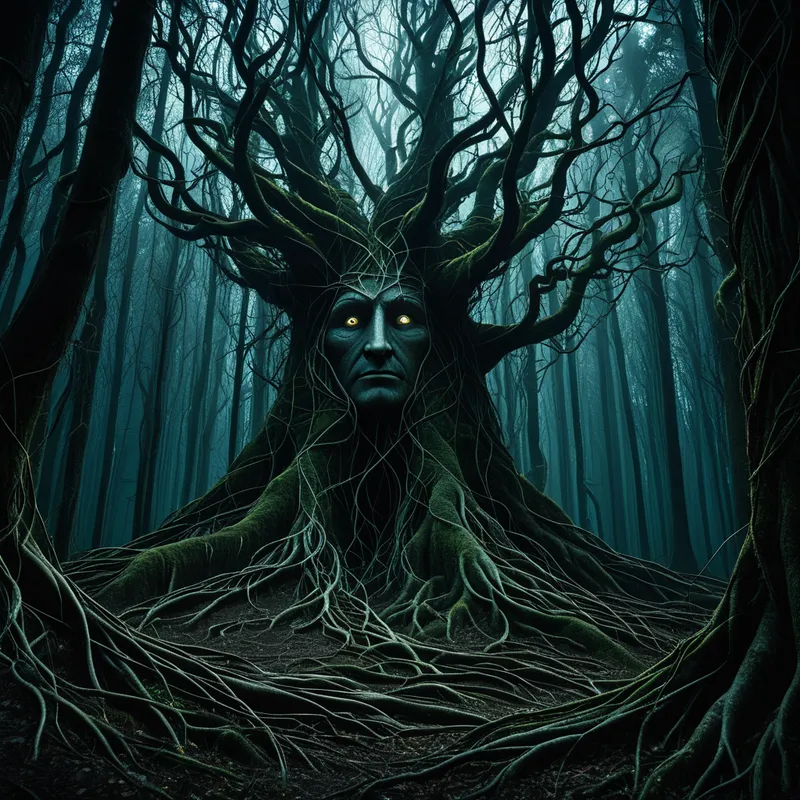
The alchemical process mirrored here is the nigredo—the blackening, the confrontation with the primal, chaotic materia prima. Gilgamesh’s quest for glory is the ego’s initial, often inflated, motivation for delving into the unconscious. The arduous journey represents the necessary dissolution of old attitudes. Reaching the forest and facing the guardian is the ultimate confrontation with the shadow.
The slaying of Humbaba is not the goal of individuation, but a violent, perhaps necessary, stage in it—the forced extraction of a precious resource (self-knowledge, creative power) from its natural, guarded state.
For the modern individual, this translates to those moments when we must confront a deeply ingrained pattern, a trauma, or a fundamental fear. We “slay” it by bringing it into conscious light, naming it, and, in a sense, breaking its autonomous power over us. We claim the “cedar”—the strength, the insight, the resource that was locked within that shadowy complex.
But the alchemy is incomplete. The epic continues with dire consequences: the gods demand retribution, and Enkidu must die. Psychologically, this signifies that a purely conquering, heroic attitude toward the unconscious is unsustainable. It creates a backlash. True alchemical transmutation requires not just victory, but later, a mourning (Gilgamesh’s grief for Enkidu) and a further, more humble journey (his search for Utnapishtim). The Humbaba episode is the brutal, foundational operation. It clears the ground, at great cost, for the possibility of a more nuanced relationship with the self—one that moves beyond the simple dichotomy of conqueror and conquered, toward an awareness of the sacredness of what was violated and the price of consciousness itself.
Associated Symbols
Explore related symbols from the CaleaDream lexicon: