Huitzilopochtli Defeats the Four Hundred Stars
The Aztec sun god Huitzilopochtli battles and defeats the Four Hundred Stars in a myth explaining cosmic order and divine supremacy.
The Tale of Huitzilopochtli Defeats the Four Hundred Stars
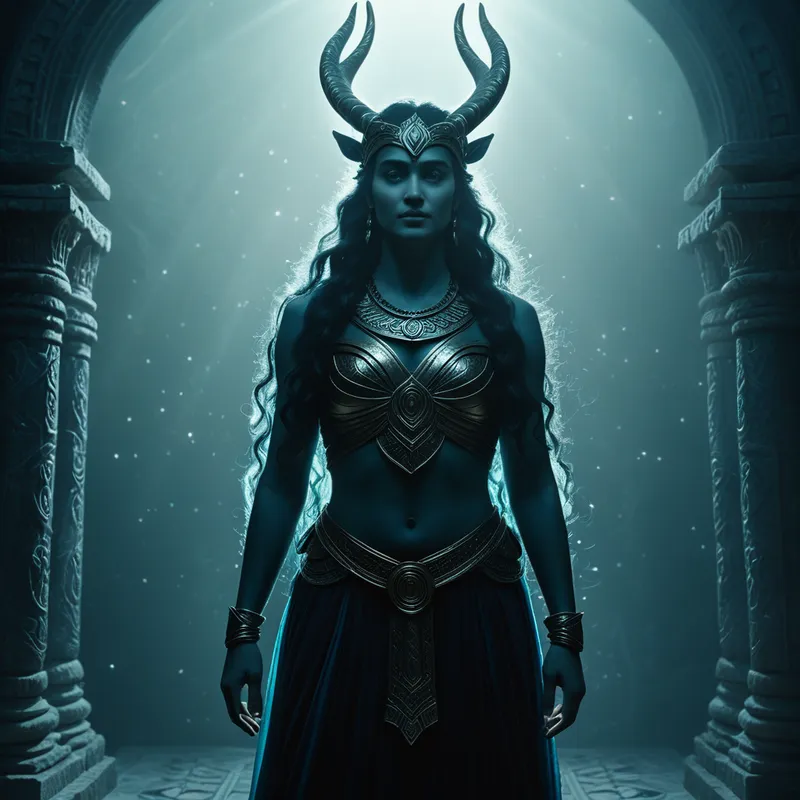
In the time before [the Fifth Sun](/myths/the-fifth-sun “Myth from Aztec culture.”/), when [the world](/myths/the-world “Myth from Tarot culture.”/) was a canvas of primordial potential, there existed a sacred mountain named Coatepec. Upon this mountain lived the goddess Coatlicue, the Serpent Skirt, a being of earth and fertility. One day, as she swept [the temple](/myths/the-temple “Myth from Jewish culture.”/) summit, a ball of exquisite hummingbird feathers descended from the heavens and settled upon her. She tucked it into her bosom, and from this divine impregnation, a new god began to quicken within her womb. This was [Huitzilopochtli](/myths/huitzilopochtli “Myth from Aztec culture.”/), the Hummingbird of the South, the fierce and brilliant sun-to-be.
Yet this miraculous conception ignited a storm of fury and shame. Coatlicue’s other children, the Four Hundred Stars, and their sister, the mighty moon goddess Coyolxauhqui, saw their mother’s state as a profound dishonor. In their gleaming, celestial rage, they resolved to march upon Coatepec and slay Coatlicue, to cleanse their lineage of this perceived stain. Led by Coyolxauhqui, a warrior of terrible beauty, they armed themselves and began their ascent, a host of glittering wrath moving up the sacred slopes. Their intent was murder; their rallying cry, the restoration of a fallen order.
Within the mountain, the unborn Huitzilopochtli heard the clamor of their approach. From the dark warmth of [the womb](/myths/the-womb “Myth from Various culture.”/), he spoke to his mother, his voice a resonant promise in the deep. “Do not fear. I know what I must do.” As the stellar army closed in, their spears glinting like cold fire, the moment of crisis became the moment of birth. In a cataclysmic eruption of light and force, Huitzilopochtli sprang forth from Coatlicue fully armed and radiant, his face painted for war, his left leg feathered, and in his hand, the terrible [Xiuhcoatl](/myths/xiuhcoatl “Myth from Aztec culture.”/), the Turquoise Serpent.
The cosmic battle was not a prolonged campaign but a swift and definitive act of solar will. Huitzilopochtli first turned his fury upon his sister, Coyolxauhqui. With a single, devastating blow from the Xiuhcoatl, he struck her down, beheading her. Her body tumbled down the slopes of Coatepec, breaking apart as it fell, a lesson written in stone and sky. He then hurled the Xiuhcoatl into the midst of the Four Hundred Stars. The weapon, a beam of concentrated solar fire, whirled among them, a scythe of dawn cutting through the night. The stars, the Centzon Huitznahua, were scattered and defeated, their collective light broken and subdued.
From [the summit](/myths/the-summit “Myth from Taoist culture.”/), Huitzilopochtli took Coyolxauhqui’s severed head and cast it into [the sky](/myths/the-sky “Myth from Persian culture.”/), where it became [the moon](/myths/the-moon “Myth from Tarot culture.”/), a cold, dismembered reminder of his supremacy. The defeated Four Hundred Stars were driven into the southern sky, where they remain, outshone and ordered by the sun’s daily journey. In this victory, the new order was born: the sun, born of earth and heaven, now reigned supreme, and the daily cycle of his [triumph](/myths/triumph “Myth from Roman culture.”/) over the forces of night was eternally established.
Cultural Origins & Context
This myth is central to the Aztec, or Mexica, worldview, recorded primarily in post-Conquest texts like the Florentine Codex compiled by Bernardino de Sahagún. It is not merely a story of familial conflict but the foundational narrative justifying the Mexica’s identity, imperial destiny, and most critically, their state religion’s core practice: ritual warfare and sacrifice.
Huitzilopochtli was not just a sun god; he was the divine patron of the Mexica, a tribal deity who guided them on their long migration from Aztlan to the Valley of Mexico. His victory at Coatepec served as the divine prototype for the Mexica’s own martial ideology. Just as Huitzilopochtli required the vital energy (tonalli) of battle to be born and triumph, so too did the sun require the tonalli found in human blood—the “precious [water](/myths/water “Myth from Chinese culture.”/)” (chalchiuhatl)—to win his daily battle against the forces of darkness (the stars and moon) and continue his journey across the sky. The myth directly linked the state’s military expansion (capturing warriors for sacrifice) to the cosmic sustenance of the universe. The Templo Mayor at Tenochtitlan was a physical representation of Coatepec, with Coyolxauhqui’s massive dismembered stone disk lying at its base, and Huitzilopochtli’s shrine at the summit.
Symbolic Architecture
The [architecture](/symbols/architecture “Symbol: Architecture in dreams often signifies structure, stability, and the framing of personal identity or life’s journey.”/) of this myth is a profound map of psychic and cosmic processes. Coatepec is the [axis](/symbols/axis “Symbol: A central line or principle around which things revolve, representing stability, orientation, and the fundamental structure of reality or consciousness.”/) mundi, the point where [heaven](/symbols/heaven “Symbol: A symbolic journey toward ultimate fulfillment, spiritual transcendence, or connection with the divine, often representing life’s highest aspirations.”/), [earth](/symbols/earth “Symbol: The symbol of Earth often represents grounding, stability, and the physical realm, embodying a connection to nature and the innate support it provides.”/), and the [underworld](/symbols/underworld “Symbol: A symbolic journey into the unconscious, representing exploration of hidden aspects of self, transformation, or confronting repressed material.”/) meet, and where transformation becomes possible. Coatlicue represents the creative, all-containing [earth](/symbols/earth “Symbol: The symbol of Earth often represents grounding, stability, and the physical realm, embodying a connection to nature and the innate support it provides.”/), the materia prima that holds the potential for the luminous [consciousness](/symbols/consciousness “Symbol: Consciousness represents the state of awareness and perception, encompassing thoughts, feelings, and experiences.”/) (Huitzilopochtli) within her.
The conflict is not between good and evil, but between an emerging, integrative consciousness and the established, fragmentary order of the psyche. The Four Hundred Stars and Coyolxauhqui represent the legion of autonomous complexes—old identities, judgments, and familial loyalties—that rise up to annihilate a nascent, transformative Self before it can be born.
Coyolxauhqui’s [fate](/symbols/fate “Symbol: Fate represents the belief in predetermined outcomes, suggesting that some aspects of life are beyond human control.”/) is particularly potent. Her dismemberment is not mere brutality but a symbolic act of cosmic ordering. The scattering of her [body](/symbols/body “Symbol: The body in dreams often symbolizes the dreamer’s self-identity, personal health, and the relationship they have with their physical existence.”/) parts mirrors the [fragmentation](/symbols/fragmentation “Symbol: The experience of breaking apart, losing cohesion, or being separated into pieces. Often represents disintegration of self, relationships, or reality.”/) of the [moon](/symbols/moon “Symbol: The Moon symbolizes intuition, emotional depth, and the cyclical nature of life, often reflecting the inner self and subconscious desires.”/)’s light and the [dispersal](/symbols/dispersal “Symbol: The act of scattering, spreading, or breaking apart. Often represents release, transition, or loss of cohesion.”/) of the stars. It is the necessary deconstruction of a powerful but [static](/symbols/static “Symbol: Static represents interference, disruption, and the breakdown of clear communication or signal, often evoking feelings of frustration and disconnection.”/) archetypal [pattern](/symbols/pattern “Symbol: A ‘Pattern’ in dreams often signifies the underlying structure of experiences and thoughts, representing both order and the repetitiveness of life’s situations.”/) (the old, ruling complex) to make way for a new, centralizing principle. Her [ascent](/symbols/ascent “Symbol: Symbolizes upward movement, progress, spiritual elevation, or striving toward higher goals, often representing personal growth or transcendence.”/) to become the [moon](/symbols/moon “Symbol: The Moon symbolizes intuition, emotional depth, and the cyclical nature of life, often reflecting the inner self and subconscious desires.”/) transforms her from a defeated [enemy](/symbols/enemy “Symbol: An enemy in dreams often symbolizes an internal conflict, self-doubt, or an aspect of oneself that one struggles to accept.”/) into a necessary counterpart, eternally subordinate but eternally present, defining the [rhythm](/symbols/rhythm “Symbol: A fundamental pattern of movement or sound in time, representing life’s cycles, emotional flow, and universal order.”/) of the new order.
The Dreamer’s Resonance
For the individual [psyche](/myths/psyche “Myth from Greek culture.”/), this myth resonates with the traumatic yet necessary process of psychological birth and differentiation. It speaks to the moment a new, centralizing awareness or vocation (the Huitzilopochtli-self) emerges from the unconscious (Coatlicue). This emergence is invariably met with fierce internal resistance—the “four hundred” voices of self-doubt, shame, internalized familial expectations, and old, rigid identities (the stars). The sister, Coyolxauhqui, often personifies a particularly powerful anima figure or a dominant, critical aspect of the psyche that feels betrayed by this new development.
The dreamer may experience this as a period of intense inner conflict, where old patterns rally to “kill” the nascent feeling or insight before it can take hold. The myth suggests that the birth of true consciousness is an act of spiritual warfare. It requires one to “arm” oneself with the Xiuhcoatl—the focused, purifying fire of discernment and will—to confront and scatter these fragmentary forces. Victory does not mean their annihilation, but their subordination and integration into a new psychic hierarchy, where they become the background “stars” over which the conscious Self now rules.

Alchemical Translation
In alchemical terms, the myth describes the opus of separation and coagulation on a cosmic scale. Coatlicue is the [nigredo](/myths/nigredo “Myth from Alchemical culture.”/), the dark, fertile [prima materia](/myths/prima-materia “Myth from Alchemical culture.”/) pregnant with potential. The descent of the hummingbird feathers is the infusion of [the divine spark](/myths/the-divine-spark “Myth from Gnostic culture.”/), the [anima mundi](/myths/anima-mundi “Myth from Greek culture.”/). The rebellion of the stars is the necessary [separatio](/myths/separatio “Myth from Alchemical culture.”/), the violent division of the homogeneous mass into conflicting principles.
The battle is the rubedo, the reddening, a phase of fierce confrontation and fire. Huitzilopochtli’s Xiuhcoatl is the alchemical sword that performs the decisive separation, dividing the fixed (the old stellar order) from the volatile (the new solar spirit). The scattering of the stars is the multiplicatio, the proliferation of the work’s effects throughout the cosmos.
The final state is the [coagulatio](/myths/coagulatio “Myth from Alchemical culture.”/): the establishment of a new, stable, and radiant order. The sun rules the day, the moon the night, and the stars are fixed in their places. The once-chaotic potential of the prima materia has been successfully “cooked” in the furnace of conflict into a structured, living cosmos—the philosopher’s stone on a universal scale, which is the perfectly ordered and sustained world of the Fifth Sun.
Associated Symbols
Explore related symbols from the CaleaDream lexicon:
- Sun — The radiant, centralizing principle of consciousness and life, born from conflict and sustained through sacrifice, ruling over the fragmented multiplicity of the psyche.
- Stars — The multitude of autonomous complexes, ancestral voices, and fragmentary potentials within the unconscious, which must be ordered and subdued by a centralizing solar will.
- Mountain — [The axis mundi](/myths/the-axis-mundi “Myth from Chinese culture.”/) or world pillar, the sacred site of transformation where heaven and earth meet, and where divine battles for cosmic order are fought.
- Serpent — The dual-natured force of destruction and renewal; as the Xiuhcoatl, it is the weapon of solar fire that purges and scatters the old order.
- Blood — The vital, sacred essence (tonalli) that fuels the cosmic cycle, representing the cost of creation and the necessary sacrifice to sustain a realized consciousness.
- Mother — The all-containing, creative matrix (Coatlicue) from which new consciousness is born, often at the cost of internal conflict and perceived betrayal.
- Sacrifice — The fundamental act of offering vital energy to sustain a higher order, linking human ritual to cosmic necessity in an eternal cycle of [death](/myths/death “Myth from Tarot culture.”/) and rebirth.
- Conflict — The necessary, fiery catalyst for the birth of a new order, the alchemical fire that separates and refines opposing forces within the psyche and cosmos.
- Moon — The reflective, dismembered counterpart to the sun, representing the fate of the old ruling complex, now subdued and integrated into the new hierarchy of light.
- Order — The achieved state of cosmic and psychic harmony, where previously warring principles are assigned their proper place and function under a sovereign will.
- Rebirth — The explosive emergence of a new, potent form of being (Huitzilopochtli) from a state of potential or gestation, requiring the defeat of what came before.
- Aztec [Sun Stone](/myths/sun-stone “Myth from Aztec culture.”/) — The monumental symbol of cosmic order, depicting the five suns and the central face of [Tonatiuh](/myths/tonatiuh “Myth from Aztec culture.”/), encapsulating the entire cycle of destruction and sustenance this myth informs.