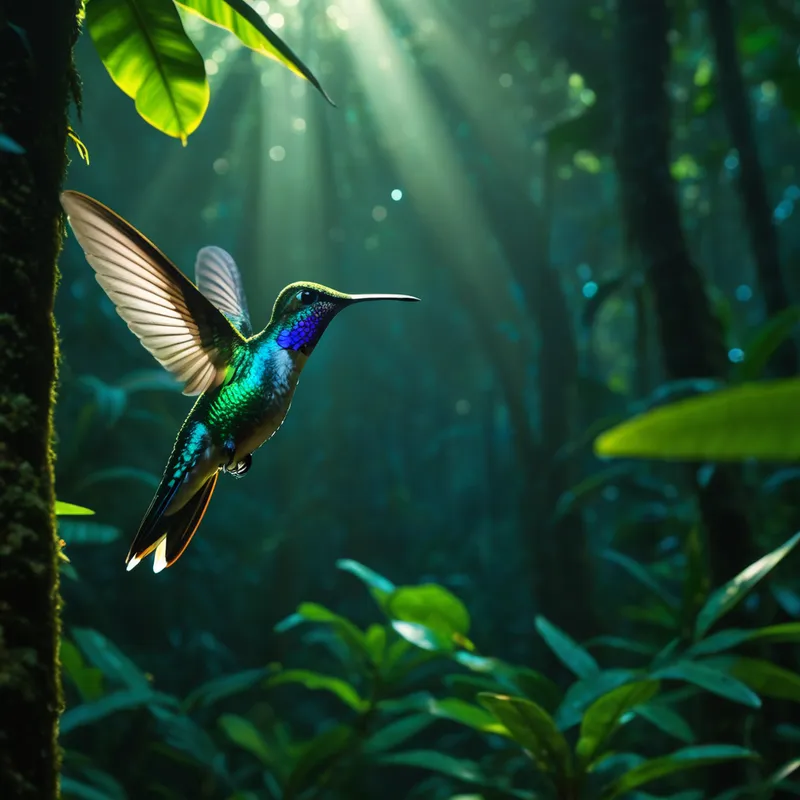
The Hummingbird Myth Meaning & Symbolism
A myth of love's enduring spirit, where a grieving man is transformed into a hummingbird to carry messages between the living and the dead.
The Tale of The Hummingbird
Listen. In the time before time, when the great ceiba tree first stretched its roots into the dark earth and its branches toward the sun, there lived a man. He was a cacique, strong and wise, but his heart was a hollow gourd, echoing with a single, beautiful sound: the name of his wife. She was the warmth of the sun on his skin, the sweet taste of yuca, the gentle rhythm of [the sea](/myths/the-sea “Myth from Greek culture.”/). But Márohu, the spirit of darkness and chill, had grown jealous of their light. He sent a cold shadow that settled in her lungs, and despite the chants of the behique and the tears of the man, her breath faded like mist at dawn.
She journeyed to Coaybay, the silent, grey island where the dead dwell in an eternal, joyless twilight. The cacique’s world shattered. The vibrant greens of the forest turned to ash. The songs of the birds became meaningless noise. He sat by her empty hammock, clutching a lock of her hair, and his grief was a physical weight, a stone in his chest that pulled him toward [the earth](/myths/the-earth “Myth from Hindu culture.”/).
He could not eat. He could not sleep. He could only yearn. In his deepest despair, he cried out to Yúcahu, the spirit of the sea and cassava, and to Atabey, his mother. “I am a canoe with no shore,” he wept. “Let me follow her path, or let me perish.”
The gods heard his plea, not with pity, but with a profound understanding of [the law](/myths/the-law “Myth from Biblical culture.”/) of all things. A spirit could not return from Coaybay. But love, true and desperate love, was a force that could bend the rules of [the world](/myths/the-world “Myth from Tarot culture.”/). They appeared to him not in glory, but in a whisper of wind and a shimmer of light on [water](/myths/water “Myth from Chinese culture.”/).
“Your body is an anchor,” the voices seemed to say. “Your love is a wing. You cannot go to her as a man. But you can become a messenger.”
They showed him a vision: a creature of impossible speed, a jewel with wings, a being that could drink the nectar of life itself from the heart of a flower. “You will become this,” they declared. “You will be small enough to pass through [the veil](/myths/the-veil “Myth from Various culture.”/), fast enough to race the sun, and your heart will beat with the frantic rhythm of your longing. You will carry the breath of the living to the dead, and the whispers of the dead to the living.”
The transformation was not gentle. His bones grew light and hollow. His skin prickled as a thousand iridescent feathers burst forth. His arms melted into wings that blurred with motion. His great form shrank, and his longing focused into a single, needle-like beak. Where a man once stood, a tiny, shimmering bird now hovered, its heart a frantic drum.
Without a moment’s hesitation, the new creature—the first Colibrí—darted toward the west, where the sun dies each day. He found the hidden cave that leads to Coaybay, a place of chilling mist and echoing silence. He flew into the gloom, his tiny body a speck of defiant light. In that grey land, he found her spirit, faint as a memory. He could not embrace her. He could not speak. But he hovered before her, and in the hum of his wings, she heard the song of his unbroken heart. He sipped from a ghostly flower and carried its essence back to the world of light, a proof of his journey.
And so he flies, eternally. A flash of emerald and ruby in the green world, a living stitch sewing together the realms of life and death, memory and presence, love and loss.

Cultural Origins & Context
This myth originates from the Taino, the Indigenous people of the Greater Antilles—islands like Hispaniola, Puerto Rico, Cuba, and Jamaica—who thrived prior to European contact. Theirs was a world animated by cemíes, where the boundaries between the human, natural, and spiritual realms were porous and constantly negotiated through ritual, story, and art.
The myth of the Colibrí was not mere entertainment; it was a functional cosmology. It was likely told by behiques (shaman-priests) and elder storytellers to explain profound natural and existential phenomena. The hummingbird’s incredible metabolism, its seeming ability to hover in mid-air, and its migratory disappearances and returns made it a natural candidate for a [psychopomp](/myths/psychopomp “Myth from Greek culture.”/)—a guide of souls. The story provided a framework for understanding grief, offering a narrative where profound loss did not mean an end to connection, but a transformation of its form. It affirmed that love had a tangible, observable presence in the world in the form of this dazzling, tireless bird, thus comforting the living and honoring the dead.
Symbolic Architecture
At its core, the myth is an alchemical map of the [psyche](/myths/psyche “Myth from Greek culture.”/) facing its greatest [shadow](/symbols/shadow “Symbol: The ‘shadow’ embodies the unconscious, repressed aspects of the self and often represents fears or hidden emotions.”/): the [loss](/symbols/loss “Symbol: Loss often symbolizes change, grief, and transformation in dreams, representing the emotional or psychological detachment from something or someone significant.”/) of the beloved Other, which is also a loss of a part of [the Self](/myths/the-self “Myth from Jungian culture.”/).
The cacique represents the conscious ego, identified wholly with a single object of love. His [wife](/symbols/wife “Symbol: The symbol of a ‘wife’ in a dream often represents commitment, partnership, and personal relationships, reflecting one’s desires for intimacy or connection.”/) symbolizes the [anima](/symbols/anima “Symbol: The feminine archetype within the male unconscious, representing soul, creativity, and connection to the inner world.”/)—the inner feminine principle of relatedness, [soul](/symbols/soul “Symbol: The soul represents the essence of a person, encompassing their spirit, identity, and connection to the universe.”/), and [life](/symbols/life “Symbol: The symbol of ‘Life’ represents a journey of growth, interconnectedness, and existential meaning, encompassing both the joys and challenges that define human experience.”/)-[connection](/symbols/connection “Symbol: Connection symbolizes relationships, communication, and bonds among individuals.”/). Her [death](/symbols/death “Symbol: Symbolizes transformation, endings, and new beginnings; often associated with fear of the unknown.”/) is the catastrophic withdrawal of this [energy](/symbols/energy “Symbol: Energy symbolizes vitality, motivation, and the drive that fuels actions and ambitions.”/), plunging [the ego](/myths/the-ego “Myth from Jungian culture.”/) into a sterile, depressive state, the “hollow gourd.”
The journey to the underworld is never a choice for the heroic, but a compulsion for the bereft. It is the psyche’s non-negotiable demand to retrieve what is lost or disintegrate.
The gods, Yúcahu and Atabey, represent the transcendent function—the Self that orchestrates wholeness. They do not reverse the loss but offer a paradoxical [solution](/symbols/solution “Symbol: A solution symbolizes resolution, clarity, and the overcoming of obstacles, often representing a sense of accomplishment.”/): transcendence through minimization. To become the hummingbird is to surrender the heavy, [human](/symbols/human “Symbol: The symbol of a human represents individuality, complexity of emotions, and social relationships.”/) [identity](/symbols/identity “Symbol: Identity represents the sense of self, encompassing personal beliefs, cultural background, and social roles.”/) (the ego’s grand narrative) for a specialized, focused function of the soul. The hummingbird is the liberated libido—the life force, once bound in a single [human](/symbols/human “Symbol: The symbol of a human represents individuality, complexity of emotions, and social relationships.”/) [relationship](/symbols/relationship “Symbol: A representation of connections we have with others in our lives, often reflecting our emotional state.”/), now freed and refined into a [purpose](/symbols/purpose “Symbol: Purpose signifies direction, meaning, and intention in life, often reflecting personal ambitions and core values.”/) that serves the [cosmos](/symbols/cosmos “Symbol: The entire universe as an ordered, harmonious system, often representing the totality of existence, spiritual connection, and the unknown.”/) itself. Its [needle](/symbols/needle “Symbol: The needle is a powerful symbol of connection, precision, and the intricate threads of life that bind experiences and emotions.”/)-beak penetrates to the essential nectar (the core [truth](/symbols/truth “Symbol: Truth represents authenticity, honesty, and the quest for knowledge beyond mere appearances.”/), the sweet essence of [memory](/symbols/memory “Symbol: Memory symbolizes the past, lessons learned, and the narratives we construct about our identities.”/)), and its frantic wings are the [perpetual motion](/symbols/perpetual-motion “Symbol: Perpetual motion symbolizes the endless pursuit of goals, embodying a sense of continuous activity and effort towards fulfillment.”/) of a [heart](/symbols/heart “Symbol: The heart symbolizes love, emotion, and the core of one’s existence, representing deep connections with others and self.”/) that has chosen eternal seeking over [static](/symbols/static “Symbol: Static represents interference, disruption, and the breakdown of clear communication or signal, often evoking feelings of frustration and disconnection.”/) possession.
The Dreamer’s Resonance
When this myth pattern stirs in the modern dreamer, it often manifests not as a literal hummingbird, but as sensations and scenarios of profound liminality. You may dream of being incredibly small yet powerful in a vast space, of moving with impossible speed and agility to avoid a looming threat, or of trying to communicate something urgent with a voice that emerges only as a high-pitched hum or vibration.
Somatically, this can correlate with feelings of anxiety—a racing heart, shallow breath, a sense of being “fluttery” or ungrounded. Psychologically, this is the psyche initiating its own transformation in the face of a perceived death. This could be the end of a relationship, a career, an identity, or a deep psychological complex. The dream-ego is being compelled to “shrink” its grandiose attachments and self-concepts, to become a nimble messenger between the conscious mind (the land of the living) and the newly forming or deeply buried contents of the unconscious (Coaybay, the land of the dead). The process feels frantic because the ego is resisting the necessary minimization; it wants its old form and its old love back.
Alchemical Translation
The individuation process modeled here is not one of heroic conquest, but of devoted servitude to a love that transcends the personal. The alchemical stages are clear:
- [Nigredo](/myths/nigredo “Myth from Alchemical culture.”/) (The Blackening): The crushing grief, the world turned to ash. The ego is dissolved in the [prima materia](/myths/prima-materia “Myth from Alchemical culture.”/) of despair.
- Albedo (The Whitening): The divine intervention—the call from the Self (Yúcahu/Atabey). This is the first glimpse of a possible meaning, a silver thread in the darkness.
- Citrinitas (The Yellowing): The transformation itself. The painful, miraculous shedding of the old, heavy “lead” of the human form for the “gold” of the hummingbird’s purpose. This is the development of a transcendent function—the capacity to be a bridge.
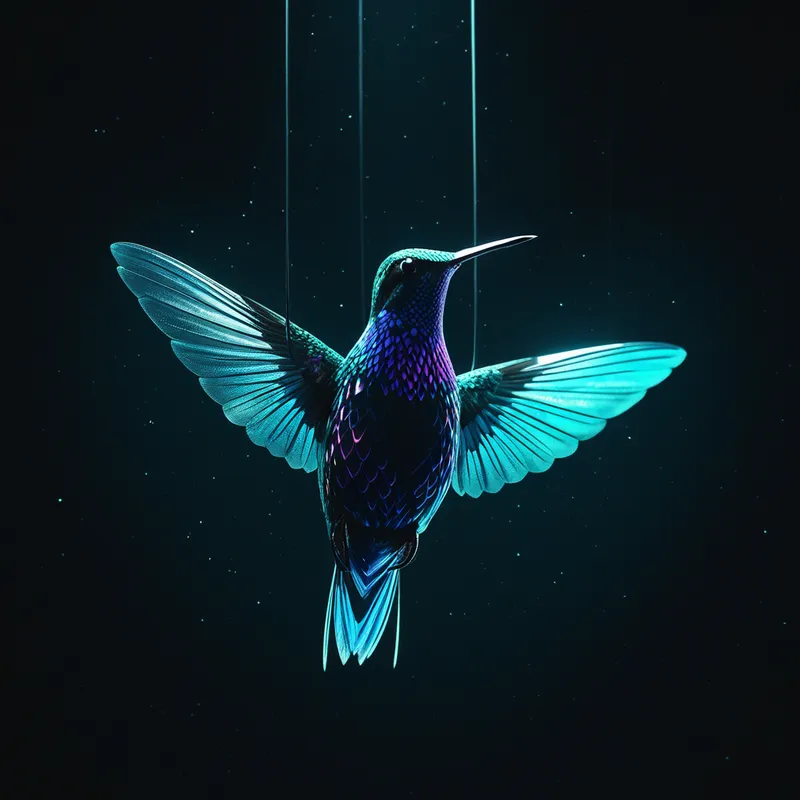
- [Rubedo](/myths/rubedo “Myth from Alchemical culture.”/) (The Redding): The eternal flight. The fully realized state where the individual no longer lives for the personal relationship, but as the principle of connection itself. The hummingbird’s iridescent red throat is the symbol of this achieved, perpetually active love.
The ultimate alchemy is not to possess the beloved, but to become the vehicle through which love itself travels between all realms of your being.
For the modern individual, this myth instructs us that [the way](/myths/the-way “Myth from Taoist culture.”/) through paralyzing grief or identity-shattering change is not to rebuild the old castle, but to become a nimble, purposeful messenger. It asks: What heavy, human-scale identity must you allow to be miniaturized and transformed? What essence of a lost love, a failed project, or a former self must you now faithfully carry between your past and your future, between your depths and your daily life? Your calling may not be to be a king in your ruin, but to be a hummingbird in your grace—small, specific, breathtakingly fast, and essential to the pollination of your own soul’s garden.
Associated Symbols
Explore related symbols from the CaleaDream lexicon: