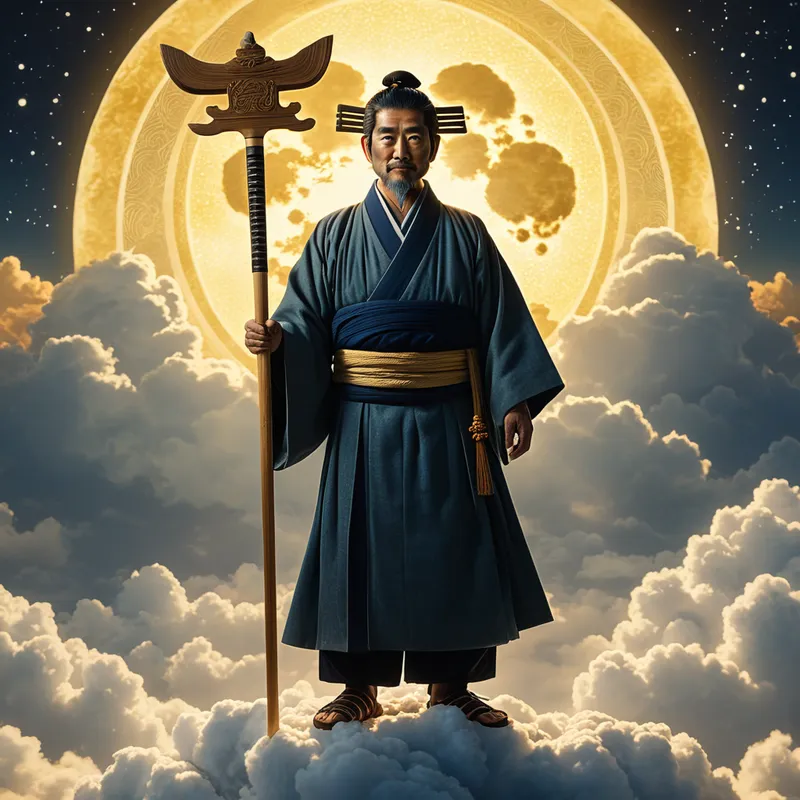
Hōki Myth Meaning & Symbolism
A divine carpenter descends to build a palace for a goddess, his creation a sacred act that binds heaven and earth, order and potential.
The Tale of Hōki
Listen, and hear the tale of the shaping of the world, not from chaos, but from promise. In the age when the kami walked the land of reed plains and high mountains, a great longing stirred in the heart of a powerful deity.
This was Ōkuninushi, the Great Land Master. He had pacified the land, but his spirit resided in no fixed home, his power flowing like a river without banks. He yearned for a dwelling worthy of his station, a place to anchor his benevolent rule and receive the homage of the people. From the misty peaks of the heavenly plain of Takamagahara, the divine will perceived this need.
And so, they sent him a craftsman.
He descended not with thunder, but with the quiet certainty of a falling star. His name was Hōki, and in his hands, he carried not weapons, but tools—the adze, the chisel, the measuring cord. He arrived at the sacred land of Izumo, where the wind sang through the pines and the earth hummed with latent power. Ōkuninushi beheld him and knew this was the answer to his silent prayer.
Hōki did not speak of glory or battle. He walked the land, his feet reading the contours of the earth like a sacred text. He felt the grain of the ancient cypress trees, listened to the whisper of the streams, and charted the path of the sun across the sky. He sought not just a location, but a juncture—the precise point where the vertical axis of the heavens met the horizontal plane of the earth.
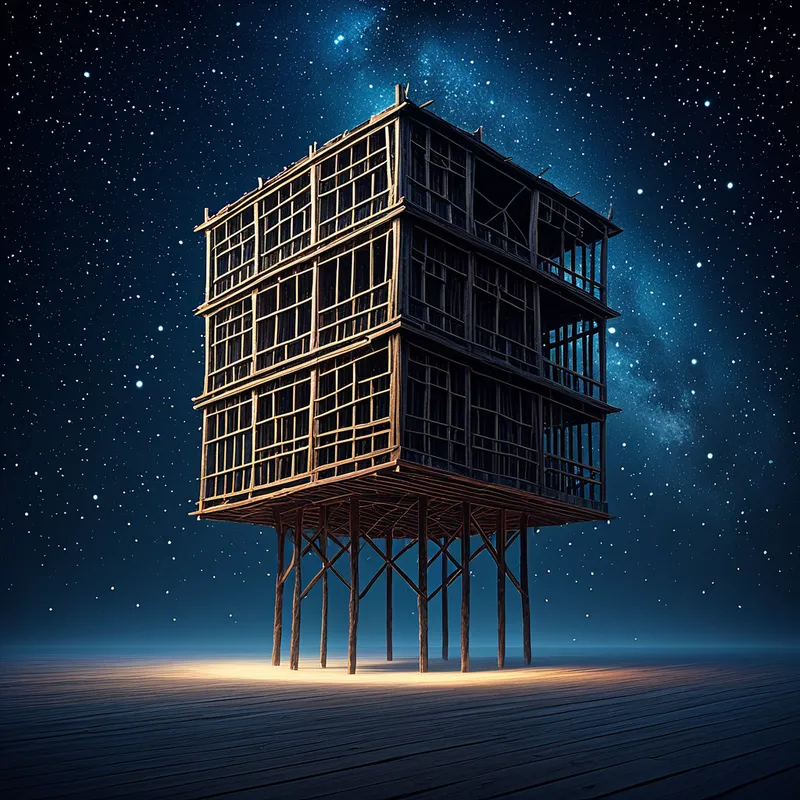
Then, he began. The sound of his adze became the heartbeat of the land. Each stroke was a prayer, each shaving of wood a released breath. He selected pillars from the finest trees, not merely cutting them, but asking for their essence to become the bones of this new body. He raised the frame, a skeleton against the sky, and as he fitted beam to post, a profound silence fell. It was the silence of perfect alignment.
He thatched the roof so thickly it seemed a mountain had grown overnight, a shelter against millennia of rain and sun. He left the central pillar, the shin-no-mihashira, pure and unadorned, for it was not a thing to be seen, but to be known—the axis mundi around which all else revolved. When the final chip of wood fell, the structure stood complete. It was not a palace of gold, but of wood and thatch, yet it pulsed with a presence that made the air shimmer.
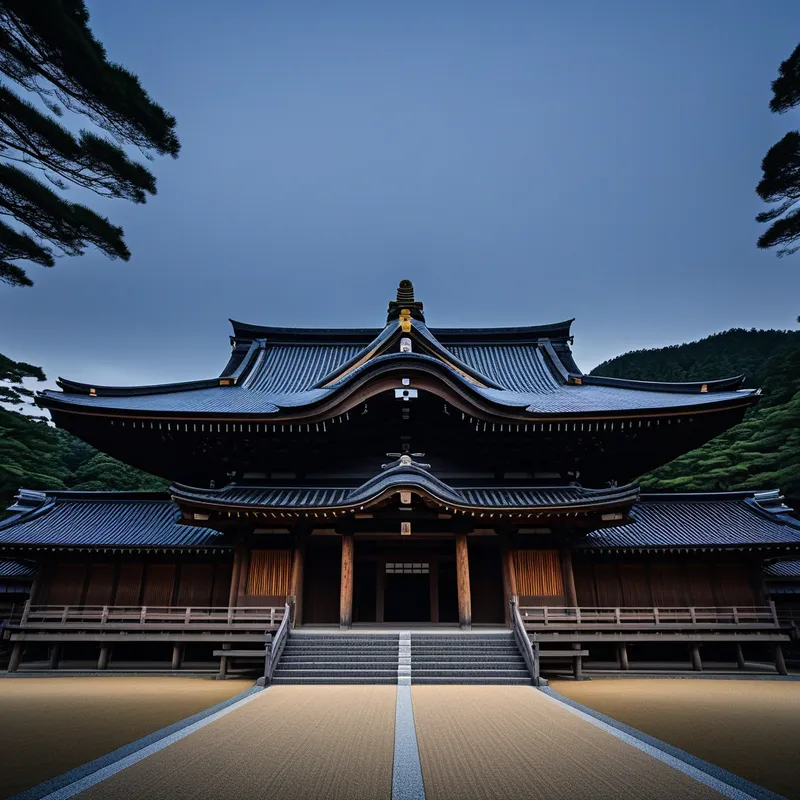
Ōkuninushi entered, and the world settled. The wild, roaming spirit of the land had found its home. The Izumo Grand Shrine was born, not as a building, but as a living covenant—a door forever ajar between the world of humans and the realm of the kami, built by the quiet, divine hands of Hōki.
Cultural Origins & Context
The myth of Hōki is enshrined within the ancient chronicles of Japan, notably the Kojiki (Records of Ancient Matters, 712 CE) and the Nihon Shoki (Chronicles of Japan, 720 CE). These texts, compiled under imperial auspices, served to codify the divine origins of the Japanese islands and the imperial lineage. Hōki’s story is intrinsically linked to the founding of the Izumo-taisha, a shrine of immense antiquity and spiritual significance.
In the cultural context, this myth functioned on multiple levels. Historically, it provided a divine sanction and origin story for one of the nation’s most powerful religious centers, legitimizing its authority. Societally, it elevated the craft of carpentry and construction from a mere profession to a sacred, kami-blessed act. The carpenter (tōryō) was seen as a mediator of divine order, channeling celestial blueprints into terrestrial form. The myth was likely perpetuated by both shrine priests, who told it as part of their sacred history, and by guilds of craftsmen, for whom Hōki was a patron and archetypal ancestor, embodying the virtue of flawless, spiritually-attuned workmanship.
Symbolic Architecture
At its core, the myth of Hōki is a profound allegory for the imposition of sacred order upon fertile chaos. Hōki himself is the archetypal homo faber—the human as maker—elevated to a divine principle. He represents the conscious, shaping mind that enters the unconscious, potential-filled realm (the land of Ōkuninushi) and through skill, intention, and reverence, creates a vessel for meaning.
The sacred shrine is not built on the land, but from a conversation with it; it is the earth’s dream of heaven given form.
The tools are extensions of his will, but they are useless without his innate knowledge—the divine blueprint. The shin-no-mihashira, the unseen central pillar, is the ultimate symbol. It is the Self in Jungian terms—the central, ordering principle of the psyche that is often invisible, yet upon which the entire integrity of the personality depends. The building that rises around it is the ego-complex, the visible life, which must be perfectly aligned with this central truth to be stable and sacred.
Ōkuninushi’s longing is the psychic urge for individuation—the Self’s desire for a defined, permanent home within the conscious personality. Hōki’s construction is the long, meticulous process of building that home through conscious effort, integration, and respect for the innate structure of the psyche.
The Dreamer's Resonance
When the pattern of Hōki stirs in the modern dreamer, it often signals a profound phase of internal structuring. One may dream of building a house, assembling intricate machinery, or following a complex, beautiful blueprint. There is a somatic sense of rightness when pieces fit together—a click, a sigh of relief in the dream-body.
Conversely, a Hōki dream in shadow may manifest as frustration: tools that break, wood that warps, or a central pillar that is off-center, causing the entire structure to lean perilously. This reflects a psyche where the conscious efforts at building a life (career, identity, relationships) are out of alignment with the deeper, unconscious Self. The dream is highlighting a foundational flaw. The emotional tone is not one of terror, but of profound anxiety and dissonance—the gut feeling that something, at the very core, is not plumb.
These dreams call the dreamer to the drafting table of introspection. They ask: What am I building my life upon? Is my central value, my shin-no-mihashira, truly at the heart of my actions? Am I working with the grain of my own nature, or against it?
Alchemical Translation
The alchemical process mirrored in Hōki’s myth is the coagulatio—the transition from the volatile, spiritual, or fluid state (solutio) into a fixed, embodied, and lasting form. Ōkuninushi’s roaming spirit is the prima materia, the raw, divine potential. Hōki is the adept who performs the opus.
For the modern individual, this translates to the often-overlooked work of consolidation. We live in an age that prizes inspiration, ideation, and the spark of beginnings (the nigredo and albedo). Hōki’s lesson is about the sacred labor that comes after the vision. It is the daily, meticulous work of making the vision real—writing the book, sustaining the relationship, mastering the skill, building the business, or simply structuring a life of integrity.
Individuation is not a revelation received, but a sanctuary built, beam by beam, through ten thousand acts of conscious choice.
This is not mere routine, but ritual. Each conscious choice aligned with the Self is a stroke of Hōki’s adze. Each integrated complex becomes a sturdy pillar. The temptation is to leave the shrine as a beautiful blueprint in the mind, or to build it hastily with rotten timber (unexamined beliefs, borrowed values). Hōki demands patience, precision, and the humility to follow a design greater than the ego’s whims. The triumph is not in a dramatic battle, but in the final, silent moment when the structure stands complete and the spirit can finally dwell within it, at home in a world of its own sacred making. The palace you build becomes the vessel that holds your soul.
Associated Symbols
Explore related symbols from the CaleaDream lexicon: