High John the Conqueror
A legendary root and folk hero from African Diaspora traditions, symbolizing strength, overcoming adversity, and spiritual empowerment in folklore and conjure practices.
The Tale of High John the Conqueror
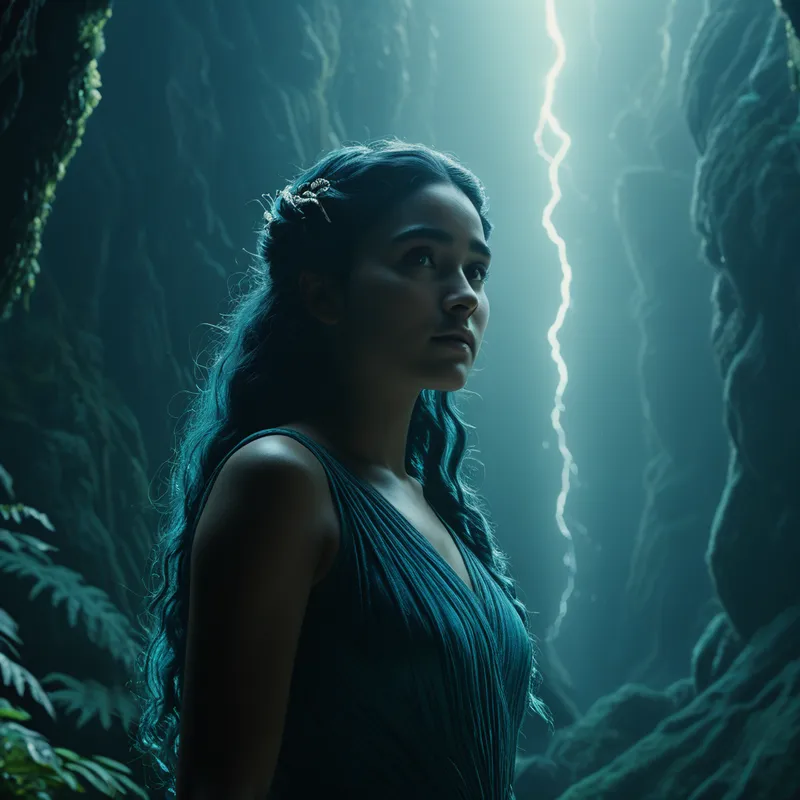
He was not born of a woman, but grew from the earth itself, a root in the shape of a man. In the long night of bondage, when the world was a weight upon the spirit, the people whispered his name. They said he walked the rows of cotton and cane not as a captive, but as a prince in disguise. His back was unbent, his laughter a secret weapon. He wore the mask of the fool, the simpleton, so the overseer’s eye would slide right off him, never seeing the fierce intelligence burning within.
High John’s power was not in the sword but in the spirit. He could not be bound, for his body was here but his soul was elsewhere, walking a Highway only he could see. One tale tells of how he was given an impossible task: to carry water in a sieve. Where another would despair, John went to the riverbank and spoke to the moss and the mud. He lined the sieve with it, and carried the water not as a liquid, but as life itself—the wet, dripping earth. He fulfilled the letter of the command by defying its cruel intent, turning a tool of futility into a vessel of creation.
His greatest conquest was not of a place, but of a condition. He confronted the very spirit of oppression, not with rage, but with cunning song and indomitable will. He played his diddley bow until the chains grew slack with inattention. He told stories so potent they became spells, weaving a world where the enslaved were sovereign. When he left, they say he didn’t die. He told the people, “My work here is done, but my root remains. When you need me, find me in the earth. I am your victory.” And he vanished, leaving behind the legend and the physical root, a hard, knotted tuber, as a promise and a weapon for the people.

Cultural Origins & Context
High John the Conqueror emerges from the crucible of the Transatlantic slave trade, a figure born in the oral traditions of enslaved Africans in the American South. He is a quintessential product of the African Diaspora’s spiritual genius—a syncretic figure weaving West African spiritual principles of ancestral power and herbal wisdom with the stark necessities of survival and resistance in a New World of brutality.
He is folklore as survival technology. In a system designed to annihilate identity, hope, and agency, the creation of High John was an act of profound psychological and spiritual rebellion. He represents the I-am-ness that slavery could not touch. His stories were told in hushed tones in quarters, passed down not merely as entertainment, but as coded sermons and maps for the soul. He became central to African American conjure, hoodoo, and rootwork traditions, where the physical Ipomoea purga root, named for him, is the most prized talisman for luck, protection, and overcoming obstacles. He is the folk hero who transitions seamlessly into a sacred, empowering botanical spirit.
Symbolic Architecture
High John’s mythology is built on a foundation of potent dualities. He is the Root that is also the Hero. He is buried, hidden, foundational, yet mobile, cunning, and triumphant. This embodies the diasporic reality: a deep, unbreakable connection to an ancestral homeland (the root) combined with the adaptive, resilient identity forged in displacement (the conquering journey).
He masters the world not through dominant force, but through indirection and spiritual intelligence. He is the Trickster wearing the mask of compliance, using the oppressor’s blindness as his cloak. His power is the power of the underestimated, the secret knowledge that the spirit cannot be imprisoned.
His conquest is alchemical: he does not destroy the base metal of his circumstance, but transforms it through wit and will into the gold of liberation. The victory he offers is first and foremost an internal state—the unconquered heart.
The physical root, gnarled and hard, is a perfect symbol of this. It does not glitter; it endures. Its value is not immediately apparent to the untrained eye. One must know how to call upon it, how to dress it, how to carry it. It teaches that true power is often hidden, potent, and must be actively engaged with to be realized.
The Dreamer's Resonance
To encounter High John in the inner landscape is to meet the archetypal force of Resilience. He personifies the part of the psyche that refuses to be defined by its wounds, that finds agency in the midst of powerlessness. For the modern dreamer, he may appear not in plantation fields, but in the confines of a draining job, a toxic relationship, or a period of profound depression—any landscape that feels like bondage.
He speaks to the Shadow aspect of the hero, not the shining knight, but the cunning, earthy survivor. Integrating High John’s energy means acknowledging that sometimes the path to victory is not a frontal assault, but a strategic retreat into the self, a gathering of inner resources. It is the courage to wear a necessary Mask while nurturing an inviolable, private truth. He represents the Journey of the soul back to its own sovereignty, a reminder that our deepest struggles often contain the very Root of our strength, waiting to be unearthed and claimed.

Alchemical Translation
The psychological process mirrored in High John’s tale is the transformation of victim consciousness into agent consciousness. The initial state is one of enforced passivity and suffering (the lead). The catalytic agent is not an external savior, but an internal awakening—the recognition of the hidden Root, the innate, unassailable core of self.
The "conquering" is an internal operation. It is the ego's surrender to a deeper, more cunning and enduring spirit within. The root is not a magic wand, but a mirror; it only works for those who have done the work of connecting to their own foundational power.
This process involves a sacred cunning. It requires assessing the landscape of one’s limitations not with despair, but with the eye of a strategist, looking for the loophole in fate’s contract, the hidden leverage in one’s own story. The final stage is not necessarily a change in outer circumstance, but a fundamental change in relationship to it. One carries the root—the solidified, talismanic proof of one’s own Resilience. The outer world may still present challenges, but the inner world has been conquered. The spirit has declared its independence, and from that fortified place, true change in the material world becomes possible. This is the Rebirth of the unconquered self.
Associated Symbols
Explore related symbols from the CaleaDream lexicon:
- Root — The foundational, often hidden source of strength, identity, and connection to ancestry; the part of the self that endures and nourishes.
- Hero — The archetypal force within that embarks on a difficult journey, faces trials, and returns with a boon for the self or the community.
- Trickster — The cunning, boundary-breaking aspect of psyche that uses wit, humor, and subversion to challenge rigid order and create new possibilities.
- Mask — A persona worn for protection, performance, or survival, which can both conceal the true self and reveal deeper truths about adaptation.
- Journey — The essential process of movement, quest, and transformation through which identity is forged and purpose is discovered.
- Resilience — The spiritual and psychological capacity to withstand, adapt, and grow from adversity, trauma, and stress.
- Shadow — The hidden, often rejected parts of the self that, when integrated, contain immense power and wholeness.
- Rebirth — The profound transformation and renewal of identity or spirit following a period of dissolution, struggle, or symbolic death.
- Earth — The symbol of grounding, embodiment, fertility, and the tangible, physical realm from which sustenance and strength arise.
- Spirit — The animating, non-material essence of a being or force; the invisible dimension of power, intention, and consciousness.