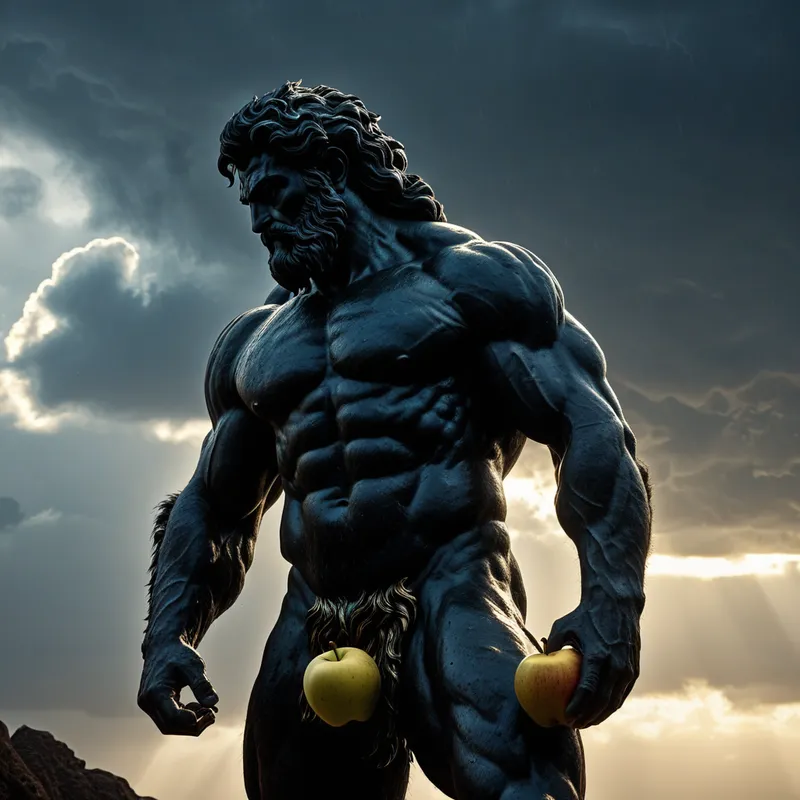
Hercules performing his twelve Myth Meaning & Symbolism
A hero, cursed by a goddess, must perform twelve impossible labors to atone for a crime born of madness, forging his legend through monstrous trials.
The Tale of Hercules performing his twelve
Hear now the tale of the strongest man who ever lived, and the heaviest burden he was made to bear. It begins not with glory, but with a scream in the dark. Hercules, son of Jupiter and the mortal Alcmene, was a man whose strength shook the earth, but whose soul was a plaything for the gods. Juno, whose wrath was as cold as mountain ice, could not abide this living proof of her husband’s infidelity. She cast upon Hercules a madness, a red mist that clouded his vision and turned his mighty hands against his own.
In that fit, believing them to be monsters sent by his enemy, he slew his beloved wife and children. The mist cleared. He stood in the silence of his home, the warmth of their blood on his hands, the reality of his actions crashing upon him with a weight greater than any sky. This was his true labor, the one no muscle could lift: the labor of waking up.
Broken, he journeyed to the sacred oracle. The voice from the stone was merciless in its clarity: to purify his soul, he must enter the service of his weak, spiteful cousin, King Eurystheus, and perform ten labors the king would devise. But treachery laced the decree; two labors would be deemed invalid, stretching the sentence to twelve. Thus began the path of atonement, a road paved with impossible things.
First, the Nemean Lion, whose hide turned aside all bronze and iron. Hercules learned to wrestle, to use his wits as much as his might, strangling the beast and fashioning its own pelt into an armor no weapon could pierce. Then came the Lernaean Hydra, rising from its swamp, breath poisonous, heads multiplying. Here, he learned he could not fight his demons alone; his nephew Iolaus brought fire to cauterize the necks, teaching the lesson of the ally, the sacred friend.
The labors unfolded like a brutal geography of the soul. He chased the Ceryneian Hind for a year, learning patience and reverence. He faced the Erymanthian Boar in deep snow, mastering the environment. He cleaned the Augean Stables not by hand, but by redirecting rivers, a lesson in intelligent labor over brute force. He drove away the Stymphalian Birds with a divine rattle, confronting terror with sound and vibration.
He journeyed to the edge of the world. To capture the Cretan Bull, to steal the Mares of Diomedes, to obtain the Girdle of Hippolyta—each task a foray into chaos, passion, and the foreign feminine. He fetched the Cattle of Geryon from the red sunset isle of Erytheia, and descended into the very underworld to leash Cerberus, confronting the finality of death itself. For his final, celestial labor, he held up the sky for the Titan Atlas and tricked him into taking the burden back, securing the Golden Apples of the Hesperides—a fruit of immortality earned not by strength alone, but by cunning and negotiation with cosmic forces.
When the twelfth labor was done, Hercules stood before Eurystheus not as a broken servant, but as a man transformed. The blood was not washed from his hands, but it had been worked into the fiber of his being, tempered by twelve trials that forged the hero from the ashes of the murderer. The path of punishment had become the road to legend.
Cultural Origins & Context
The myth of Hercules and his twelve labors is a cornerstone of Greek mythology, later adopted and adapted by the Romans. Its "Global/Universal" resonance stems from its transmission through the vast networks of the Hellenistic world and the Roman Empire, embedding itself in art, literature, and philosophy across continents. It was not a single, fixed story but a sprawling cycle, told and retold by poets like Homer and playwrights like Euripides, each emphasizing different aspects of the hero’s suffering and glory.
Societally, it functioned on multiple levels. For the city-state, it was a charter myth explaining the taming of wild frontiers and the establishment of order. For the individual, it was a profound narrative of crime, punishment, and the possibility of redemption through unimaginable effort. It asked the central, agonizing question: what does a man do after he has committed the unforgivable? The answer was not forgiveness, but a curriculum of impossible tasks—a mythic blueprint for turning catastrophic failure into a legacy of strength.
Symbolic Architecture
The twelve labors are not a random checklist of monsters. They are a precise, symbolic map of the individuation process, the heroic journey inward. Hercules begins in a state of unconscious identification with his divine strength (his hubris), which leads to a catastrophic eruption of the shadow—the murder of his family, his own softer, vulnerable human connections. The labors are the prescribed path to re-integrate this shattered self.
The hero’s journey is always a circle: he departs from a state of psychic ruin to confront the monsters of the outer world, only to discover they are the mirrored reflections of the chaos within.
Each labor targets a specific psychic complex. The Nemean Lion represents the raw, undifferentiated power of the unconscious that must be confronted directly and integrated (its skin becomes his armor). The Hydra is the problem of neurosis—cut off one head (symptom), and two more grow; it requires the "fire" of consciousness (Iolaus) to heal. The Augean Stables symbolize the decades of accumulated psychic filth, the repressed shame and guilt, which cannot be cleaned by willpower alone but requires the divine intervention of redirected energy (the rivers). Fetching Cerberus from Hades is the ultimate act of shadow integration: confronting and making peace with the terrifying guardian of one’s own deepest, most repressed contents.
The Dreamer's Resonance
When this myth stirs in the modern dreamer, it often manifests as a profound sense of being given an impossible, Herculean task. The dreamer might find themselves in a labyrinthine office building (the Labyrinth of Minos, though not a labor, is a related structure) facing a pile of paperwork that regenerates as fast as it’s completed (the Hydra). Or they may dream of trying to clean a vast, filthy, and ancient house that belongs to them (the Augean Stables), feeling the somatic weight of inherited or personal shame.
The psychological process is one of confronting a "labour of atonement." The dreamer is often in a post-crisis state, having experienced some form of personal "madness"—a relationship rupture, a career disaster, a bout of depression or rage that caused collateral damage. The dream’s impossible tasks are the psyche’s way of formulating the path back to wholeness. The exhaustion felt in the dream is real; it is the fatigue of the ego being stretched beyond its limits to accommodate a new, more responsible level of consciousness.

Alchemical Translation
The alchemical process mirrored in the twelve labors is the nigredo, the descent into blackness and mortification, followed by the long, arduous albedo of purification. Hercules’ initial crime is the nigredo—the blackening of the soul. Each labor is a stage in the albedo, washing the prima materia of his flawed character in the fires of ordeal.
The gold of the hero is not given; it is extracted, ounce by agonizing ounce, from the base ore of his failures, in the furnace of necessity.
For the modern individual, the myth models psychic transmutation not through bypassing error, but by moving through it with full responsibility. The "Eurystheus" we serve is often our own internalized critic, the voice of societal expectation or rigid morality. The "monsters" are our complexes: addiction (the Mares of Diomedes), paralyzing fear (the Stymphalian Birds), or the seductive call of inflation and grandiosity (holding up the Sky for Atlas). The triumph is not in the killing of the beast, but in the method learned. We integrate the Lion’s resilience, we use the ally’s fire to heal the Hydra’s wounds, we redirect rivers of new insight to clean our stables. The final prize, the Golden Apples, is not immortality in a literal sense, but the achievement of a self that has consciously earned its own sovereignty, having looked into the eyes of Cerberus and not gone mad. The labors end, but the transformed Hercules walks on, his strength now in service to a soul that has seen the underworld and returned, carrying its lessons in the weave of his lion-skin cloak.
Associated Symbols
Explore related symbols from the CaleaDream lexicon: