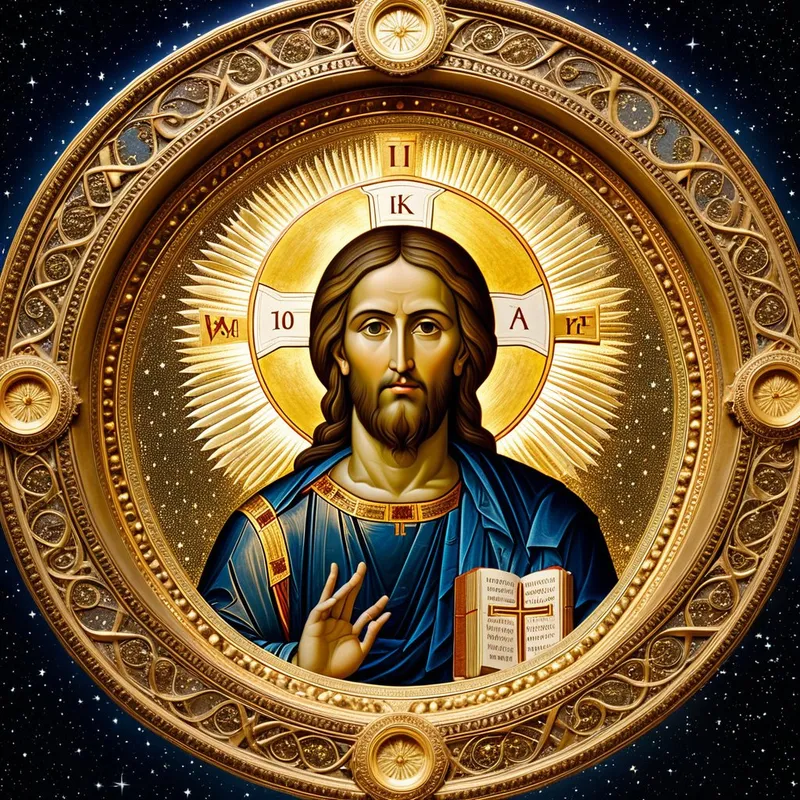
Halo/Nimbus Myth Meaning & Symbolism
A luminous circle of sanctity, the halo marks the intersection of divine grace and human potential, symbolizing the radiant self made whole.
The Tale of Halo/Nimbus
In the beginning, before the chisel met the stone or the brush touched the panel, there was only the Uncreated Light. It was not the light of the sun, which blinds and burns, but a light from within all things, a silent, singing radiance that was the first breath of being. The great storytellers, those who painted with words on the air in fire-lit halls and later with pigment on the walls of echoing caves made for prayer, spoke of this.
They told of beings who walked the dusty roads of this world yet were not entirely of it. Their feet touched the earth, their hands knew labor and sorrow, but around their heads—not upon their brows, but around them, in the very air—the Uncreated Light would gather. It would not shine on them, as from a lamp, but from them, as from a vessel too full to contain its essence. It was a crown not of gold, but of luminosity; a nimbus, a cloud of glory.
In the hush of the scriptorium, the illuminator would tell of the moment of transfiguration. A figure, human in form, would ascend a mountain. And there, in the thin air where earth meets heaven, the veil of ordinary flesh would grow thin. The Light within would pour forth, not in a wild explosion, but in a serene, terrifying effulgence. His garments would become whiter than any fuller on earth could bleach them, and about his head, the air itself would crystallize into a perfect, radiant disc—a halo. It was a seal, a silent proclamation that here, in this form, the boundless had chosen to wear a boundary. The circle declared the center: a point where eternity touched time.
The artists knew this light was shy. It would not show itself to the cynical eye, the heart armored in certainty. It appeared to shepherds, to fishermen, to those who wept at tombs. It crowned not only kings and founders but the gentle Dorothea with her basket of roses, and the scholarly John in his moment of divine vision. In their icons, they painted not a flat ring of gold, but a sphere of light, often burnished, that seemed to hover in a dimension just beyond the panel, inviting the viewer not to look at the saint, but through the halo, into the source of the light itself.

Cultural Origins & Context
The halo, or nimbus, did not spring fully formed from Christian theology. Its roots dig deep into the soil of antiquity. One finds solar discs crowning Ra in the Nile valley, and luminous auras denoting divinity in Hellenistic and Roman imperial art, often used to deify emperors. Early Christian artisans, living within this visual language, performed a profound act of cultural alchemy. They took this pre-existing symbol of temporal power and cosmic force and quietly, insistently, redirected its meaning.
They moved it from the realm of political apotheosis to that of spiritual authentication. Its primary function became didactic and devotional. In the dim light of catacombs and later in the vast spaces of basilicas, where the illiterate vastly outnumbered the literate, the halo served as a immediate, universal glyph. It instantly identified the sacred figure, setting them apart in the visual field of a crowded mosaic or a complex fresco narrative. It was a signpost for veneration.
This symbol was passed down not through a single sacred text, but through the silent, persistent labor of countless anonymous hands—the iconographers of Byzantium, the mosaicists of Ravenna, the illuminators of Irish monasteries, the stone carvers of Gothic cathedrals. Its form evolved: from a simple circle, to a golden plate, to the intricate cruciform halo reserved for Christ, and the hexagonal halo for living figures like donors. Its societal function was to make the invisible hierarchy of grace visible, to map the kingdom of heaven onto the walls of the earthly city, and to provide a focal point for the gaze of the faithful, directing it from the mortal to the eternal.
Symbolic Architecture
At its core, the halo is a symbol of paradox, a geometric container for the uncontainable. The circle, with no beginning and no end, is the ancient symbol of perfection, eternity, and unity. To place this around the head is to make a profound statement about the nature of the self it crowns.
The halo is the circumference that reveals the center; it is the boundary that proves the boundless resides within.
Psychologically, the head is the seat of consciousness, of identity, of the ego. The halo thus represents a state where individual consciousness has become transparent to, and illuminated by, a greater, transpersonal reality. It is not the annihilation of the self, but its fulfillment—the ego consciously aligned with the Self. The light does not erase the features of the face; it illuminates them, granting them a significance and serenity they did not possess in ordinary light.
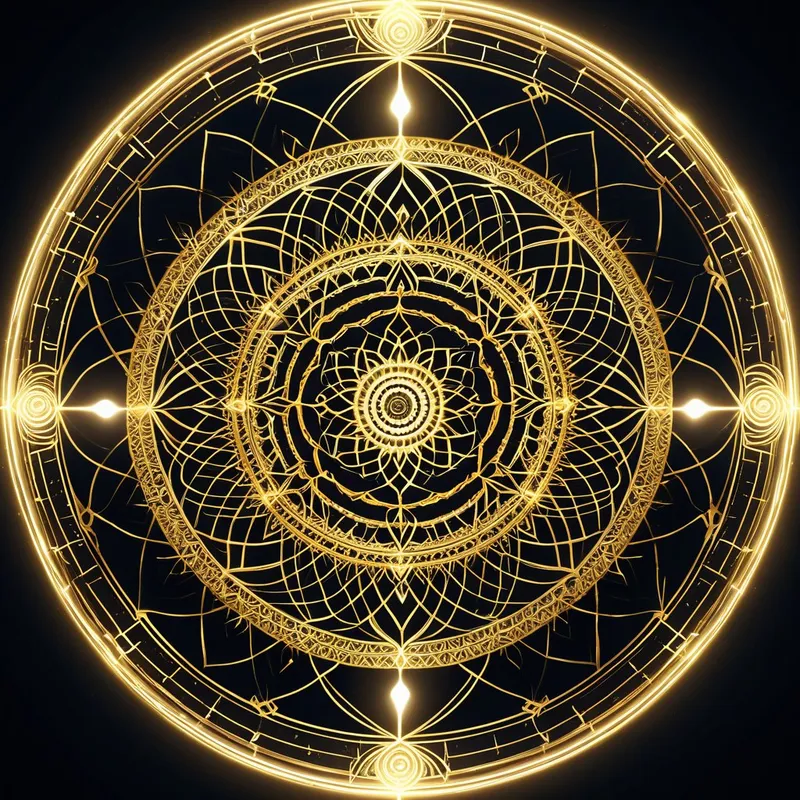
The halo also symbolizes wholeness. It is a mandala projected onto the world. In a figure with a halo, we see an individual who has achieved a state of psychic integration, where the conflicts between inner opposites (light and shadow, spirit and matter, divine and human) have been resolved or held in a sacred tension. The circular light is a symbol of this completed, sanctified personality.
The Dreamer's Resonance
When the halo appears in modern dreams, it rarely does so in its traditional, religious context. The dreaming culture.") psyche speaks in the language of the soul, not of doctrine. To dream of a halo, or more commonly, to dream of emitting a light from one’s own head or seeing such a light around another, signals a critical moment in the dreamer’s inner development.
Somatically, this can correlate with a feeling of clarity, "a weight off one’s mind," or a literal sensation of pressure or lightness in the crown of the head. Psychologically, it marks a process of recognition. It may appear after a period of intense struggle, study, or suffering, when a previously fragmented understanding suddenly coalesces into a coherent, illuminating insight. The halo in a dream is the psyche’s own iconography for a moment of self-realization, where a part of the personality is recognized as sacred, essential, and whole.
Conversely, dreaming of a cracked, tarnished, or fading halo can point to a crisis of integrity or authenticity—a feeling that one’s hard-won wisdom or moral center is under threat. Dreaming of desperately trying to hide a halo speaks to the fear of one’s own radiance, the fear of blossoming. The halo in the dreamscape is a direct report from the frontier where the personal psyche encounters the numinous.
Alchemical Translation
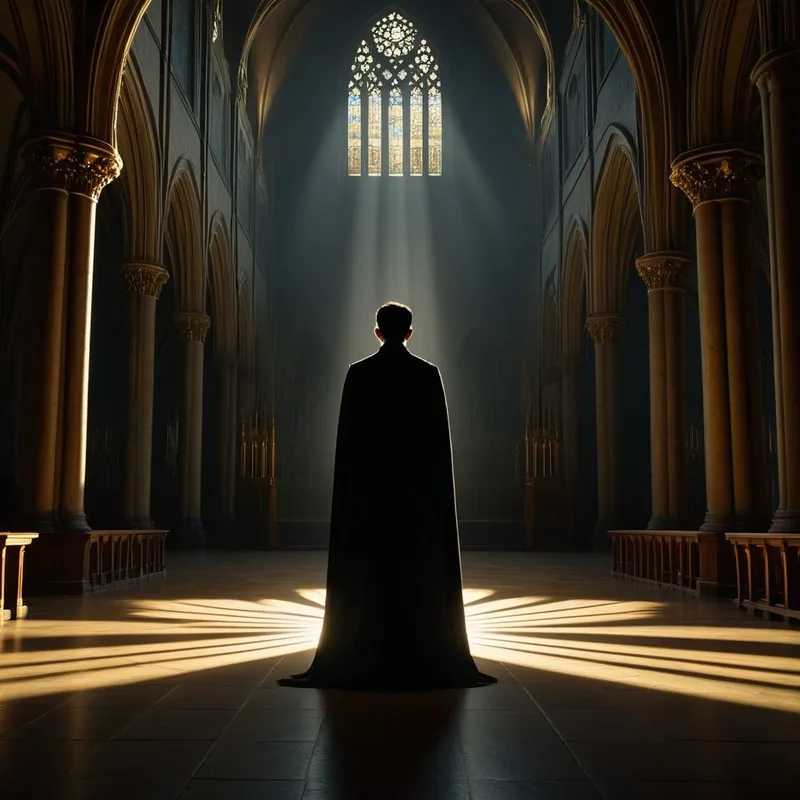
The myth of the halo provides a powerful model for the modern journey of individuation—the process of becoming who one fundamentally is. This is not about becoming a saint in a religious sense, but about achieving psychological wholeness.
The first stage is the nigredo, the dark night. This is the un-illuminated life, where one is identified solely with the ego, with its desires and fears. There is no circle, only a center that feels isolated. The call to transformation often comes as a crisis that "cracks open" this limited identity.
The work of albedo, the whitening, follows. This is the conscious work of self-examination, of engaging with the shadow, and of differentiating oneself from collective norms. It is the long, patient labor of the illuminator applying gold leaf—the slow, deliberate cultivation of awareness. One begins to sense, however faintly, an inner source of light that is not one’s own cleverness, but something deeper.
The halo is not bestowed from without, but unveiled from within; it is the visible proof of the alchemical marriage between the lead of the human condition and the gold of the spirit.
Finally, the rubedo, the reddening or culmination, is symbolized by the stable, radiant presence of the halo. This is the state where the integrated personality, having made peace with its contradictions, becomes a vessel. The light of the Self shines through the individual without distortion. The circle is closed, the mandala complete. The individual no longer seeks the light; they have become a point from which it radiates, naturally and without effort, sanctifying their ordinary human actions and presence in the world. The halo, therefore, is the alchemical gold of the psyche made visible—a sign that the long work of turning the base metal of the fragmented self into the radiant, unified being is complete.
Associated Symbols
Explore related symbols from the CaleaDream lexicon: