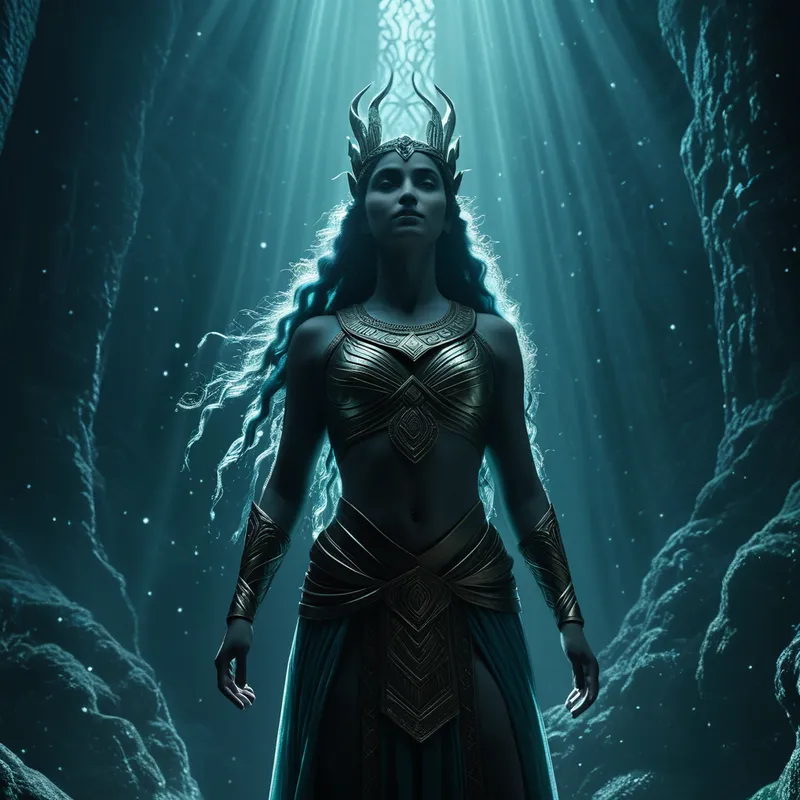
Guan Yu God of War
A legendary Chinese general deified as the Taoist God of War, revered for unwavering loyalty, martial prowess, and moral integrity across centuries.
The Tale of Guan Yu God of War
The tale begins not with a god, but with a man—a fugitive. In the waning years of the Han Dynasty, as the empire fractured into warlord kingdoms, a young man named Guan Yu fled his county after slaying a corrupt official. This act of defiant justice, born of a fiery heart, set him on the path of destiny. He encountered two other men, Liu Bei and Zhang Fei, in the peach orchard of Zhuo County. There, under the blossoming trees, they swore the Oath of the Peach Garden, pledging to be brothers unto death, to restore the Han, and to share all fortunes and calamities. This oath became the iron core of Guan Yu’s being, the celestial contract from which he would never waver.
His legend was forged in the crucible of war. Clad in green robes, his face famously ruddy with a majestic long beard, he wielded the Guandao with peerless might. He became the vanguard of Liu Bei’s cause, a figure of such awe that his very presence could scatter armies. Stories tell of him drinking wine calmly while a surgeon scraped poison from the bone of his wounded arm, his composure unbroken. He fought not for personal glory, but for his sworn brother and their shared ideal of righteous loyalty.
Yet, the path of the unwavering hero is paved with impossible choices. In a pivotal moment of war, Guan Yu was separated from Liu Bei and, to protect the families of his brothers, he submitted temporarily to the powerful warlord Cao Cao. Cao Cao, recognizing his valor, heaped him with gifts: gold, titles, the legendary steed Red Hare. Guan Yu accepted these, but always with one condition: the moment he learned of Liu Bei’s whereabouts, he would leave to rejoin him. He used Cao Cao’s resources to defeat a rival general, repaying the debt, and then, leaving every gift behind except the horse to carry him, he embarked on a perilous journey through five passes, slaying six generals who barred his way. This was not betrayal, but the ultimate fulfillment of his primary loyalty.
His end, however, is shrouded in the tragedy of betrayal and pride. Years later, as the commander of Jing Province, his unwavering adherence to his own code and perhaps a touch of the hubris that shadows great heroes led to a strategic miscalculation. He was outmaneuvered by the forces of Sun Quan, his retreat cut off. Captured not in fair combat but through a ruse, he was executed. His death was not a clean warrior’s end on the battlefield, but a political assassination. It is said his head was sent to Cao Cao, who, in a final act of twisted respect, buried it with the honors of a nobleman. Guan Yu’s body, however, was interred separately, his spirit thus divided—a poignant symbol of his fractured fate.
But for a spirit of such potent qi, death was not an end. He began to appear to the living, his spectral presence felt in temples and battlefields. A monk once saw his angry ghost roaming Mount Yuquan, crying out, “Return my head!” The monk counseled him, asking how many heads he had taken in his life, and urged him to release his earthly grievance. In that moment of spiritual reckoning, the vengeful ghost began his transformation. Through the lens of Taoist and folk belief, his immense, unresolved energy—his loyalty, his rage, his sense of injustice—was not dissipated but alchemized. The betrayed general became the divine protector, the God of War.
Cultural Origins & Context
Guan Yu’s deification is a uniquely Chinese phenomenon, a process where history, folklore, and state ideology merged to create a national icon. His historical basis is found in the Records of the Three Kingdoms, but his myth was exponentially expanded and popularized by the 14th-century novel Romance of the Three Kingdoms. This literary masterpiece crystallized his image as the epitome of loyalty (zhong 忠) and righteousness (yi 義).
His incorporation into Taoism was a gradual sanctification. As a popular folk deity, he was seen as a powerful spirit who could ward off demons and evil influences, a logical extension of his martial prowess. Formal Taoist liturgy, particularly during the Ming and Qing dynasties, began to codify his role. He was given the title Guansheng Dijun (Saintly Emperor Guan) and later, in a supreme act of imperial promotion, Guandi (Emperor Guan). The state, recognizing the utility of a symbol embodying unwavering loyalty to one’s lord (a metaphor for the emperor), actively promoted his worship.
He thus occupies a rare space, revered simultaneously in Taoist temples, Buddhist monasteries (where he is venerated as a protector deity, Sangharama Bodhisattva), and Confucian halls for his moral exemplarity. He is the god of war, but not in the Greco-Roman sense of a patron of chaos and bloodshed. He is the god of righteous warfare, of the martial virtue that protects the state, upholds oaths, and executes justice. He is also, paradoxically, a patron god of literature, commerce, and the police—all spheres where loyalty, integrity, and the enforcement of order are paramount.
Symbolic Architecture
Guan Yu’s myth is a grand architecture built upon pillars of profound psychological and spiritual conflict. He is the archetypal Self in its martial aspect, representing the psychic force required to establish and defend boundaries, values, and sacred commitments.
His journey maps the perilous path of the individual who takes a stand on absolute principles. The Oath is the crystallization of the ego’s highest ideal, but the world, in its complexity, inevitably forces that ideal into confrontation with competing loyalties and ambiguous realities.
The central tension is between his unbreakable vertical loyalty (to his sworn brother and the Han) and the compelling horizontal obligations (to Cao Cao’s generosity, to the soldiers under his command). His tragedy stems from the impossibility of perfectly reconciling these in a fallen world. His death by betrayal and deceit is the ultimate violation of the warrior’s code, the shadow that stalks the man of pure honor. Yet, his posthumous transformation suggests that it is precisely through the wounding of our highest ideals—through failure, betrayal, and death—that a deeper, transpersonal power is released.
The divided burial of his head and body is a powerful symbol of a fragmented consciousness. The spiritual work, as shown by the monk’s intervention, is to integrate these severed parts—the intellectual pride (head) with the instinctual, action-oriented body—to become a whole and effective sacred presence.
The Dreamer's Resonance
To encounter Guan Yu in the inner landscape of a dream or active imagination is to confront the psyche’s own martial principle. He appears when the dreamer’s sense of integrity is under assault, when a sacred boundary has been crossed, or when a profound commitment must be made or defended. He embodies the fierce, protective energy necessary to say “no” to corruption, compromise, or chaos.
His presence can also signal a confrontation with pride and its consequences. The dreamer may be in a situation where rigid adherence to a personal code is causing isolation or downfall. Guan Yu’s fate asks: What oaths have you sworn that now bind you? What ideals do you defend, and at what cost? Is your loyalty to a person, a principle, or an outdated image of yourself?
Furthermore, he represents the alchemy of failure. His resonance speaks to anyone who has been betrayed, who has fallen from a height due to their own miscalculation or another’s treachery. The myth offers a template: the raw, ghostly rage of the wound (“Return my head!”) must be witnessed and counseled by a deeper wisdom (the monk) to be transformed into a protective, guiding authority. The betrayed one must become the protector.
Alchemical Translation
In the vessel of Taoist alchemy, Guan Yu’s saga is a recipe for refining the base metal of human passion and suffering into the gold of spiritual power. His life represents the initial gathering and purification of jing (essence) into potent qi (vital energy)—his formidable martial skill and unwavering will. His death is the necessary nigredo, the blackening, the dissolution of the egoic structure in the fires of betrayal and defeat.
The moment of his execution is the crucial separation (separatio) of the spirit from its earthly attachments. The rage of his ghost is the volatile qi, unstable and dangerous. The monk’s spiritual intervention represents the conscious application of shen (spirit) to guide this raw energy.
His deification is the albedo and rubedo—the whitening and reddening—where the purified spirit is reconstituted at a higher level. He becomes an Taoist Talisman in divine form, a stabilized constellation of virtues (loyalty, righteousness, courage) that can now be invoked by the community. To worship Guan Yu is to participate in this alchemy, to call upon that integrated, righteous power to operate within one’s own life and the wider world, transforming chaos into protective order.
Associated Symbols
Explore related symbols from the CaleaDream lexicon:
- Oath — A sacred vow that forges identity and destiny, creating unbreakable bonds but also potentially tragic obligations.
- Horse — Instinctual power, momentum, and noble service; the vehicle that carries the will toward its goal, as Red Hare carried Guan Yu to his brothers.
- Bridge — A perilous passage between states of being; the crossing from mortal life to deification, or from one sworn loyalty to another.
- Blood — The substance of life, kinship, and sacrifice; the spilled blood of the oath in the peach orchard and on the battlefield.
- Mask — The fixed, formidable persona of the hero; the stern, red-faced visage that both reveals his righteous fury and conceals his human vulnerabilities.
- Wound — The necessary injury that initiates transformation; the betrayal and execution that shattered the mortal man to make way for the god.
- Bone — The enduring structure of character and principle; the unyielding integrity that remains when all else is stripped away.
- Temple — The sacred space where the fragmented spirit is made whole and worshipped; the site of integration for Guan Yu’s divided head and body.
- Warrior — The archetype of disciplined strength and protection, who fights not for chaos but for a defined order and justice.
- Light — The illuminating power of righteousness and integrity, which cuts through the obscurity of moral compromise and deceit.
- Pride — The towering virtue that, when unbalanced, becomes the fatal flaw leading to isolation and downfall.
- Taoist Talisman — The stabilized, inscribed power of a divine principle; Guan Yu himself becomes a living talisman of loyalty and martial virtue.