Geese Clans Myth Meaning & Symbolism
A myth of a hunter who becomes the progenitor of a people, bridging the worlds of human and wild through a sacred, transformative marriage.
The Tale of Geese Clans
In the time when the world was still soft with creation, when the marshes whispered secrets to the wind and the long sunsets painted the water in fire, there lived a man who was alone. He was a skilled hunter, but his skill had carved a hollow in his spirit. His lodge was silent, his fire spoke only to him, and the paths he walked knew only the echo of a single set of footprints.
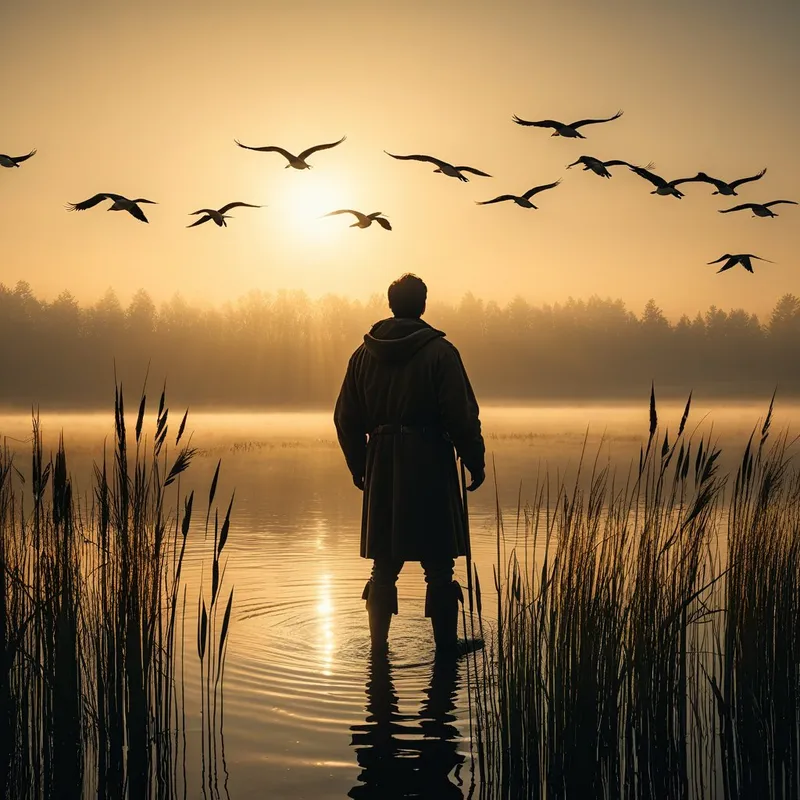
One autumn, as the great Turning of the World began, he followed the game to a vast, reed-choked lake. The sky was a restless river of wings. Thousands of geese—their voices a clamorous, honking song—gathered on the water, a living, breathing island of feather and purpose. Among them, he saw her.
She walked from the water, but she was not of it. Her form was that of a woman, draped in a cloak of down so white it seemed to hold the moon’s own light. Yet in her eyes was the far-seeing look of the migratory path, the knowledge of star-roads and wind-currents. She was of the Geese-People. The hunter’s breath caught, not in fear of the strange, but in recognition of a loneliness mirrored.
For days, he watched from the reeds, not as a hunter stalks prey, but as one soul observes another. He saw her dance with her sisters on the water at twilight, their movements a language older than words. He felt the pull of her world—a world of fierce community, of unwavering direction, of a home that was not a place, but a flock.
Driven by a yearning he could not name, he stepped from his hiding. The geese-women startled, a symphony of alarm. But she, the one he had watched, held her ground. He had no weapon. Instead, he offered the only truth he had: his empty hands, and the solitude in his eyes.
“I have no clan,” he said, his voice rough against the wind. “My fire is cold. Will you share the warmth of yours?”
The geese-woman studied him, her head tilted in that ancient, avian way. “Our fire is the sun on our wings,” she replied, her voice like wind over water. “Our warmth is in the press of the flock against the storm. Can you fly? Can you follow a path written in your blood and the stars?”
“I cannot,” he admitted. “But I can learn the language of your footprints in the mud. I can guard the nest when the fox comes. I can remember the stories of the lake.”
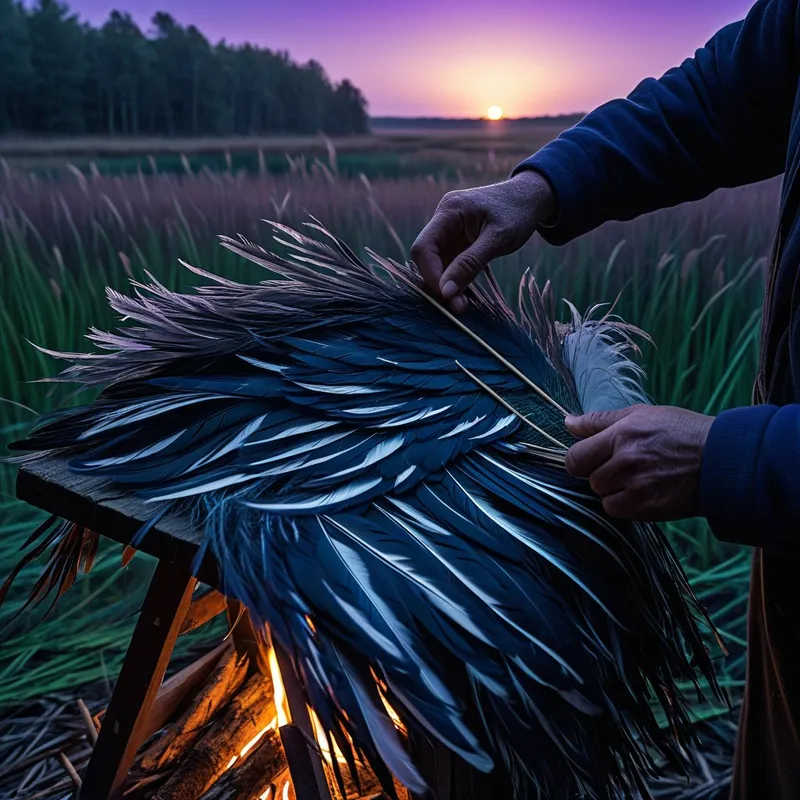
A silent treaty passed between them. She would stay, but at a price. Her beautiful feathered cloak, the source of her power to fly with her people, must be given into his keeping. Without it, she was earth-bound, human. He would hide it, and she would become his wife.
He built a lodge by the lake. She taught him to read the weather in the goose’s cry, to find the sweetest roots, to understand that the land was not a territory to be owned, but a relative to be known. Children were born to them—strong, bright-eyed children who carried in their laughter the echo of a honk and in their eyes the deep knowing of two worlds.
For years, the secret of the hidden cloak lay between them, a silent stone at the bottom of their happiness. Then, one spring, the old, familiar cry echoed from the heavens. The vanguard of the migration returned. His wife stood at the water’s edge, her body tense as a drawn bowstring. She watched her sisters wheel and call, and a sound escaped her—a low, grieving honk that seemed to tear from her very soul.
Their eldest daughter saw her mother’s anguish. Driven by a child’s compassion, she unearthed the hidden cloak from its burial place and brought it to her. The moment the feathered garment touched the woman’s shoulders, the transformation began. Not back into a goose, but into her full, true self—a being of both earth and sky.
She looked at her human husband, her children, her home. Then she looked at the sky, at the calling arrow of her people. The conflict was the whole world. With a cry that held both love and lament, she spread her arms, now wings, and leapt into the air.
But she did not leave them. Circling low, she called down, her voice now fully the voice of the goose. “You are my clan, as they are my clan. You are of the water and the earth. We are of the wind and the star-path. Remember us. When you hear our cry, know it is my voice. When you see our V in the sky, know it is the shape of my love holding you. You are the Geese Clans now.”
And so she rose, joining the flock, leaving behind a people forever marked by that sacred marriage, forever listening for the call from the boundless sky.
Cultural Origins & Context
The myth of the Geese Clans finds its roots among various Algonquian and other Native American peoples, including the Menominee and Anishinaabe. It belongs to a vast corpus of animal-spouse narratives that serve as foundational aetiologies. This story was not mere entertainment; it was a living document of identity, told by elders and storytellers around winter fires and during community gatherings.
Its primary societal function was to explain and sanctify the origin of a specific clan—the Goose or Waterfowl Clan—within the tribe’s complex clan system. It answered profound questions: Why are we connected to this animal? What are our duties? The myth established a sacred, reciprocal relationship with the geese, mandating respect, regulating hunting practices, and embedding ecological ethics into spiritual law. To be of the Geese Clan was to carry a specific responsibility toward those creatures and the wetlands they inhabited, a reminder that human society was woven into a larger, more ancient community of persons, both human and other-than-human.
Symbolic Architecture
At its heart, this is a myth of the individuation of a people, born from the tension and ultimate reconciliation between opposing states of being.
The hunter represents the conscious ego in its isolated state—competent yet unfulfilled, human-centric and earthbound. His loneliness is the psychic ache of the ego that has lost connection to the instinctual, communal soul. The Goose-Woman is the embodiment of the anima and the collective unconscious. She is nature as a conscious, intelligent personhood; she is migratory instinct, group identity, and connection to cosmic patterns (the stars).
The marriage is the ego’s pact with the deep psyche. The hidden cloak is the necessary sacrifice: the instinctual, untamed spirit must be contained, made latent, for the relationship—the new consciousness—to be born.
The children are the new psychic products of this union: potentials that carry the traits of both worlds. The climax—the daughter returning the cloak—symbolizes the inevitable return of the repressed. The instinctual nature cannot be buried forever; it will be unearthed by the innocent, uncompromising part of the psyche (the child). The wife’s transformation and departure are not an abandonment, but a differentiation. She reclaims her full nature, and in doing so, establishes a new, conscious relationship with the human world. She is no longer captive (as a wife without her essence) nor is she lost (as a spirit without connection). She becomes a transcendent function, a living bridge.
The enduring call of the geese becomes the symbol of this permanent, conscious connection to the soul’s wild, migratory depths. We are grounded, but we are called.
The Dreamer's Resonance
When this myth pattern stirs in the modern dreamer, it often signals a profound crossroads between a grounded, familiar identity and a powerful call from the instinctual self. Dreaming of a goose or swan that transforms, of finding a feathered garment, or of feeling a desperate longing to join a migratory flight points to this archetypal drama.
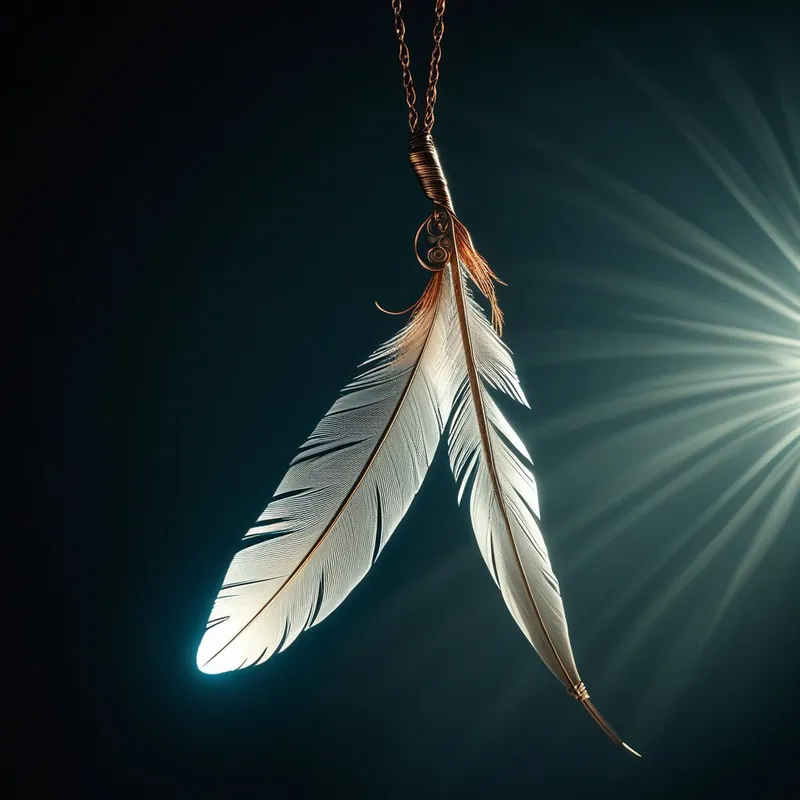
Somatically, one might feel a tightness in the chest—the “cloak” buried—or a restless energy in the limbs, a somatic memory of wings. Psychologically, the dreamer is navigating the tension between containment and release. There is a part of the psyche (the Goose-Spouse) that has been domesticated, its wild wisdom and autonomy traded for the security of a known life (the lodge culture.") by the lake). The dream emerges when this arrangement is no longer sustainable; the instinctual self is grieving its captivity. The process is one of acknowledging that a sacred, life-giving part of oneself has been hidden away, and that its recovery, while it may change the form of one’s life, does not mean its loss. It means establishing a new, more authentic relationship with it.
Alchemical Translation
The alchemical journey modeled here is the coniunctio oppositorum—the sacred marriage—followed not by a static union, but by a sublime and necessary separation that creates a lasting connection.
The hunter’s initial state is the nigredo, the blackening of leaden solitude. His encounter is the albedo, the whitening, as he recognizes the anima in her pure, otherworldly form. The marriage and hidden cloak represent the citrinitas, the yellowing, where the new conscious structure is built and tested through daily life and the creation of new potentials (the children).
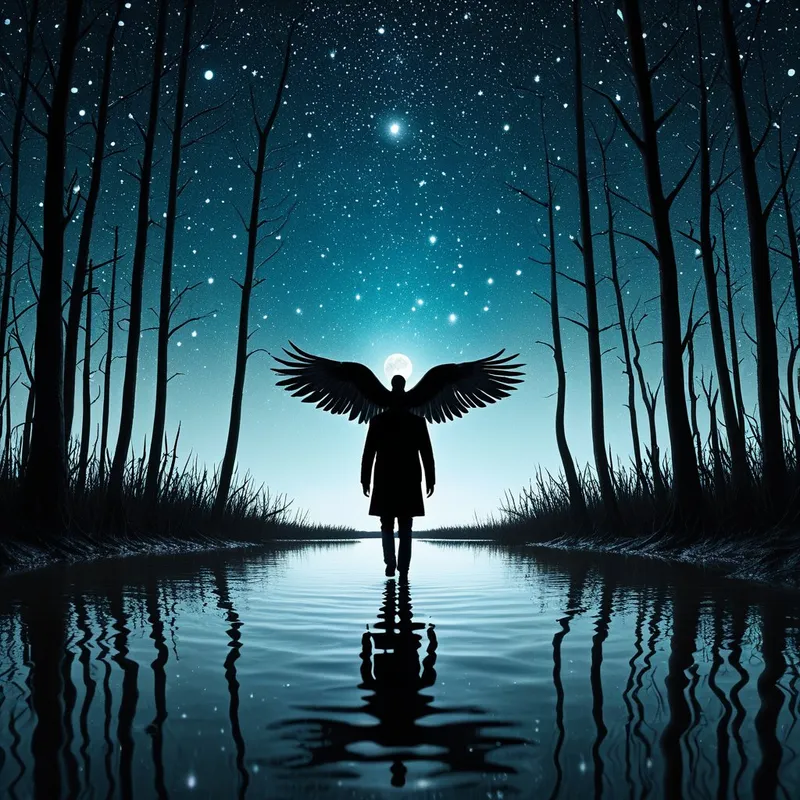
The final stage, the rubedo or reddening, is not a return to the beginning, but an ascent to a higher order. It is the fiery, painful, and glorious moment when the hidden essence is returned, and the psyche differentiates. The ego does not consume the anima, nor does the anima abandon the ego. They achieve a paradoxical state of related autonomy.
For the modern individual, this myth maps the process of honoring a deep, instinctual calling—perhaps to art, to a different way of life, to a reconnection with nature—while maintaining responsibility in one’s human community. It teaches that individuation is not about becoming the wild, untamed spirit (flying away forever). Nor is it about permanently taming it (keeping the cloak buried). It is about becoming the clan that remembers. It is about building a conscious life (the lodge, the family) that is forever in dialogue with that wild, migratory spirit, so that when you hear its call in your soul, you do not despair at its distance. You understand it as the shape of your own completed love, holding the tension between earth and sky, between the solitary self and the flock to which it eternally belongs.
Associated Symbols
Explore related symbols from the CaleaDream lexicon: