Gede Spirits Myth Meaning & Symbolism
The myth of the Gede spirits, trickster guardians of the veil, who mediate between the living and the dead, embodying life's sacred, profane, and regenerative power.
The Tale of Gede Spirits
Listen, and let the drums tell you. In the place where the road turns to dust and the dust turns to memory, there is a gate. It is not made of iron or wood, but of the last breath and the first cry. This is the crossroads, the threshold where all journeys meet. And here, they wait.
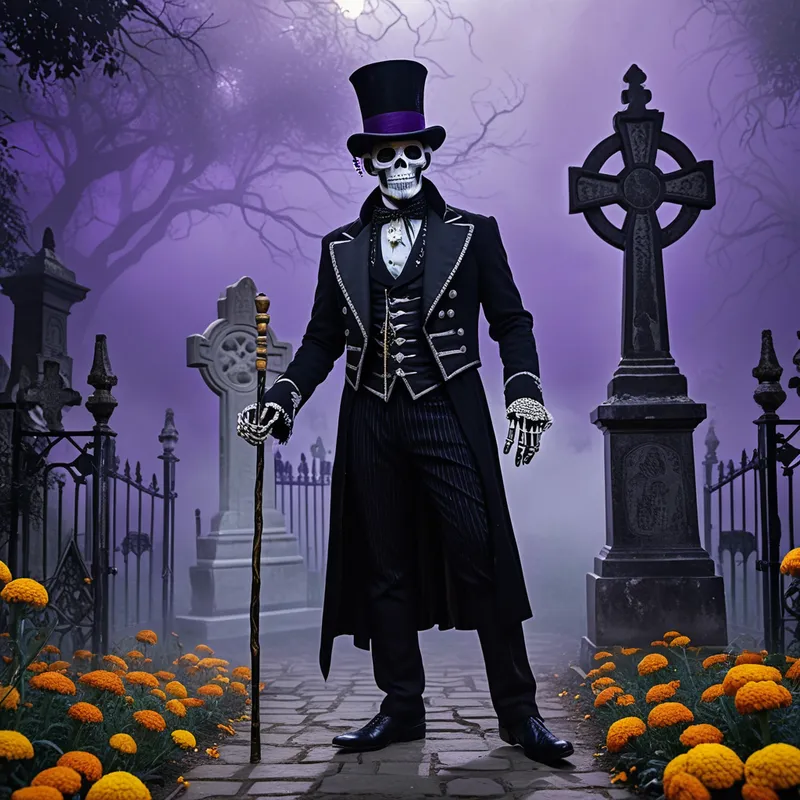
They are the Gede. They wear the faces of the ancestors, but their grins are too wide, their laughter too loud. They speak with the voices of the dead, but their jokes are of life—of sex, of hunger, of the body’s rude, glorious functions. Their king is Baron Samedi. He leans on his phallic cane at the cemetery gate, a skeleton dressed for a funeral he will never attend, his top hat tipped at a jaunty angle, his eyesockets deep pools of knowing mirth. With him is Maman Brigitte, who guards the first tomb in the cemetery, her voice a rasp of gravel and grace.
The world was out of balance. The living feared the dead, building walls of silence. The dead grew lonely, their wisdom untended. The sacred and the profane were torn asunder, and the nanm of the people grew heavy with unspoken grief. The crossroads grew choked with thorns.
Then came the drumming. Not from the village square, but from under the earth. A rhythm that was a heartbeat and a death rattle in one. The Gede pushed at the veil. They did not come with solemn hymns, but with a riotous, disruptive carnival. Baron Samedi swaggered into the marketplace, tipping his hat to fluster the proud, pinching the cheeks of children, demanding his offerings of spicy rum and roasted peanuts. Maman Brigitte cursed in crude poetry, healing with one hand while scattering grave dirt with the other.
The people were shocked, then bewildered, then… they laughed. A deep, belly laugh that shook loose the tears they had locked away. In the chaos of the Gedes’ arrival, the great conflict was revealed: not between life and death, but between denial and acceptance. The rising action was a possession—a dancer in the peristyle seized by the spirit, their body becoming a bridge. They spoke truths, delivered messages from beyond, mocked pretense, and celebrated the raw fact of existence. The resolution was not a battle won, but a balance restored. The veil remained, but now it was a tapestry woven with threads of memory and laughter. The living learned to feed the dead, to speak their names, to dance for them. The dead, through the Gede, reminded the living that to truly live, one must embrace the entirety of the cycle—the ecstasy, the decay, and the inevitable, fertile return to the source.
Cultural Origins & Context
The Gede spirits are a foundational pillar of the spiritual systems forged in the crucible of the African Diaspora, most prominently in Haitian Vodou. Their roots stretch back to the cosmological understandings of West and Central African peoples, particularly the Fon and Kongo, for whom the ancestors are active, intercessory forces in daily life. The Middle Passage and the horrors of plantation slavery did not destroy these beliefs; instead, they were transmuted. In the face of systematic dehumanization and a staggering mortality rate, the concept of the ancestral spirit took on a new, potent, and defiant character.
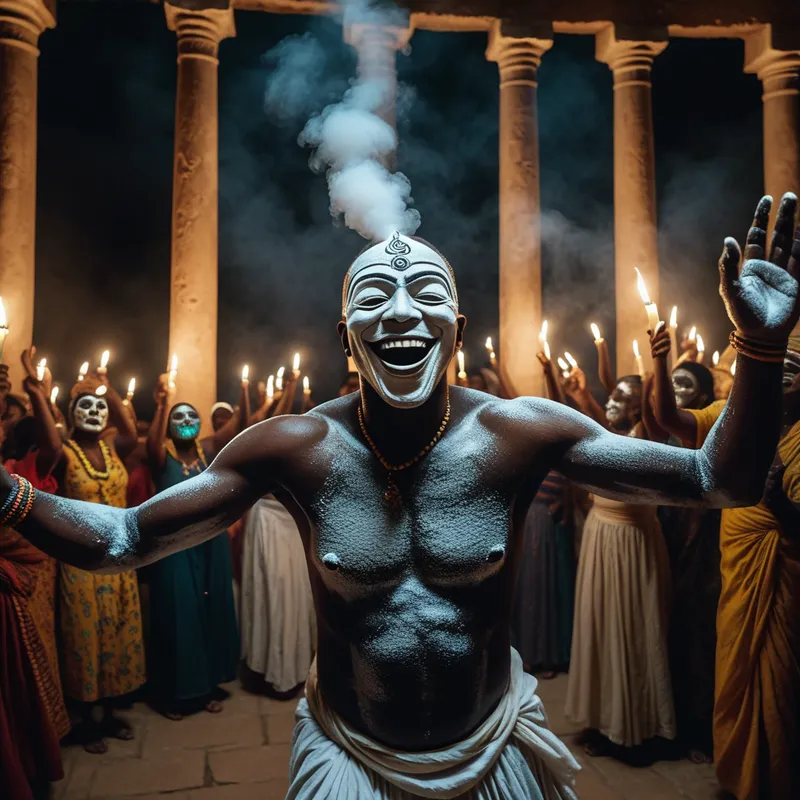
The Gede became the spirits of those who died in the traumatic passage to the New World, those who perished under the lash, those whose graves were unmarked. They are, in a profound sense, the collective voice of a people’s historical grief and resilience. They were not passed down in formal texts but in the secret nighttime ceremonies, in the rhythms of the drum, in the embodied knowledge of the houngan and mambo. Societally, the Gede function as essential mediators and psychological pressure valves. They provide a sanctioned, ritualized space to commune with the dead, to process collective trauma through possession and ecstatic dance, and to confront the reality of death with humor rather than paralyzing terror. They uphold social order by mocking hypocrisy and, crucially, they guard the gates to the afterlife, ensuring the proper transition of the soul and protecting the living from wandering, unsettled spirits.
Symbolic Architecture
The Gede are the ultimate symbol of the crossroads, not as a barren intersection, but as a fecund, creative nexus. They embody the paradoxical unity of opposites that lies at the heart of profound spiritual truths.
To laugh in the face of death is not to deny its power, but to acknowledge a deeper truth: that life and death are dancers in the same eternal ceremony.
Psychologically, the Gede represent the integration of the shadow—not just the personal shadow of repressed desires, but the collective, existential shadow of mortality, decay, and the "uncivilized" drives of the body (sexuality, digestion, elimination). Baron Samedi, with his phallic cane and skeletal grin, is the archetypal fusion of Eros and Thanatos. He declares that creation and dissolution are two sides of the same coin. The Gede’s obscene humor is a sacred mechanism; it shocks the ego out of its pretensions and rigidities, creating an opening for the numinous and the ancestral to enter. The veve for the Gede often incorporates a cross, a coffin, and a phallus—a compact glyph of their domain: the intersection (cross) of termination (coffin) and regeneration (phallus).
The Dreamer's Resonance
When the pattern of the Gede erupts in modern dreams, it signals a profound somatic and psychological process at the threshold of consciousness. It is the psyche’s attempt to mediate a critical crossroads in the dreamer’s life.
You may dream of a grinning figure in a crowd wearing a mask that is also a skull. You may find yourself in a cemetery that feels oddly festive, or discover a hidden, ribald truth about a revered but stern authority figure. The somatic experience is key: uncontrollable laughter that turns to sobs, a feeling of being simultaneously hollow (like a skeleton) and overflowing with vibrant, almost aggressive life force. This is the psyche working to digest something that has been "buried alive"—a grief too sharp to feel, a trauma silenced, a vital aspect of one’s own sensuality or creativity that has been condemned to a psychic grave. The Gede in dreams act as psychopomps for these buried contents, seeking to bring them across the threshold into the light of awareness, not with gentle therapy, but with the disruptive, healing shock of truth-telling laughter. They appear when the ego’s orderly world is preventing necessary decay and rebirth.

Alchemical Translation
The Gede myth models the alchemical process of nigredo and albedo in the vessel of the modern soul. The core struggle is the ego’s resistance to its own mortality and its shadow aspects. The triumph is the transmutation of that fear into liberated vitality.
The individuation journey requires us to sit at our own crossroads, to become both the cemetery and the fertile field that grows from it.
The process begins with a confrontation with the "Baron" of our personal underworld—the repressed, the shameful, the aspects of ourselves we have tried to kill off or entomb in silence. This is the nigredo, the blackening, the descent. The Gede teach that this is not a passive suffering, but an active, even raucous engagement. We must, in a psychological sense, "feed the Gede"—offer our rum of attention and our spicy peppers of honest feeling to these buried parts. The possession that follows is the integration: allowing that silenced voice to speak through us, to mock our personas, to reclaim its rightful, vital energy. The laughter is the albedo, the whitening light of consciousness that emerges after the black decay. It is the realization that in embracing our full cycle—our wounds, our endings, our primal drives—we do not become morbid, but paradoxically more fully, authentically alive. The cane of Baron Samedi becomes our own spine, upright and capable of supporting both our earthly desires and our spiritual aspirations. We become the guardian of our own threshold, able to honor the past without being enslaved by it, and to face the future with the clear-eyed, humorous courage of one who knows the final joke is on fear itself.
Associated Symbols
Explore related symbols from the CaleaDream lexicon:
- Death — The primary domain of the Gede, not as an end but as a transformative gateway and a constant companion in life, whose acknowledgment leads to greater vitality.
- Crossroads — The sacred point of intersection guarded by the Gede, representing critical life decisions, fateful meetings, and the threshold between worlds.
- Spirits of the Ancients — The Gede are the vibrant, active manifestation of the ancestral dead, who remain involved in the world of the living as guides and tricksters.
- Dance — The ecstatic, possessed dance through which the Gede spirits manifest, bridging the spiritual and physical realms and releasing pent-up psychic energy.
- Mask — The Gede wear the metaphorical mask of the dead and use literal face paint (white powder, sunglasses), representing the fluid identity between spirit and human, and the revealing nature of concealment.
- Bone — The literal skeleton of Baron Samedi and a symbol of the essential, stripped-down framework of existence that remains after death, the truth beneath the flesh.
- Trickster — The essential archetype embodied by the Gede, who use humor, obscenity, and chaos to break rigid structures, deliver truth, and restore balance.
- Rebirth — The ultimate promise of the Gede’s domain; from the cemetery (death) comes fertile ground for new life, both physically and psychically.
- Ritual — The structured ceremonies, offerings (rum, peppers), and drumming that provide the container for the Gede’s chaotic energy, allowing for safe communion and transformation.
- Shadow — The psychological aspect perfectly represented by the Gede: the repressed, "indecent," and mortal parts of the self that demand integration for wholeness.