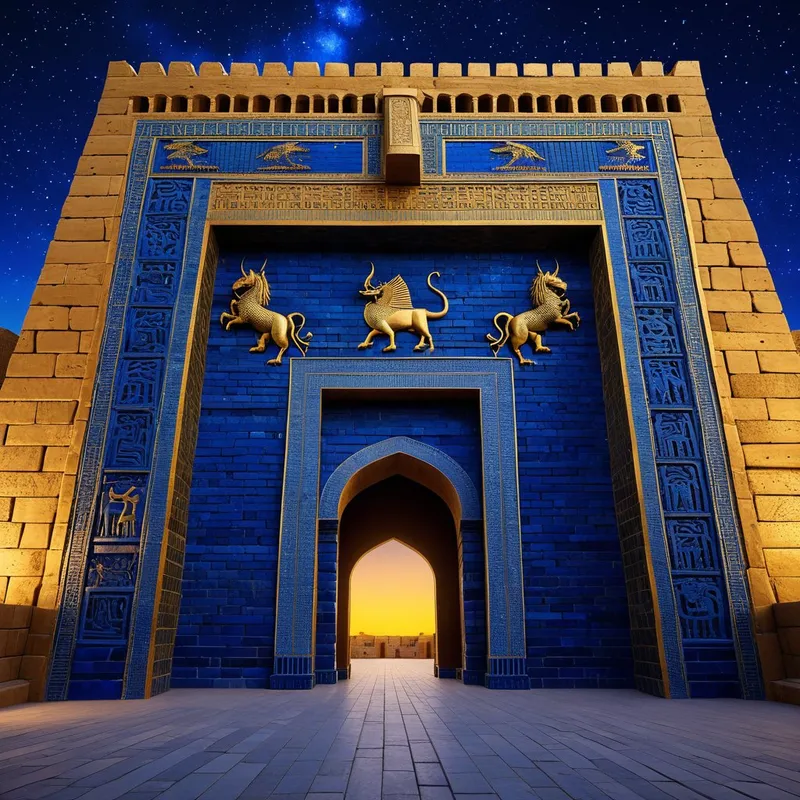
Gate of Ishtar Myth Meaning & Symbolism
The goddess Ishtar descends to the underworld, facing death to confront its queen, a journey of sacrifice and ultimate return that re-establishes cosmic order.
The Tale of the Gate of Ishtar
Hear now the tale that echoes from the baked-brick walls of Babylon, a story not of stone and glaze, but of spirit and will. It begins not with a gate, but with a goddess, and a hunger that the heavens could not sate.
Ishtar, the Lady of Heaven, she of the roaring lion and the planet Venus’s piercing light, turned her gaze downward. Her heart, a tempest of desire and dominion, fixed upon the one realm beyond her command: the Kur, the Land of No Return. Its queen, Ereshkigal, ruled in absolute, silent sovereignty over the dust and the shades. A terrible longing, or perhaps a challenge, stirred in Ishtar. She would descend. She would enter her sister’s house.
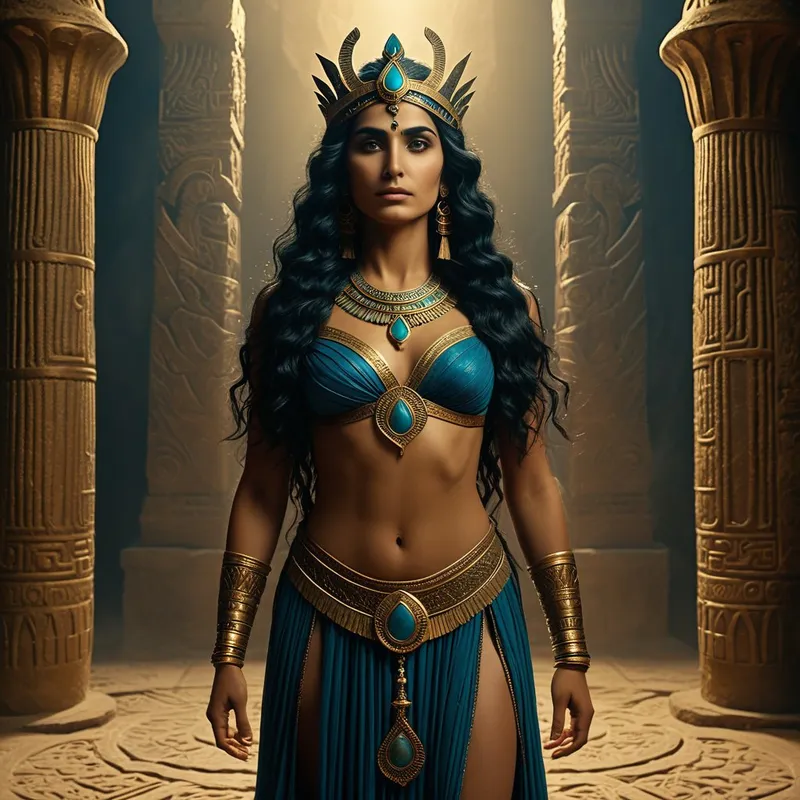
She adorned herself in the majesty of heaven: the crown of the plains upon her brow, the pendants of lapis at her ears, the chokers of gold about her neck, the birthstone beads upon her breast, the girdle of birthstones about her hips, the bracelets of gold and lapis upon her hands and feet, and the proud robe of queenship about her shoulders. Thus arrayed, she came to the entrance of the underworld, a gaping maw in the silent earth, and demanded the gatekeeper open to her.
But the ways of the Kur are not the ways of the living. At the first gate, the keeper, his face shadowed, spoke the law of that place: “Enter, Lady of Heaven, but you must pay the toll of this gate.” And he removed her great crown. A shock, cold as subterranean water, ran through her. At the second gate, he took her lapis pendants; at the third, her chokers; at the fourth, the birthstone beads; at the fifth, the girdle; at the sixth, the bracelets; and at the seventh and final gate, he stripped from her the very robe of her identity.
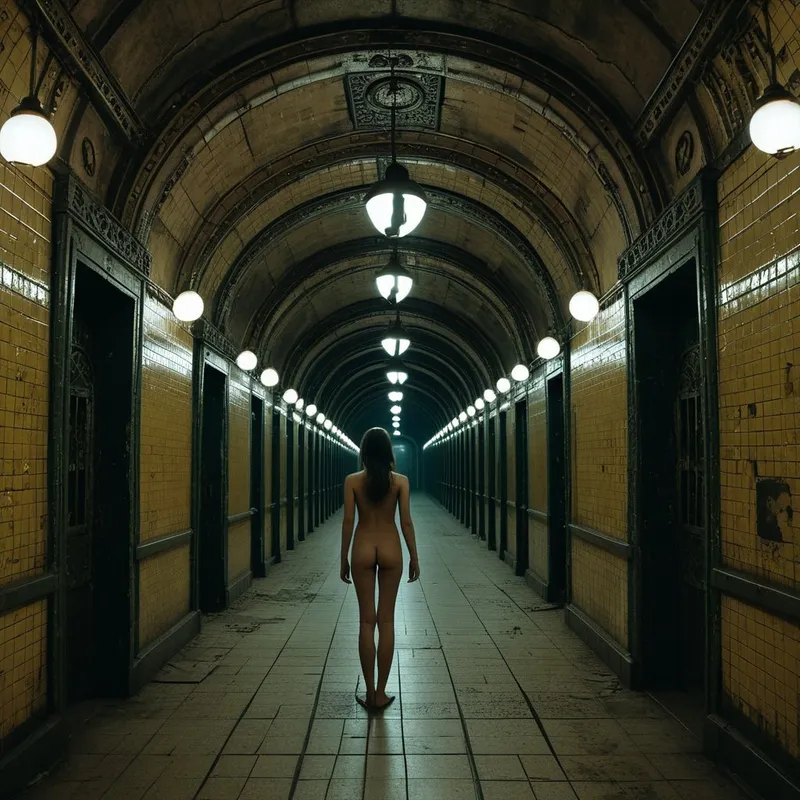
Naked, shorn of all symbols of her power, Ishtar entered the throne room of Ereshkigal. Here was no light, no sound of life, only the heavy stillness of eternal dust. Ereshkigal, upon her bone-pale throne, looked upon her radiant sister, now reduced to essence, and her wrath was the wrath of the absolute depths. She fastened upon Ishtar the Eye of Death, and the goddess of love and war was turned to a corpse, a piece of rotting meat hung upon a hook.
And above, all movement ceased. The bull would not mount the cow, the man would not approach the woman. The world, bereft of Ishtar’s force, fell into a sterile, mourning silence. The gods themselves grew fearful in the stagnant air.
It was Ea, the deep-minded, who crafted a stratagem. From the dirt under his fingernail, he fashioned Asushunamir, a being of exquisite beauty and neutral essence, immune to the fixed laws of the underworld. Sent to Ereshkigal, Asushunamir spoke words of such cunning sympathy that the Queen of the Dead, in a moment of unguarded vulnerability, granted a boon. “Let me have the waters of life,” the creature asked, “to sprinkle upon the hanging corpse.”
A curse of terrible potency Ereshkigal laid upon Asushunamir for this trick, but the boon was given. The waters of life were sprinkled, and Ishtar stirred, returning from the clay. Yet, the Kur does not release its visitors without a ransom. As Ishtar was led back through the seven gates, each garment, each jewel, was returned to her in reverse order. The robe, the bracelets, the girdle—piece by piece, she was reconstituted, but was she the same? She emerged, whole and radiant once more, but behind her, another had to take her place: her beloved, the shepherd-god Dumuzid, was chosen to dwell in the underworld for half the year, ensuring the cycle of descent and return would forever turn.
Cultural Origins & Context
This myth, known as Ishtar’s Descent to the Netherworld, is not a story of a physical gate, but the archetypal blueprint for one. It was inscribed on clay tablets in Sumerian and later Akkadian, recited by priests and scribes not merely as entertainment, but as sacred liturgy. Its function was cosmological and societal. It explained the annual cycle of fertility—the withering of summer when Ishtar/Dumuzid is in the underworld, and the rebirth of spring upon their return. It was a narrative anchor for the Sacred Marriage ritual, where the king’s sovereignty was renewed through symbolic identification with Dumuzid.
The story was a profound meditation on order. The Me, the divine decrees of civilization which Ishtar carried, were nullified by her descent, throwing the world into chaos. Her return re-established them, but at a cost. This echoed the Mesopotamian worldview: life, sovereignty, and fertility were precarious gifts, maintained only through a painful, negotiated balance with the powers of chaos and death, embodied by the underworld and its stern queen.
Symbolic Architecture
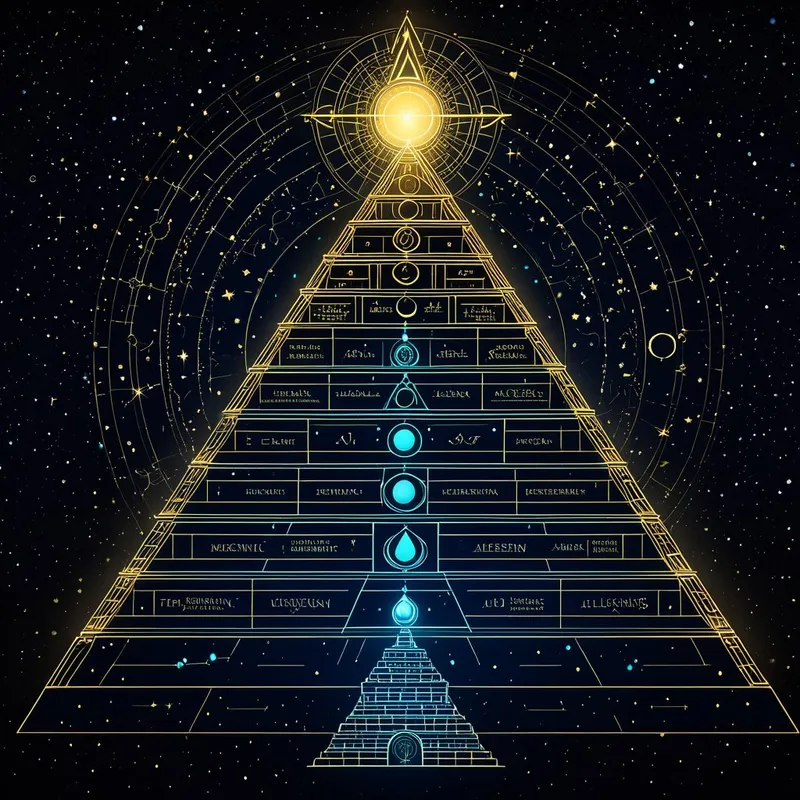
The myth’s power lies in its stark, symbolic architecture. The seven gates are not mere doors; they are stations of deconstruction. Ishtar does not fight a monster; she submits to a process.
The journey to the core of the Self requires the surrender of every identity we clothe ourselves in for the world.
Each piece of jewelry represents a facet of her cultivated persona: her authority (crown), her allure (pendants), her vitality (birthstones), her defining roles (girdle and robe). To enter the realm of the unconscious, the prima materia of the soul, all this conscious structuring must be stripped away. The nakedness before Ereshkigal is the ego’s confrontation with the pure, often terrifying, reality of the Shadow—the part of the psyche that holds all we have disowned, our latent power and our mortality alike. Ereshkigal is not a villain; she is the ultimate, implacable fact of nature and the unconscious, which demands absolute honesty.
The rescue is equally symbolic. Asushunamir, the “mind-creature” born from dirt (instinct) and wisdom (Ea), represents a transcendent function—a new perspective born from the union of consciousness and the unconscious. It is empathy and cunning, a fluidity of being that can negotiate with the absolute. The ransom of Dumuzid establishes the necessary rhythm: life (consciousness) and death (unconscious immersion) must alternate. Wholeness is not a permanent state of light, but a cyclical dialogue between the upper and lower worlds.
The Dreamer's Resonance
When this myth patterns a modern dream, the dreamer is in a profound process of psychic initiation. Dreaming of a series of doors or gates, especially where one must leave something behind at each, signals an involuntary yet necessary descent. The somatic feeling is often of weight being lifted, followed by vulnerability and dread.
The dreamer may find themselves in a basement, a cave, or a descending elevator—all modern Kur analogues. The items left behind are personal “garments”: a job title, a relationship role, a cherished self-image, a source of pride. The confrontation at the bottom is not with a monster, but with a profound emptiness, a depression, or a stark truth about one’s life that has been avoided. This is the “hooked corpse” phase—a feeling of being spiritually dead, inert, and suspended. The psyche is in the grip of a necessary dissolution, composting old identities so a more authentic self can be rewoven upon the return journey.
Alchemical Translation
For the modern individual seeking individuation, Ishtar’s descent is the ultimate model of psychic alchemy. The goal is not to avoid the underworld, but to learn its rites of passage.
The first alchemical stage, Nigredo (blackening), is the stripping at the gates and the hanging corpse—the utter dissolution of the ego’s certainties. It feels like a dark night of the soul, a depression, a crisis of meaning. Ereshkigal is the archetypal force that performs this solve, this breaking down.
The treasure you seek is guarded by the dragon of your deepest fear; you must become naked to pass by it.
The rescue by Asushunamir symbolizes the Albedo (whitening), the dawn of a new, reconciling consciousness. This is the insight that arises from hitting bottom—the compassionate, nuanced understanding that can finally negotiate with our inner darkness. The “waters of life” are the psychic energy released when we stop resisting the descent and accept its reality.
The return and re-clothing are Citrinitas (yellowing) and Rubedo (reddening)—the integration and return to the world. We put our roles back on, but now we wear them consciously, knowing they are garments, not our skin. The ransom of Dumuzid is the final, crucial lesson: the conscious self cannot remain permanently “redeemed.” We must accept a cyclical rhythm, willingly descending into our creative darkness (the artist’s block, the reflective winter, the period of grief) to be replenished. The true “Gate of Ishtar” is not a monument in Babylon, but the threshold within each person, through which we must pass, again and again, to reclaim the sovereignty of an authentic life.
Associated Symbols
Explore related symbols from the CaleaDream lexicon: