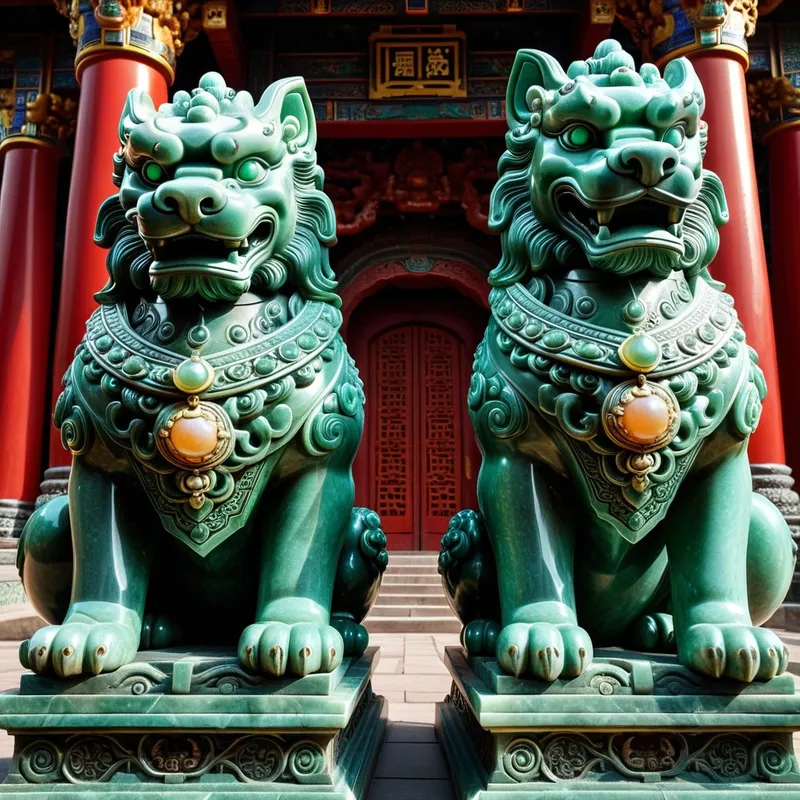
Fu Dogs Myth Meaning & Symbolism
The myth of celestial lion-dogs sent to guard the sacred, embodying the fierce protection of inner and outer boundaries.
The Tale of Fu Dogs
Hear now a tale not of men, but of stone and spirit, of thresholds and the things that guard them. In the high, thin air where the world of mortals brushes against the realm of the celestial, there was a silence. Not an empty silence, but a waiting one. The sacred mountains held their breath; the temples, though built with perfect piety, stood vulnerable. For what is a door without a keeper? A word without meaning? A sacred space is a wound in the ordinary world, and all wounds attract.
The gods perceived this lack. From the Hundun, the formless mist before time, they summoned a concept and gave it flesh and fang. They took the majesty of the mountain lion, king of the earthly realm, and infused it with the wisdom of the qilin. They forged not one creature, but a pair—a complete system. The male, his paw resting firmly upon a woven sphere, the Flaming Pearl. The female, her paw gently restraining a playful cub.
They were set down not with a crash, but with the finality of a seal being pressed into wax. One to the left of the gate, one to the right. Their eyes were not stone, but pools of concentrated will. Their mouths were open not to roar, but to form the sacred syllable that banishes disorder. They did not move, for their power was in their absolute presence. They were a declaration: From here, inward, is different. This space is claimed. This order is defended.
And the waiting silence ended. The male, gazing eternally outward, channeled the chaotic energy of the approaching world, taming it, rolling it beneath his paw like the pearl of cosmic truth. The female, gazing inward toward the sanctum, ensured the vital force, the lineage, the soft growth within remained protected and nurtured. Together, they became the hinge of the world, the fixed point around which the sacred and profane could safely turn. They were the manifested No that makes the sacred Yes possible.
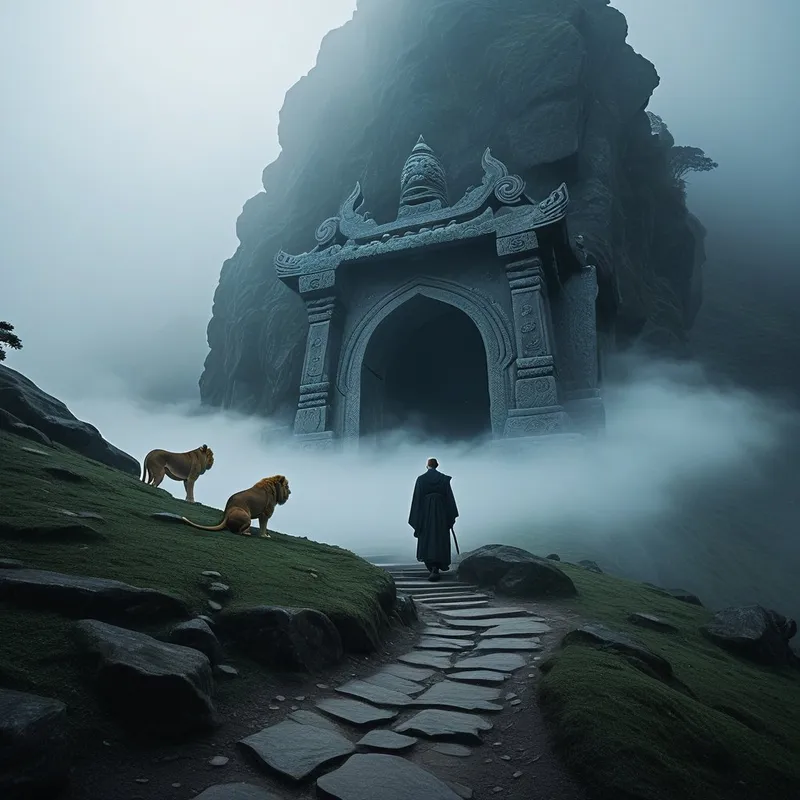
Cultural Origins & Context
The figures we call Fu Dogs or Guardian Lions have a journey that mirrors the flow of ideas along the Silk Road. Their origin lies not in a single mythic tale penned by an author, but in a cultural synthesis. The concept of powerful, protective feline creatures entered Chinese consciousness from Buddhist traditions originating in India and Persia, where lions symbolized the power of the Dharma.
In China, a land where the lion was not a native animal, it transformed from a biological entity into a purely mythological one. It was sinicized, absorbing the symbolic language of Chinese cosmology. They became fixtures at the gates of imperial palaces, government offices, temples, and the homes of the elite. Their function was societal and spiritual: to demarcate and protect spaces of authority, learning, and holiness from malevolent influences, both human and supernatural. They were less characters in a story and more permanent actors in the daily drama of cosmic order (Dao) versus chaos. Craftsmen, not poets, were their primary storytellers, their lore passed down in the grain of stone, the curve of bronze, the patience of jade.
Symbolic Architecture
The Fu Dog is not a pet; it is a principle made manifest. Its symbolism is an architecture of psychic defense and balanced power.
The true guardian does not merely repel invasion; it transforms the energy of the approaching unknown into something that can nourish the sanctum within.
The pair embodies the fundamental duality of Yin and Yang. The male (Yang) is often shown with the Flaming Pearl, representing the active, intellectual, and spiritual pursuit of truth, his paw controlling the chaotic essence of the world. The female (Yin) restrains or nurtures a cub, symbolizing the protective, nurturing, and generative forces that ensure continuity and life. Together, they represent a complete system of protection: one facing outward to engage and manage external threats, the other facing inward to safeguard the vulnerable, growing essence.
Psychologically, they represent the necessary function of the Self in establishing healthy boundaries. The Ego, in Jungian terms, must be able to say "this far, and no further" to the invasive pressures of the outer world (the male's role) and also to the disruptive upwellings of the inner world (the female's calming influence). They are the sentinels of the psyche's sacred space—the individual's core identity and values.
The Dreamer's Resonance
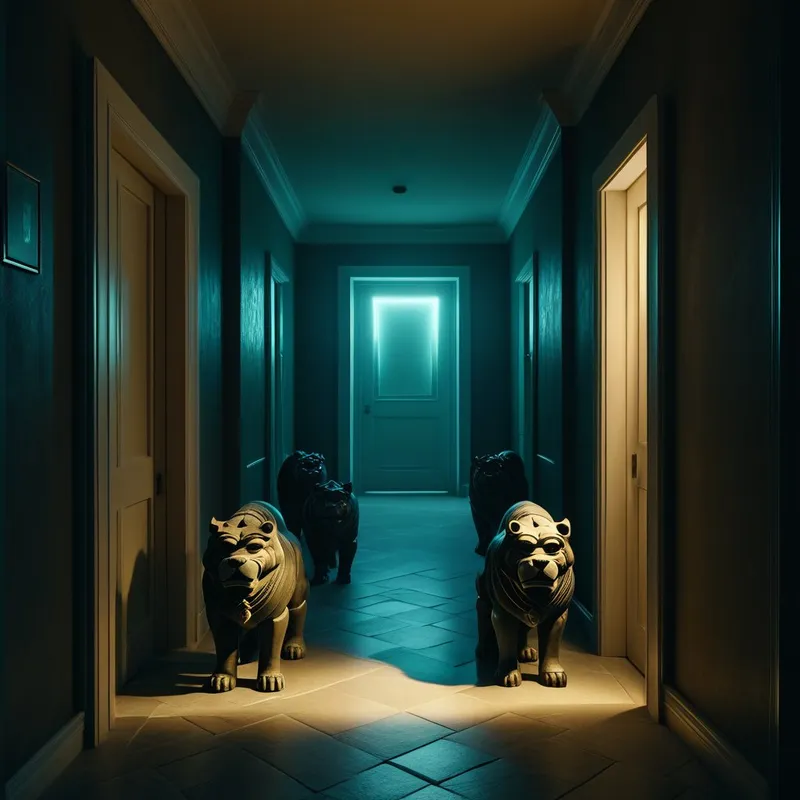
When the Fu Dogs pad into the modern dreamscape, they rarely appear as ornate museum pieces. They manifest as the dreamer's unconscious recognition of a boundary issue. One might dream of discovering stone lions flanking the door to one's childhood home, now cracked and overgrown. Or of a pair of large, silent dogs—a Rottweiler and a nurturing Retriever—standing watch at the entrance to a new office.
The somatic sensation is often one of containment or alertness. The dreamer may feel a sudden calm, a solidity in their chest, as if an internal structure has been silently erected. Conversely, if the dream-Fu Dogs are damaged, sleeping, or absent, it can evoke anxiety, a feeling of being exposed or "un-housed" in one's own life. These dreams signal a psychological process of demarcation. The psyche is working to establish where the individual ends and the world begins, to protect a nascent sense of self, a new relationship, a creative project, or a hard-won inner peace from being eroded.
Alchemical Translation
The individuation process—the journey toward psychic wholeness—requires not just exploration but fortification. One must build a temenos, a sacred enclosure, within which the delicate work of self-discovery can occur without being scattered by every passing wind of opinion or internal storm of doubt.
The alchemy of the Self begins with the creation of a vessel strong enough to contain the transformation. The Fu Dogs are the mythic blueprint for that vessel's guardians.
The "male" Fu Dog represents the conscious discipline we must apply: the focused will that says "this time is for my practice," "this energy will not be diverted," "this criticism will not define me." It rolls the chaotic "Flaming Pearl" of external demands and distractions under the paw of conscious intention. The "female" Fu Dog represents the nurturing, protective compassion we must turn inward: the part that soothes the inner child, protects the fragile new idea, and ensures our growth is not harshly pruned by our own inner critic.
To integrate the Fu Dog archetype is to perform an alchemical translation of ancient, stone-bound guardians into living psychological functions. It is to become, for oneself, both the unwavering sentinel at the gate and the gentle guardian of the hearth. In doing so, we do not become walled off from the world, but rather, we create a defined and protected inner space from which we can engage with the world from a place of integrity, power, and unshakeable calm.
Associated Symbols
Explore related symbols from the CaleaDream lexicon: