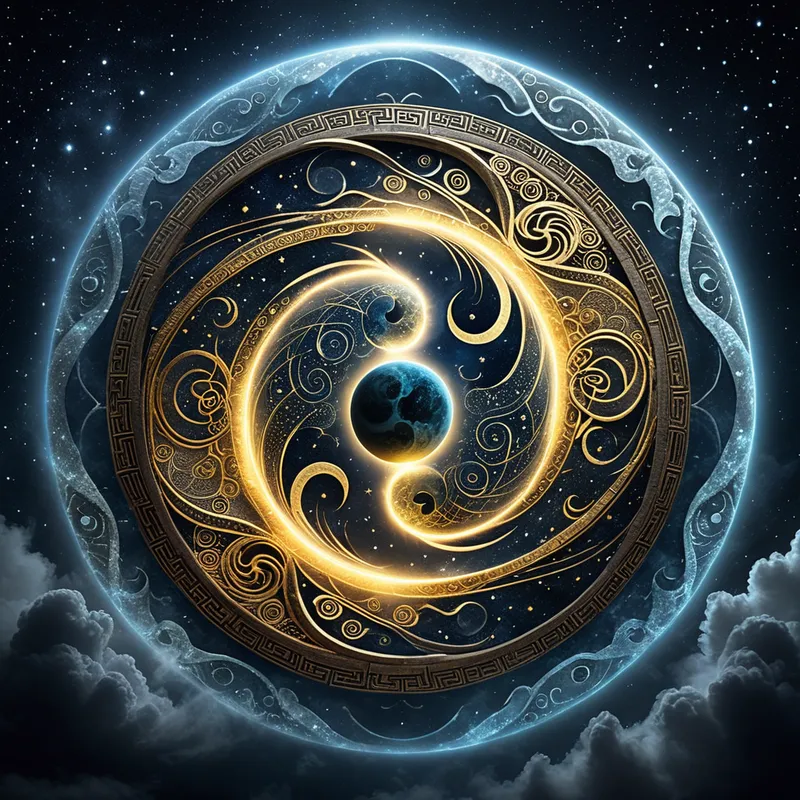
Yin and Yang Myth Meaning & Symbolism
The primordial story of how chaos birthed complementary forces, whose eternal dance creates and sustains all existence.
The Tale of Yin and Yang
Before the first breath, before the first thought, there was only the Hundun. It was not emptiness, but a profound, pregnant fullness—a silent, swirling ocean of potential where light and dark, sound and silence, hard and soft were not yet born, but slept entwined in a single, seamless womb. It was the Cosmic Egg, resting in the void, humming with the song of everything that could ever be.
Within this boundless Hundun, a tension grew—a longing for expression. The potential for rhythm stirred in the heart of the formless. And so, from its own silent depths, a vibration arose. It was not a sound, but the idea of sound. This vibration became a pulse, and the pulse became a beat: the first differentiation.
From this beat, two essences awoke. They were not gods with faces, but primordial principles, twin serpents of energy coiled within the egg. One was heavy, cool, and yielding, drawn to the center. It was Yin—the deep, magnetic pull towards form, the whisper of the moon, the patience of the valley receiving the river. The other was light, warm, and active, straining outward. It was Yang—the radiant push towards expression, the shout of the sun, the ambition of the mountain reaching for the sky.
They began to move. Yang surged upward, its fiery breath spinning into the clear, bright heavens. Yin sank downward, its cool substance settling into the solid, nurturing earth. This was the Great Separation, the birth of space itself. But theirs was not a divorce; it was a dance of desperate attraction. For as Yang soared, it carried within it a seed of Yin—a core of stillness. And as Yin descended, it held within it a spark of Yang—a heart of fire.
Thus, the heavens were not pure Yang, but held the dark of night. The earth was not pure Yin, but held the fire of volcanoes. They chased each other in an eternal, cosmic embrace. Their interaction bred the ten thousand things: the cycle of day and night, the seasons from summer's peak to winter's depth, the fierce heat of noon yielding to the gentle cool of evening. The world was born not from a single act, but from this ceaseless, dynamic, and loving tension—the eternal turning of the Taiji.
Cultural Origins & Context
The concepts of Yin and Yang are not the product of a single author or text, but emerged from the deep, collective observation of the natural world by ancient Chinese thinkers, likely during the Zhou Dynasty. They are first systematically discussed in the appendices of the I Ching (Yijing), and form the foundational bedrock of Daoist cosmology and TCM.
This was not a "myth" told around a fire in a linear story, but a living, symbolic language woven into every aspect of life. Farmers understood it in the sun and rain on their fields. Doctors saw it in the balance of heat and cold in the body. Strategists applied it to the interplay of advance and retreat. It was passed down not just by philosophers, but through proverbs, agricultural almanacs, medical practices, and artistic principles. Its societal function was profoundly practical: it was a cognitive tool for navigating a universe understood not as a collection of objects, but as a web of dynamic, relational processes. It taught that to understand a thing, one must always see its opposite nascent within it and the relationship between them.
Symbolic Architecture
At its core, the myth of Yin</ab title="The active principle.">Yang is a map of consciousness itself. It symbolizes the fundamental psychic fact that reality is perceived through differentiation. Light is known because of shadow, sound because of silence, self because of other.
The whole of existence is a dialogue between two voices that emerged from the same breath.
Yin represents the unconscious, the shadow, the receptive, the body, the feeling function, and the containing womb. Yang symbolizes consciousness, the persona, the active, the spirit, the thinking function, and the penetrating seed. Crucially, neither is "good" or "evil." Pure Yang, without the cooling Yin, is manic burnout, a fire that consumes all fuel. Pure Yin, without the warming Yang, is stagnant depression, a pool that never moves. The dot of opposite within each symbolizes the profound truth that every conscious position contains its unconscious counter-position, and every strength holds the seed of its related weakness.
The S-curve that divides them is the boundary that makes relationship possible—it is the shoreline between ocean and land, the moment of choice, the threshold of the psyche. It is not a wall, but a dynamic interface where transformation occurs.
The Dreamer's Resonance
When this myth stirs in the modern dreamer, it often manifests as dreams of profound duality seeking resolution. One may dream of being chased by one's own double, of a house with two opposing wings in different seasons, or of a marriage or battle between a figure of light and a figure of shadow. These are not nightmares of conflict, but somatic blueprints of integration.
The psychological process is one of recalibration. The dream ego is often caught in an over-identification with one pole: the relentless achiever (Yang) dreams of drowning in a calm, dark sea (Yin), signaling a deep somatic need for rest and reception. The passive accommodator (Yin) dreams of a contained, controlled fire (Yang) growing within their chest, pointing to a repressed will and agency seeking expression. The dream presents the missing opposite, inviting the dreamer to acknowledge and incorporate it, to restore the inner Taiji.

Alchemical Translation
The individuation process, the journey toward psychic wholeness, is perfectly modeled by the Yin-Yang dynamic. It begins with the unconscious, undifferentiated state—the Hundun of our early lives or our neurotic suffering. The first alchemical step is differentiation: consciously recognizing our inner opposites—our ambition and our laziness, our love and our rage, our spirituality and our materialism.
The goal is not to eliminate the tension, but to become the space in which the dance occurs.
The struggle is to hold these opposites in conscious tension without collapsing into one or violently rejecting the other. This is the friction that generates psychic heat, the nigredo of the alchemists. As we endure this tension, a third, transcendent thing begins to emerge—the rotating flow of the Taijitu itself. This is the conjunctio oppositorum, the marriage of opposites. We no longer are our anger or our patience; we have them, and we learn the rhythm of their appropriate expression. We become the vessel that contains the dance. The ultimate alchemical translation is the realization that the seeker, the sought, and the process of seeking are all manifestations of the same eternal, turning whole. We achieve not a static balance, but a dynamic, flowing equilibrium—a participation in the primordial dance that first breathed the world into being.
Associated Symbols
Explore related symbols from the CaleaDream lexicon: