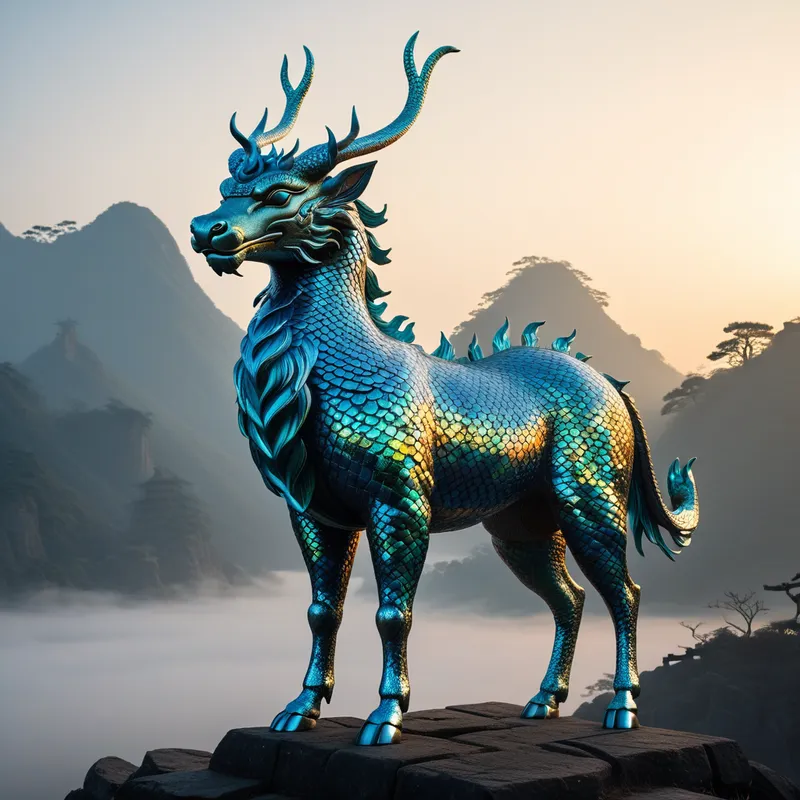
Qilin Myth Meaning & Symbolism
A celestial chimera of prophecy and virtue, the Qilin appears in times of profound peace or transition, embodying the harmonious union of opposites.
The Tale of Qilin
Hush, and listen. Before the age of emperors and empires, when the world was a tapestry of raw potential, the heavens held their breath. The Hundun was still, a silent egg waiting to crack. Then, from the confluence of all benevolent stars, from the whispered agreement between mountain and cloud, it descended. Not with thunder, but with the sound of wind chimes woven from moonlight.
It was the Qilin. Its form was a poem of impossible harmony: the noble body of a deer, armoured not in plate but in the iridescent scales of a carp that had leaped the final waterfall. Its head was that of a dragon, yet softened by a gaze of bottomless compassion, antlers branching like ancient coral holding captive embers of soft fire. Its tail was a lion’s, sweeping the air with a bovine’s patient grace, and its feet were cloven, not to trample, but to tread so lightly it could walk on water or grass without causing a ripple or bending a single blade.
It moved through the primordial landscapes, a living principle. Where it walked, springs of sweet water bubbled forth. Where it lay to rest, rare herbs sprouted, their scent curing sorrow. It did not hunt; it sustained. It spoke not in roars, but in a music that resonated in the heart, not the ear—a silent hymn of ren and yi.
Its most famous visitation came not in mythic pre-history, but on the cusp of recorded legend. The great sage mother, Yan Zhengzai, walked by a quiet cave. There, in a pool of dappled sunlight, the Qilin appeared. It did not startle, nor she it. In its mouth, it carried a piece of jade, upon which were inscribed celestial prophecies. It offered the jade with a gentle bow of its antlered head, and as she accepted it, a profound knowing settled upon her—a knowledge of a son who would weave the moral fabric of a civilization. Then, as silently as it came, the Qilin turned and faded into the forest mist, leaving behind only the scent of orchids and an unshakable peace. Its appearance was the herald, the marker between one age of chaos and the dawning age of ordered virtue.
Cultural Origins & Context
The Qilin’s lineage is woven into the very fabric of Chinese symbolic thought, appearing in texts as early as the Zuo Zhuan (5th century BCE). Unlike gods of thunder or flood dragons, the Qilin was never a deity to be worshipped, but an omen to be recognized—a living signifier from the cosmos itself. It belonged to the scholar, the historian, and the court diviner.
Its stories were passed down not by wandering bards of adventure, but by chroniclers and philosophers like Confucius, who reportedly wept upon hearing of a Qilin’s death, seeing it as an omen for the decline of virtuous rule. The Qilin functioned as a supreme political and moral barometer. Its spontaneous appearance signaled the reign of a truly benevolent ruler, a wang, or the birth of a sage. Its injury or death foretold times of great turmoil and moral decay. Thus, the myth served a critical societal function: it externalized the ideal of harmonious governance, making it visible, tangible, and awe-inspiring. It was culture’s way of dreaming its own highest potential into a form that could be witnessed.
Symbolic Architecture
The Qilin is not a monster of parts, but a perfect symbol of synthesis. It is the embodied resolution of cosmic duality.
The Qilin is the psyche’s answer to fragmentation: a living testament that the dragon’s power and the deer’s gentleness can share one skin.
Its composite form—dragon, deer, ox, lion, fish—transcends the chaos of the chimera to achieve a serene unity. Each element is chosen for its symbolic virtue: the dragon’s spiritual authority, the deer’s longevity and peace, the ox’s dedication, the lion’s courage, the fish’s abundance. This makes the Qilin a complete psychic entity, a Self symbol par excellence. It represents the individuated being in whom all inner conflicts and opposing traits (aggression/passivity, spirit/matter, fire/water) are not eradicated, but harmoniously integrated.
Its most famous trait—treading without harming grass—is the ultimate symbol of conscious embodiment. It represents action in the world that is utterly precise, considerate, and without collateral damage. It is the virtue of wu wei (effortless action) made flesh. The jade tablet it carries signifies divine knowledge or destiny, but knowledge that is given, not taken—a wisdom that arrives when the inner vessel is prepared through virtue.

The Dreamer's Resonance
To dream of a Qilin is to encounter a profound moment of intra-psychic diplomacy. You are not dreaming of a external creature, but of an emergent state of your own potential wholeness.
Somatically, such a dream may be accompanied by a feeling of profound calm, a release of muscular tension, or a sense of “rightness” and alignment. Psychologically, it often appears during life transitions—the end of a chaotic period, the birth of a new creative project, or a moment of ethical clarity. The Qilin does not battle your demons; it simply appears, and in its presence, the inner cacophony stills. It represents the Self arriving to mediate between warring inner factions (the inner critic, the needy child, the aggressive achiever), not with force, but with the undeniable authority of completeness. If the dream-Qilin is injured or distant, it may reflect the dreamer’s fear that their core integrity or moral compass is under threat or has been compromised by life’s brutalities.

Alchemical Translation
The myth of the Qilin models a specific alchemy: the transmutation of inner conflict into serene coherence. The modern individuation journey is often experienced as a struggle—slaying dragons, confronting shadows. The Qilin offers a different, perhaps more mature, map.
The great work is not the heroic conquest of parts of oneself, but the sacred hospitality where all parts are invited to the same table.
The process begins with the recognition of one’s own fragmented nature—the fiery temper (dragon), the skittish vulnerability (deer), the stubborn diligence (ox). The alchemical fire is not aggression, but the sustained, compassionate attention of consciousness. In this vessel, the elements are not destroyed but re-contextualized. The dragon’s fire becomes the warmth of conviction; the deer’s flight becomes graceful discernment; the ox’s stubbornness becomes unwavering integrity.
The “birth of the sage” heralded by the Qilin is the birth of this inner authority. The jade tablet is the unique insight or life-purpose that can only be “read” once this inner harmony is achieved. To walk like the Qilin is to move through one’s relationships and work with that same precise, non-harmful grace—your actions becoming beneficial by their very nature, not by strenuous effort. The ultimate triumph is not a victory, but a state of being: becoming a vessel so harmonious that you, yourself, become an omen of peace in the world around you.
Associated Symbols
Explore related symbols from the CaleaDream lexicon: