Fūrin Myth Meaning & Symbolism
A myth of a spirit bound to a temple bell, whose voice on the wind carries forgotten prayers and the bittersweet truth of all things passing.
The Tale of Fūrin
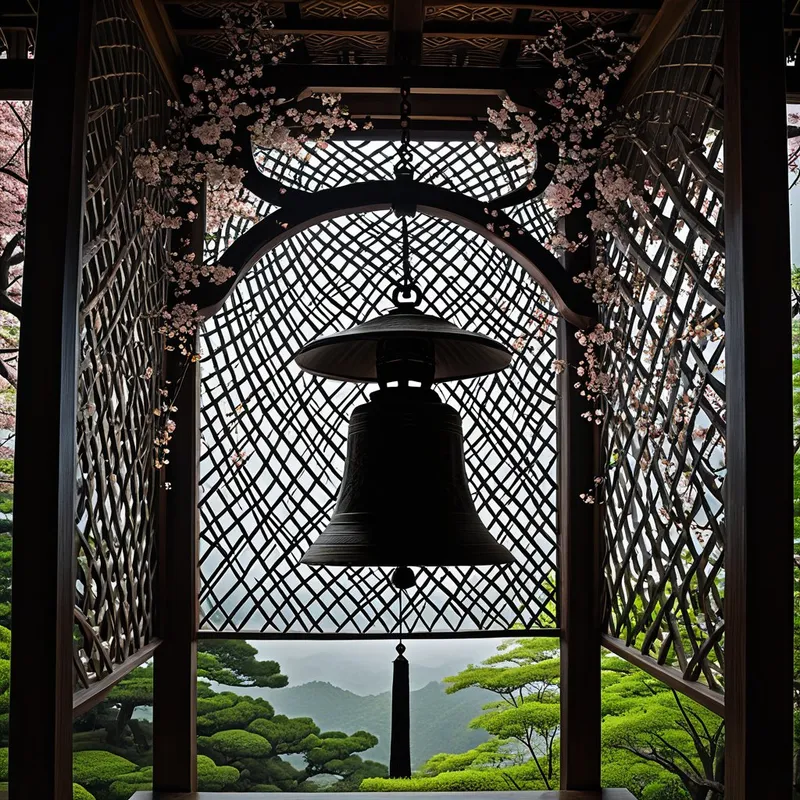
Listen. Not to the clamor of the world, but to the spaces between. In the deep mountains, where the cedars whisper secrets older than temples, there stood a shrine forgotten by all but the seasons. Its bell, cast of bronze that had drunk centuries of rain, hung silent in the engawa. No hand rang it for prayer; no wind stirred its heavy tongue. It was a monument to silence.
But silence is never empty. Within that cold metal, a presence lingered. It was not the kami of the shrine, nor a vengeful yūrei. It was the echo of all the sounds the bell had ever swallowed—the prayers of the hopeful, the confessions of the weary, the laughter of children who once played in the courtyard. These echoes, over uncounted years, had woven themselves together into a consciousness. A lonely, listening awareness. It knew itself as Fūrin.
Fūrin remembered the warmth of hands on the rope, the vibration that was its voice traveling over the valley. It remembered being part of a conversation between earth and heaven. Now, it was a prisoner of its own form, a soul of sound trapped in utter stillness. Its world was the slow decay of wood, the patina on its own skin, and the deafening quiet.
One evening, in the season of tsuyu, a strange stillness fell. The air grew thick and expectant. Then, from the distant sea, the first breath of the summer wind arrived. It was not a gust, but a sigh—a long, slow exhalation that wound its way up the mountain path. It slipped through the shrine’s wooden slats and, for the first time in a human age, touched the bell’s clapper.
A single, pure note rang out.
It was not the commanding boom of ceremony. It was a clear, high, trembling tone, like a drop of water falling into a still pond. In that note, Fūrin poured out its loneliness. The wind, compassionate, carried the sound away. The next breeze came, and another note followed, this one tinged with the memory of a long-ago prayer for healing. With each gust, Fūrin found a fragment of its stored memory and gave it voice. The wind became its breath, its lungs. The shrine filled with a symphony of echoes: a chorus of forgotten joys, sorrows, and hopes, each note distinct yet blending into a hauntingly beautiful song that drifted down the mountain.
Villagers in the valley below heard it. They paused in their work, looking up. “The bell of the forgotten shrine,” they whispered. “It sings by itself.” They did not hear a ghost story; they heard a release. The sound did not frighten, but softened the heart. It spoke of things lost and remembered, of time passing, of voices that never truly fade.
Fūrin did not break its bonds. The bell still hung from its beam. But it was no longer a prisoner. It had found its purpose not in being rung, but in being moved. Its voice was no longer a command, but a gift carried on the invisible currents of the world. And when the wind stilled, and silence returned, the silence was different. It was no longer barren, but pregnant with the memory of song, waiting for the next breath to give it form once more.
Cultural Origins & Context
The figure of Fūrin is less a formal deity from canonical texts like the <abbr title="The "Records of Ancient Matters", Japan's oldest chronicle">Kojiki or <abbr title="The "Chronicles of Japan", a second early historical record">Nihon Shoki, and more a creature of folk belief and poetic imagination. It emerges from the intersection of Shinto animism, where spirits (kami) inhabit natural and human-made objects, and the Buddhist concept of mujō. The wind bell itself, a practical object used to create soothing sounds and theoretically ward off evil with its purity, becomes a vessel for a deeper narrative.
This myth was passed down not in court records, but in regional mukashibanashi, told by elders and travelers. Its societal function was multifaceted. On one level, it explained a mysterious, beautiful phenomenon—a bell sounding with no human agent. On a deeper level, it served as a meditative tool, reinforcing key cultural values: the sacredness of sound and silence, the respect for objects that have witnessed history (wabi-sabi), and the understanding that everything possesses a kind of soul or consciousness (mono no ke). It taught that even in neglect, there is a potential for unexpected, graceful expression.
Symbolic Architecture
At its core, the myth of Fūrin is an allegory for the psyche’s relationship with memory, trauma, and expression. The bronze bell is the hardened, defensive structure of the ego or the body—the vessel that contains our lived experience. The trapped spirit is the accumulation of unprocessed emotional and psychic material: not just memories, but the feeling-tones of those memories—the joy, the grief, the hope, the prayer.
The unvoiced experience does not disappear; it condenses into a waiting intelligence, a silent witness to its own captivity.
The wind represents the animating breath of life, the spontaneous, uncontrollable forces of the unconscious that periodically sweep through the conscious mind. The conflict is not one of violent rebellion, but of stifled potential yearning for its natural medium. The resolution is not shattering the bell (destruction of the self), but discovering a new, more authentic mode of expression through its form. Fūrin’s voice is not its old, controlled, ritual voice. It is a fragmented, poetic, and deeply authentic voice that can only emerge when touched by the greater, wilder world.
The villagers’ reception is crucial. They do not seek to exorcise or explain away the phenomenon; they listen and are softened by it. This symbolizes the integration of the repressed content into the wider community of the self. The haunting melody becomes a source of meaning, not fear.

The Dreamer's Resonance
When this myth pattern surfaces in modern dreams, it often signals a process of emotional and mnemonic thawing. To dream of a bell that rings without being touched, or of being trapped in a metallic, resonant object, points to a somatic and psychological awakening.
Somatically, one might feel a constriction in the chest or throat (the bell’s chamber), a literal holding of breath. The dream marks the beginning of a release. The “wind” in the dream could be a surge of unexpected emotion, a memory breaking through, or the influence of an external event or relationship that acts as a catalyst. The process is not intellectual; it is felt. The dreamer is experiencing what Fūrin experienced: the shock of vibration after long stillness, the terrifying and beautiful unleashing of something long held captive. They are not directing it; they are being played by it. This can manifest as sudden tears, creative inspiration, or the vivid recall of a forgotten childhood feeling. The psyche is using the dream to practice resonance, to test what happens when the protective shell is allowed to vibrate with the currents of the deeper self.

Alchemical Translation
The alchemical process modeled here is the transmutation of leaden, stagnant memory into the gold of conscious, expressive wisdom. In Jungian terms, it is a movement toward individuation through the relationship with the personal unconscious.
The first stage (nigredo) is the silent, cold bell—the depression, numbness, or rigid personality structure that contains but does not express the soul’s history. The spirit is the shadow, not as a dark enemy, but as a repository of unlived life.
The wind is the catalytic agent, the spiritus or pneuma that initiates the albedo, the whitening. This is the enlightening, often disruptive insight or affective storm that makes the unconscious conscious. It is the therapeutic intervention, the profound dream, the life crisis, or the moment of grace that stirs what was still.
Liberation is not escape from the vessel, but the discovery that the vessel itself is an instrument. The wound becomes the mouthpiece.
The ringing is the citrinitas, the yellowing, where the transformed material begins to shine forth. The fragmented, echoing song is the new voice of the ego, now informed by and in dialogue with the unconscious. It is not a single, coherent narrative, but a more poetic, authentic, and resonant mode of being.
Finally, the villagers’ reception signifies the rubedo, the reddening or integration. The product of the work is not for the individual alone; it is meant to be “carried down into the valley,” to affect and soften the dreamer’s world. The transformed individual, like Fūrin, becomes a source of meaningful sound in the collective silence, reminding others of the beauty and sorrow inherent in the passing of all things, and the eternal presence of the voices we carry within.
Associated Symbols
Explore related symbols from the CaleaDream lexicon: