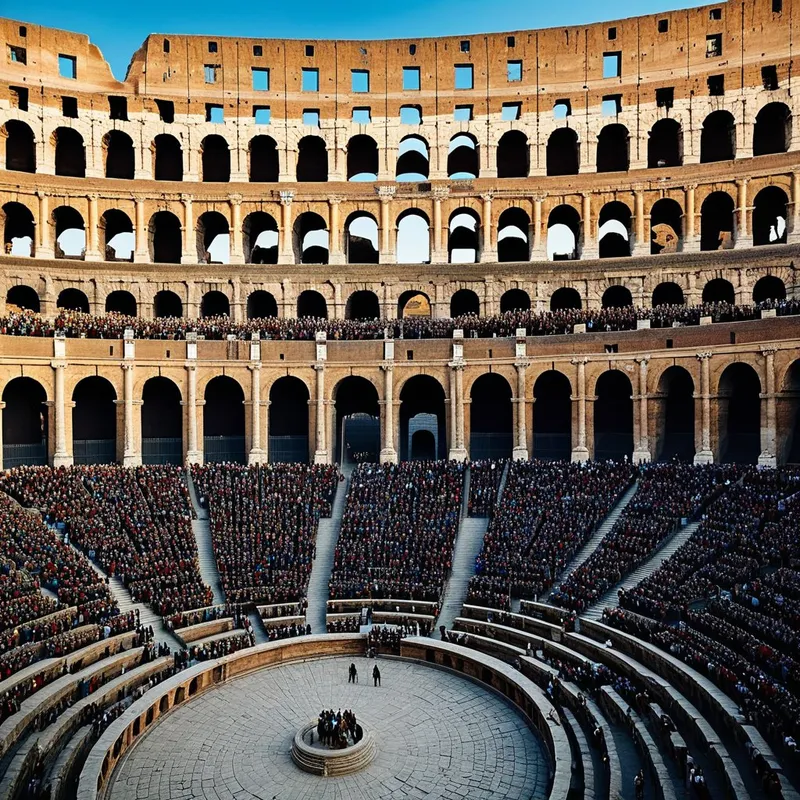
Flavian Amphitheatre Myth Meaning & Symbolism
The Flavian Amphitheatre is a mythic stage where Rome enacted its cosmic order through spectacle, sacrifice, and the confrontation with chaos.
The Tale of Flavian Amphitheatre
Hear now the tale not of a building of stone, but of a living dream, born from the breath of an empire. In the heart of the world, where seven hills cradle destiny, a vision took root in the mind of a Vespasian. He looked upon the golden house of a tyrant, a palace of solitary indulgence, and saw a wound in the soul of Rome. "This," he declared to his son Titus, "shall be a palace for the people. Not of marble for one, but of sand for all."
And so the dream was made flesh. From the quarries at Tivoli came bones of travertine, hauled by armies of the willing and the enslaved, stacked into a mountain of perfect order. Eighty arches, like gaping mouths, drank in the multitudes. Tier upon tier rose, a frozen wave of humanity, from the senatorial purple at the sand's edge to the gods and the common breath in the high, hot air. It was a cosmos in miniature: the emperor, a Pontifex Maximus, in his box like Jupiter on Olympus; the ordered ranks of citizens below; and in the center, the harena, the world stage.
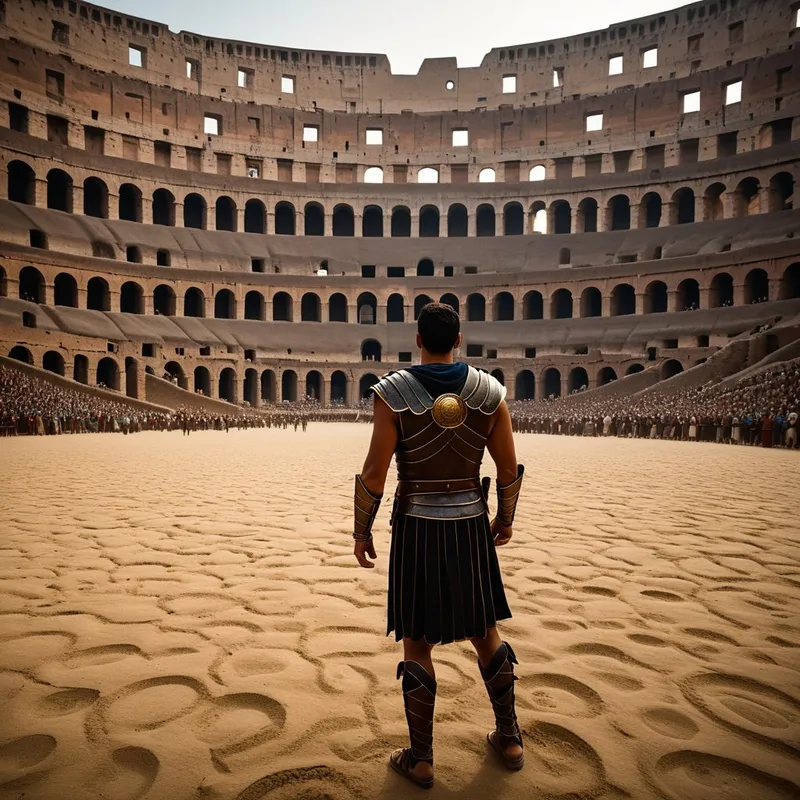
Upon that sand, the myth was performed daily. At dawn came the venationes, where the wildness of the empire—lions of Africa, bears of the north—was paradied and slaughtered, a ritual taming of the outer chaos. Then, the heart of the spectacle: the gladiators. They were not mere men, but personae. A murmillo became a legionary, a retiarius</ab title> a demon of the deep. Their combat was a sacred drama. The clash of steel was a prayer. The fallen would look to the editor of the games, and the crowd would roar with a single voice—Jugula! or Mitte!—life or death held in the gesture of a thumb.
The climax was the naumachia, when the arena would flood, and whole ships would duel, re-enacting the empire's naval triumphs. Here, water met earth, chaos met order, and Rome witnessed its own power to remake reality within this sacred circle. When the last combatant fell, and the sand was raked clean, the great velarium would close like an eyelid. The dream would end, only to be dreamed again with the next rising sun.
Cultural Origins & Context
This was no spontaneous myth, but a carefully engineered civic religion. The Amphitheatrum Flavium was conceived in the wake of civil war, the Year of the Four Emperors, a time when the Roman world-soul had fractured. The Flavians, a new dynasty without the august lineage of the Julians, needed a new foundation myth built not on bloodline, but on spectacle and shared experience.
The myth was propagated not through scrolls, but through performance. It was told by the herald announcing the day's games, by the bet-taker in the crowd, by the mother explaining the symbols to her child. Its function was multifaceted: it was a demonstration of imperial liberalitas, a redistribution of wealth and pleasure. It was a reinforcement of the social hierarchy, literally set in stone by the seating arrangements. Most profoundly, it was a ritual of catharsis and reaffirmation. The violence on the sand was a controlled release of the empire's own internal and external violence, a sacrificial offering that, in theory, restored Pax Deorum and, by extension, Pax Romana.
Symbolic Architecture
The Amphitheatre is a supreme symbol of the Senex archetype in its Roman incarnation. It represents the psyche's attempt to create a perfect, bounded arena for the confrontation with chaos.
The Colosseum is the ego's fortress: a magnificent, ordered structure built to contain and ritualize the terrifying, formless drama of the unconscious.
Its oval form is a mandala, a symbol of wholeness and the cosmos. The external facade, with its rigid, repetitive arches, represents the persona—the acceptable, orderly face shown to the world. The interior, focused on the central void of the arena, is the unconscious itself. The hypogeum beneath the floor is the shadow realm, where the beasts and gladiators (the instinctual and repressed forces) were held before being elevated into the light of consciousness for battle. The spectacle was a sanctioned, public negotiation between order and chaos, civilization and wildness, life and death.
The Dreamer's Resonance
To dream of the Flavian Amphitheatre is to dream of being placed at the center of a vast, watching structure. The modern dreamer is both spectator and participant.
If you are in the stands, you are witnessing some part of your own psyche performing or struggling on the stage below. You are the conscious mind observing an internal conflict—perhaps a battle between duty and desire (the secutor and retiarius), or the taming of a fierce emotional instinct (the venatio). The roar of the crowd may mirror internalized judgments or societal pressures.
If you are the one in the arena, the dream signals a profound moment of ordeal and exposure. You are being called to confront a shadow aspect in full view of your own critical awareness (the crowd). The feeling is one of intense somatic pressure—the weight of expectation, the dryness of the throat, the glare of scrutiny. This dream often precedes a life event that feels like a public test or a necessary, brutal confrontation with a part of oneself one has long avoided.
Alchemical Translation
The alchemical process modeled here is not a gentle sublimation, but the nigredo and albedo enacted through ordeal. The myth presents a path of individuation through public sacrifice and ritualized combat.
First, the massa confusa of the personal and collective shadow—the wild beasts, the condemned criminals, the raw aggression—is brought up from the hypogeum (the repressed unconscious) into the vas or vessel of the arena (the circumscribed space of conscious work). Here, under the sun (the light of consciousness), the brutal, unintegrated elements are forced to fight. The ego (the gladiator-hero) must face them with discipline (ludus training).
The thumb's gesture, life or death, is the critical moment of psychic discrimination. It is the ego's choice, witnessed by the whole Self (the crowd), to integrate or annihilate a complex.
Triumph is not merely survival. It is the transformation of the chaotic force into an acknowledged part of the self, earning the rudis of liberation. The final flooding of the arena for the naumachia symbolizes the dissolution of the old, rigid ego-structure in the waters of the unconscious, leading to a rebirth of the personality on a new, more complex level. For the modern individual, this translates to the courage to stage one's inner conflicts in the arena of awareness, to face them with ritual respect, and to make conscious, often difficult, choices about what to integrate, thereby building a more resilient and authentic psychic empire.
Associated Symbols
Explore related symbols from the CaleaDream lexicon: