Fire Keeper Myth Meaning & Symbolism
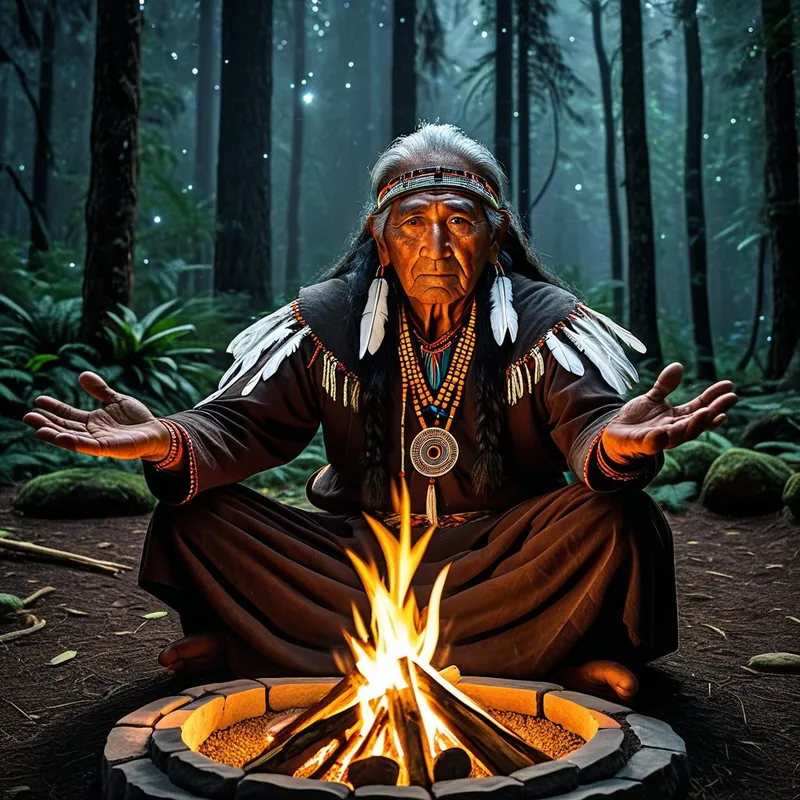
A myth of a being who holds the sacred fire for the people, embodying the eternal duty of tending the communal spirit and the inner flame of the soul.
The Tale of the Fire Keeper
In the time before memory, when the world was raw and the people were new, the Great Mystery gave a gift. It was not a spear for hunting, nor a seed for planting. It was a spark, a single, living tongue of flame, born from the heart of the sun and the friction of the world's turning. This was the First Fire, and it was the life of the people. It cooked their food, warmed their lodges, lit their councils, and carried their prayers to the sky.
But fire is a restless spirit. It dances, it consumes, it dies to ash if left untended. Who would hold this fragile, powerful heart for all the people? Who would bear the weight of its light and the terror of its loss?
The call went out. The mighty hunter, whose arm never tired, stepped forward. He took the fire and built it high, a roaring beacon. But he grew bored with its constant need. He left to chase the elk, and the fire, neglected, gorged on the dry wood of the lodge culture.") and fled into the forest as a devouring beast. The clever storyteller tried next. She wove beautiful tales around the flame, but she fell asleep to dreams of her own making, and the fire dwindled to a cold, grey memory.
A deep cold began to creep into the bones of the world. The people huddled, spirit and body growing numb. From the edge of the circle, a quiet one watched. She was not the strongest, nor the loudest. She was the one who noticed when a child was cold, when an elder’s bowl was empty, when the circle of the community had a crack. Her name is not sung in boasts, but whispered in gratitude. She was the one who mended.
Without a word, she walked to the dead ashes. She knelt. With hands that knew the patience of weaving and the tenderness of healing, she began to sift. For three days and three nights, as the wind howled and the people despaired, she searched. Her fingers grew raw, her hope a thin thread. Then, in the deepest, most forgotten corner of the hearth, her touch found a tiny, buried coal. A faint, almost invisible pulse of warmth.
She did not grab it. She did not blow on it fiercely. She cupped her hands around it as if it were the last breath of a loved one. She fed it not with great logs, but with the softest, driest tinder—a whisper of bark, a breath of grass. She shielded it with her own body from the wind. She gave it her attention, her unwavering presence, her breath—slow and steady as the earth’s own rhythm.
Slowly, agonizingly slowly, the coal accepted her offering. A single orange eye opened in the darkness. A tendril of smoke, then the faintest, most courageous flame, no bigger than a berry, trembled into being. She did not move. She became a vessel, a living hearth. The flame grew, fed by her constancy. It did not roar; it hummed. Its light was not the blinding light of conquest, but the warm, golden light of the hearth, of the held space, of the promise that life continues.
And so she remained. The people named her Keeper of the Fire. Her lodge became the heart-fire lodge. Her duty was eternal, her vigil unending. She was the one who stayed, so that all others could come and go. The fire was no longer just a tool; it became the Sacred Heart of the People, and she, its humble, indispensable guardian.
Cultural Origins & Context
The motif of the Fire Keeper is not a single, monolithic myth from one specific nation, but a profound archetypal role woven into the spiritual and practical fabric of many Indigenous cultures across North America. In societies where fire was literal survival—for warmth, cooking, protection, and ceremony—the role of tending the communal fire was a sacred charge. Often, this duty fell to a designated clan, family, or individual, such as a clan mother or a spiritual elder.
The stories surrounding this role were transmitted not as grandiose epics of heroes slaying monsters, but as teaching stories, shared in lodges and around the very fires they described. They functioned as societal glue, encoding the values of responsibility, selfless service, and the understanding that the community’s vitality depends on often-invisible acts of constant care. The Fire Keeper’s story is a map of relational accountability, teaching that the most crucial tasks are not always the most dramatic, but are always the most sustaining.
Symbolic Architecture
At its core, the myth of the Fire Keeper is a parable of consciousness itself. The fire represents the living spirit—of the individual, the family, the tribe, and the land. It is the spark of life, the light of awareness, the warmth of relationship, and the transformative power of spirit.
The sacred fire is not a possession; it is a relationship. To keep the fire is to engage in a perpetual ceremony of reciprocity with the animating spark of the world.
The Keeper is the archetype of the Nurturing Consciousness. Their power lies not in force, but in attentive presence. The failed attempts by the hunter (the ego of action) and the storyteller (the ego of imagination) illustrate that the flame of spirit cannot be maintained by occasional, grandiose gestures or self-absorbed fantasy. It requires the humble, daily discipline of showing up—the psychology of the container. The Keeper’s act of sifting through cold ashes is the ultimate symbol of hope and discernment: the willingness to search for a faint pulse of life when all seems dead, a metaphor for finding the will to live in moments of profound depression or despair.
The Dreamer's Resonance
When the pattern of the Fire Keeper emerges in modern dreams, it often signals a critical phase of soul-tending. The dreamer may find themselves in a cold, dark place, tasked with guarding a small, vulnerable flame. They may be searching desperately for an ember in a vast landscape of ash. The somatic feeling is one of acute responsibility mixed with anxiety—a chilling fear that the fragile light will go out on their watch.
Psychologically, this dream points to the exhaustion of the inner caregiver, or the awakening to a sacred duty one has neglected. The “fire” may be a creative project, a relationship, one’s physical health, or a core spiritual value that has been left untended. The dream is a call from the deep self to cease wandering and to commit to the vigil—to become the vessel that holds the warmth. It is the psyche’s way of stating that a fundamental life-force is at risk and requires your devoted, patient attention above all else.

Alchemical Translation
The journey of the Fire Keeper is a masterful model for the alchemical process of individuation, framed not as a heroic quest outward, but as a sacred commitment inward. The initial nigredo (the blackening) is the cold, dead hearth—the feeling of inner emptiness, burnout, or spiritual numbness. The failed heroes represent the ego’s futile attempts to solve a soul-problem with persona-based strengths.
The Keeper’s act is the albedo (the whitening)—the patient, humble sifting in the ashes. This is the work of introspection, of sorting through the debris of the past and the failures of the ego to find the authentic, living core. The discovery of the coal is the first connection to the Self.
The transmutation occurs not in the roaring blaze, but in the sustained, breath-by-breath act of tending. The gold is forged in the constancy of the vessel.
The final stage, the rubedo (the reddening), is not a single triumphant moment, but the ongoing, lifelong vigil. The “gold” produced is not fame or power, but a tempered, resilient consciousness capable of sustaining life—in oneself and for one’s community. The individuated individual becomes a Fire Keeper for their own soul, understanding that their primary task is to maintain the connection to their inner sacred flame, thereby becoming a stable source of genuine warmth and light in the world. The myth teaches that wholeness is found not in what you acquire, but in what you faithfully, lovingly sustain.
Associated Symbols
Explore related symbols from the CaleaDream lexicon: