The Dream of Sacredness: Reclaiming the Inviolable Core
The Somatic Echo
Before the image forms, before the story begins, the body knows. It is a sensation that arrives not as a thought, but as a field. A sudden, profound stillness in the chest, as if the heart has become a silent, sun-warmed stone at the center of a forest clearing. The breath deepens, involuntary, drawing air that feels older and cleaner. There is a weight, but it is not the weight of burden; it is the gravity of significance, the density of something real. The skin may prickle, not with fear, but with a heightened sensitivity, as if the boundary between self and world has become a permeable membrane through which a deeper current flows. This is the somatic echo of the sacred—a visceral memory of wholeness, a cellular recognition of a space within you that was never, and can never be, violated. It is the architecture of the soul announcing itself, not in words, but in the quiet hum of being.
The Dreamer's Log
The dreamer walks a familiar, rain-slicked city street at midnight, the neon signs bleeding color into the puddles. Their gaze is drawn downward, to a crack in the concrete. Nestled in the grime and stagnant water is a single, flawless pearl, glowing with a soft, internal moon-light. As they reach for it, the chaotic sounds of the city—the sirens, the shouts, the bass from a passing car—fade into a distant, meaningless hum. Their fingertips hover just above its surface, feeling not cold wetness, but a resonant warmth.
This is the alchemy of the mundane: the profane world, in its cracked and grimy reality, becomes the very setting that reveals the indestructible, self-luminous core.

The False Lead
Sacredness is not piety. It is not a set of rules, a prescribed ritual, or a moral checklist handed down from an external authority. To mistake it for mere religiosity is to confuse the map with the territory, the menu with the feast. This dream theme is also not about creating a perfect, sterile, "positive-only" life. It is not the denial of pain, shadow, or the grit of existence. In fact, the dream of sacredness often arises through the cracks, in the midst of the mess. It is the recognition of the holy within the broken, not as its opposite. The false lead is to seek it only in designated places—churches, mountaintops, retreats—and to miss its persistent, quiet pulse in the clutter of your own kitchen, the tension in your own body, the unresolved grief in your own history.
Psychological Architecture
To dream of sacredness is to be called to the most profound act of shadow work: the reclamation of sovereignty from the internal profanations. We live in a world, and within minds, that routinely desecrates. It happens when a child’s innate wonder is met with cynicism, when a vulnerable feeling is shamed into hiding, when the body’s wisdom is overridden by the mind’s frantic agenda. These are not just memories; they are psychic events that fracture the inner sanctum. Parts of the self—the Innocent, the Lover, the Creator—go into exile, walled off behind barriers of shame, fear, or numbness. The sacred dream is the signal from these exiled parts. It is the blueprint of the inner temple, showing you what wholeness feels like, so you can begin the labor of clearing the debris.
This is the architecture of Individuation in its deepest sense: not becoming a better ego, but becoming a vessel for the Self. It requires you to sit in the council of your own internal family—to listen to the scorned orphan, the furious rebel, the manipulative magician—not as enemies to be defeated, but as lost citizens of your own soul, each guarding a fragment of your sacred wholeness. The process is one of holy hospitality. You invite the exiled ones back from the cold, not by fixing them, but by acknowledging the sacred truth in their protest. The grief of the orphan is sacred. The rage of the rebel is sacred. The illusion of the magician is a sacred attempt at protection. As you do this, the internal walls dissolve. The partitioned rooms of your psyche become a single, consecrated space.
Mythic Resonance
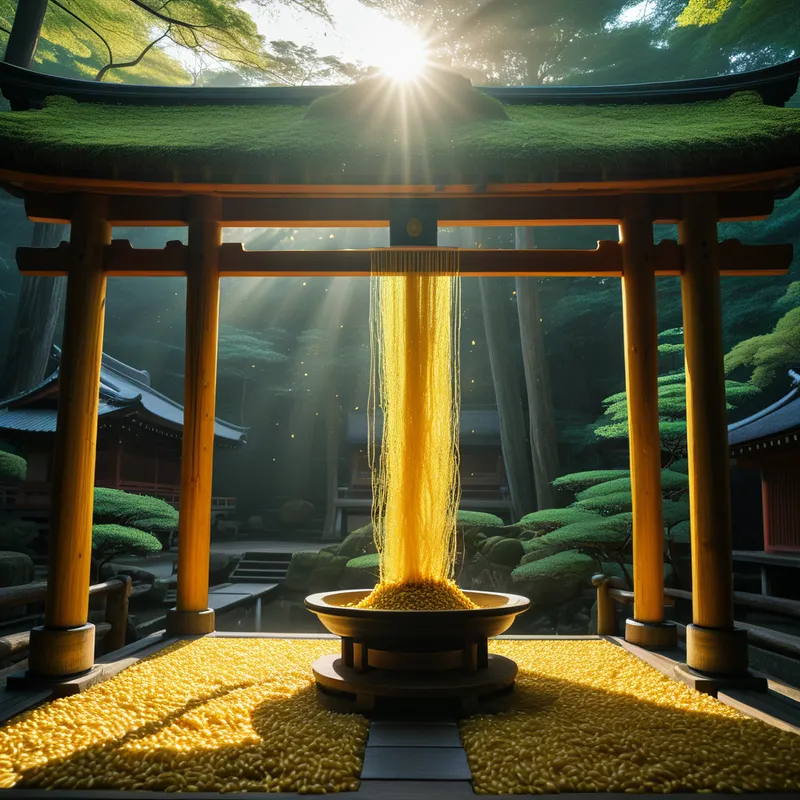
Consider the Grail myths. The quest is never for a trophy, but for a vessel that heals the wounded king and the wasted land. The Fisher King’s ailment is a psychic wound that mirrors the desolation of his realm; his infertility is the world’s. The Grail is not found in a distant castle, but in the asking of a simple, profound question: Whom does the Grail serve? The myth reveals that sacredness is not a possession, but a relationship of service to a life-giving principle. It appears only when the seeker’s motivation shifts from conquest to compassionate inquiry. Similarly, in the Japanese Shinto tradition, kami—sacred spirit—resides not only in grand mountains but in uniquely formed rocks, ancient trees, and even well-used tools. This animist perspective teaches that sacredness is an inherent quality of being, awaiting recognition. It is not bestowed; it is remembered. The dream is your personal Grail Castle, your kami-rock, asking you its version of the question: What in you, long neglected or profaned, awaits the recognition of its inherent sanctity?
Symbolic Nodes
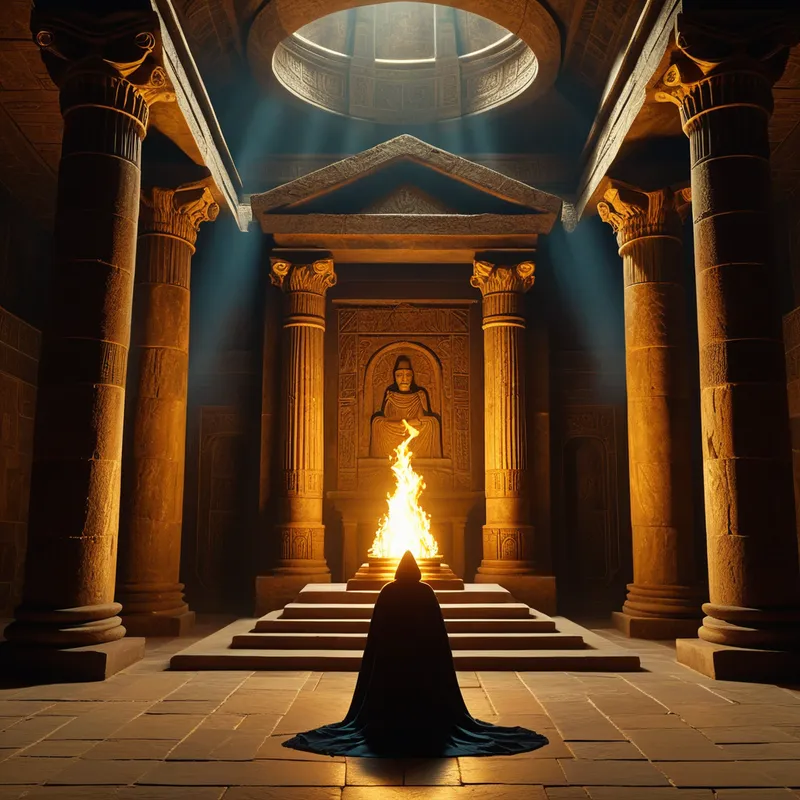
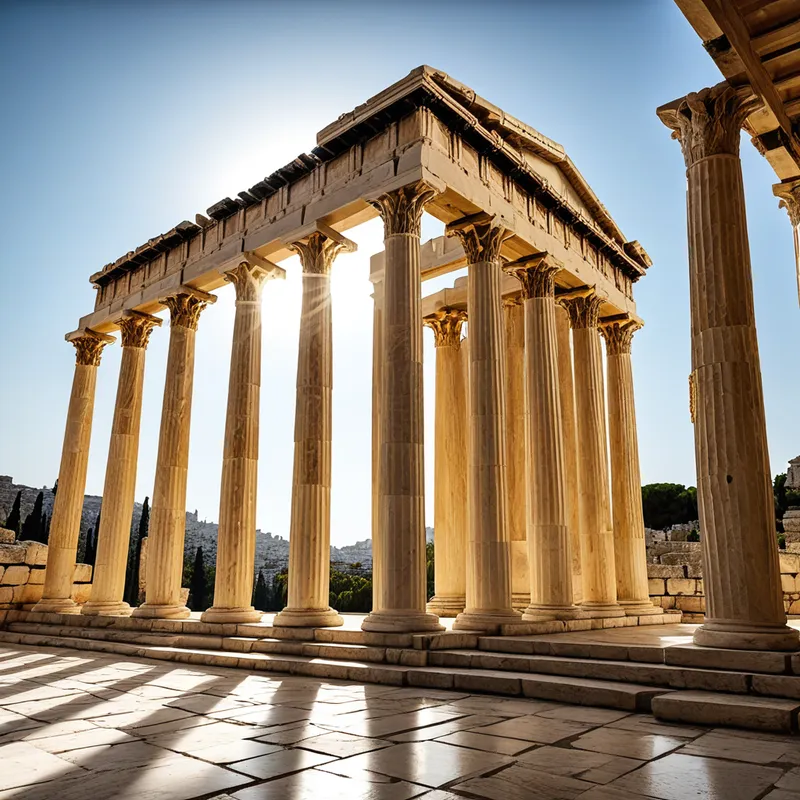
- Sanctuaries & Temples: Often ruined, overgrown, or hidden within mundane structures (a temple in a subway station, a chapel in an attic).
- Luminous Objects: Pearls, crystals, geodes, polished stones, orbs, and self-illuminating artifacts that glow from within.
- Silent, Natural Clearings: A ring of stones in a forest, a sun-dappled glade, a still pool untouched by wind.
- Thresholds & Veils: Archways, shimmering curtains, doors that were always there but unseen, gates that open without touch.
- Sacred Geometry: Mandalas, labyrinths, perfect spirals, or fractals appearing in organic or architectural forms.
- The Sound of Silence: Not an absence of noise, but a palpable, resonant quiet that seems to listen back.
Archetypal Resonance
The Magician Archetype is the active principle in the dream of sacredness. This is not the Shadow Magician, who manipulates energy for personal gain or weaves convincing illusions. This is the Magician in its highest expression: the Alchemist and Visionary who understands the fundamental unity of all things and operates from the axis between the seen and unseen worlds. The somatic echo—the feeling of resonant stillness and heightened significance—is the Magician’s numinous charge, the sensation of tapping into a deeper current of reality. The archetype’s core energy is transformation through conscious connection to source. Its alchemical potential here is precisely the transmutation of the profane (the cracked sidewalk, the exiled inner parts) into the sacred (the luminous pearl, the integrated Self). The Magician does not create sacredness from nothing; it reveals the sacredness that is already, always there, hidden in plain sight, waiting for the correct inner alignment to make it visible.
The Alchemical Process
The alchemy of sacredness is the Opus Contra Naturam—the work against nature—but here, "nature" is the conditioned, profane world of fragmentation. The base material is your lived experience of violation, cynicism, and exile. The heat is applied by the conscious, unwavering act of turning toward that which you have been taught to ignore, disdain, or fear within yourself. It is the pressure of holding two opposing truths: the reality of your wounding and the reality of your inviolable core. This is the nigredo, the blackening—not as despair, but as the sincere acknowledgment of the shadow that obscures the light.
The albedo, the whitening, occurs in the moment of recognition—the dream-image of the pearl in the mud. It is the flash of insight that separation is an illusion, that the wound and the wholeness are part of the same substance. The transmutation is not an eradication, but a change in relationship. You stop trying to heal the "broken" parts and start listening to them as sacred messengers. The grief, once a sign of brokenness, becomes a holy water that cleanses. The anger, once a destructive fire, becomes the forge-fire of your sovereignty. The rubedo, the reddening, is the embodied integration: the somatic echo becomes a permanent residence. You don’t just visit the clearing; you become the clearing. The sacred is no longer a theme in your dreams; it is the ground of your being from which all of your life arises.

The Integration Protocol
Question 1: Where in your body, right now, can you locate a sensation of neutrality or quiet? Not pleasure or pain, but simple, unadorned presence. Can you rest your awareness there for five breaths, without asking it to change?
Question 2: Reflect on a recent moment of irritation, shame, or anxiety. If this feeling were not a problem to be solved, but a lost, sacred part of you knocking at the door, what single word might name its deepest, unmet need? (e.g., "Recognition," "Safety," "Expression").
Question 3: Imagine your sense of self as a territory. What one inner space—a memory, a quality, a dream—feels most "off-limits," walled off, or profaned? What would it mean to simply place a candle at its threshold, not to enter yet, but to acknowledge it exists?
Action 1 (Sanctuary of the Senses): For one minute today, engage one sense with utter, non-utilitarian attention. Trace the grain of wood on your desk as if reading a sacred text. Listen to the complex symphony of ambient noise without labeling it. Feel the air moving in and out of your nostrils. Let the act itself be the ritual.
Action 2 (Dream Altar): Create a small, physical space—a corner of a shelf, a windowsill. Place upon it one object from your waking life that, however mundane, gives you a flicker of the somatic echo (a smooth stone, a dried leaf, a piece of worn metal). Once a day, simply place your hand near it and recall the feeling from your dream.
Action 3 (Map of Exile): Take a large sheet of paper and some drawing materials. In the center, draw a simple symbol of your luminous dream object (the pearl, the crystal). Now, without overthinking, let your hand draw lines, shapes, or scribbles radiating out from the center that represent the "cracks," the "grime," the internal exiles that feel far from that center. Don’t illustrate, let it be abstract. The act is not to fix the map, but to see its landscape without judgment.
Final Validation
This work is not for the faint of heart. To reclaim the sacred is to agree to feel the full weight of its absence, to touch the places within that have felt abandoned, cheapened, or defiled. It is a courageous and often lonely archaeology of the soul. Yet, the dream comes as proof: the pearl is already there, glowing in the crack. The temple is not in ruins; it is merely waiting for your recognition to restore its liturgy. You are not building a sanctuary from scratch. You are remembering the one that has always existed, at the very center of your being, breathing quietly beneath the noise of the world. Your task is not creation, but homecoming. Begin by listening for the echo.