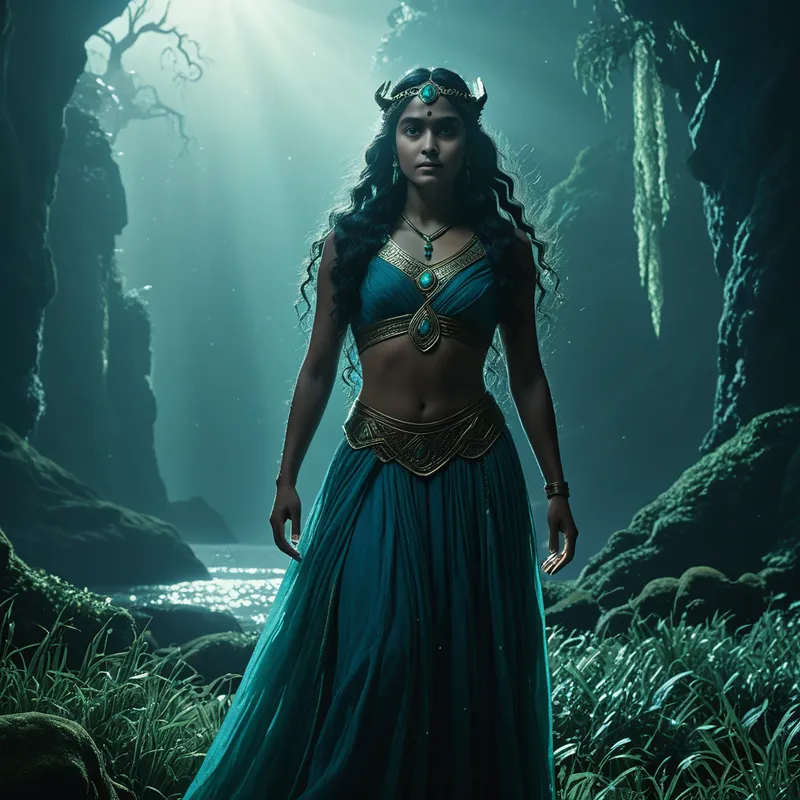
Eshu at the Crossroads
The Yoruba trickster deity Eshu governs crossroads, communication, and fate, embodying chaos and order through clever mischief that teaches moral lessons.
The Tale of Eshu at the Crossroads
The sun was a hammer on the iron earth of the savanna. Two friends, bound by years of shared toil and palm wine, walked the dusty path toward their village. Their bond was a public fact, celebrated by all. To test this very bond, to stir the still waters of certainty, Eshu descended.
He did not appear as a god, but as a traveler. Upon his head sat a cap, woven of mysteries. One side was black as a moonless night, the other white as bleached bone. He walked between the two friends, greeting them with a nod, and continued on his way down the path.
For a long moment, the friends walked in silence. Then the first turned to the second. “Did you see that honorable elder? His white cap gleamed in the sun, a sign of great purity.”
The second friend stared, baffled. “White? Brother, your eyes are tired from the sun. The elder’s cap was black, deep and dark as charcoal. A sign of solemnity.”
A harmless disagreement curdled into debate, then into heated argument. “You insult my sight!” cried one. “You call me a liar!” retorted the other. The bond of years, so solid moments before, now seemed a fragile thread. By the time they reached the village square, they were in a rage, demanding the elders judge who spoke truth.
The air thickened with accusation. Families began to take sides. The village, once a single organism, began to split along the fault line of a cap’s color. Just as the first blows seemed inevitable, a laughter, dry and ancient as the wind through baobab branches, stilled the crowd.
There stood the traveler, but now his presence filled the space. He was Eshu. He said nothing, but slowly turned his head. To the first friend, he showed the white side of the cap. To the second, the black. Then he turned fully, revealing himself in profile, and the entire village saw the truth: the cap was both. Black and white, divided yet whole.
His voice, when it came, was not an admonishment but a revelation. “Did I not cause you to dispute?” he asked. “I came from the crossroads, and to the crossroads I return. I am the one who brings strife so that truth may be examined, who tests loyalty so that its depth may be known. You saw a fraction and believed it the whole. Remember this at every crossroads, at every choice: what is, depends entirely on where you stand.”
With that, he vanished. The argument died, not in victory or defeat, but in a humbled, profound silence. The friendship was mended, but it was a different friendship now—one that had passed through the fire of illusion and been tempered by a deeper, more conscious truth. Eshu had not broken their bond. He had revealed it.
Cultural Origins & Context
Eshu (also known as Elegba or Legba in diasporic traditions like Santería and Candomblé) is among the most primordial and essential of the Yoruba Orisha. He is the divine linguist, the only one who speaks all languages of gods and humans. This makes him the indispensable messenger between the realm of the supreme creator, Olodumare, the other Orisha, and humanity. Without Eshu, no prayer is delivered, no sacrifice is received, no destiny is activated.
His domain is the crossroads—orita in Yoruba—the literal and metaphysical point of intersection, decision, and potential. In Yoruba thought, the crossroads is not merely a junction of paths but a liminal space where the visible world touches the invisible, where individual choice (ase, or personal authority) engages with predetermined destiny (ayanmo). Eshu is the keeper of this gate. He controls the flow of possibility, opening some doors and closing others based on his inscrutable wisdom and the offerings of mortals. He is the necessary chaos that prevents order from becoming stagnation, the divine provocateur who ensures that life is a dynamic process of becoming, not a static state of being.
Symbolic Architecture
Eshu’s mythology constructs a profound psychological architecture where chaos is not the enemy of order, but its crucible. He represents the irreducible “third” that shatters the complacency of a binary.
Eshu is the personification of the cognitive dissonance that precedes growth. He is the unexpected variable, the confounding data point that forces a system—be it a village, a belief, or a psyche—to expand or collapse.
His trickery is never purposeless malice; it is a pedagogical device of the highest order. The story of the cap is not about deceit, but about perspective and the paralysis of a single viewpoint. He teaches that truth is often relational and contextual, a lesson vital for navigating a complex world. As the messenger, he symbolizes the very act of communication—and all its perils of misinterpretation, ego, and projection. To encounter Eshu is to have one’s certainties dismantled so that a wider, more resilient understanding may be built.
Psychologically, he embodies the trickster archetype as defined by Carl Jung: the boundary-crosser, the shape-shifter, the spirit of disorder who nonetheless serves a vital, compensatory function in the psyche. He disrupts the tyranny of the conscious ego, allowing unconscious contents and new possibilities to erupt into awareness. He is the catalyst for individuation, the painful but necessary force that breaks down rigid personas to make way for the more integrated Self.
The Dreamer's Resonance
When Eshu strides into the dreamscape, he rarely comes with clear messages. He is the agent of confusion, the architect of paradoxical scenarios. To dream of a crossroads shrouded in mist, of receiving a message in a language you cannot decipher, or of a familiar person acting in baffling, contradictory ways—these are the fingerprints of Eshu. He appears in the psychic moment where a life decision looms but clarity is absent, or where a long-held belief is about to be overturned by experience.
The emotional tone is often one of frustration, anxiety, or exhilarating disorientation. The dreaming culture.") ego is confronted with its own limitations, its biased perspective. Such dreams invite the dreamer to ask: Where in my life am I seeing only the black or only the white cap? What binary am I trapped in that a third, reconciling perspective might resolve? Eshu’s dream presence is a call to embrace ambiguity, to communicate more deeply, and to approach life’s junctions with humility and alertness, knowing that one’s viewpoint is always partial.
Alchemical Translation
The alchemical process mirrored in Eshu’s myth is solutio—dissolution. The fixed, solidified compounds of our beliefs, relationships, and self-image are dissolved in the solvent of chaos and paradox. The two friends’ solid bond had to be dissolved into the chaos of argument before it could be reconstituted at a higher level of consciousness.
In the soul’s work, Eshu administers the nigredo, the blackening. He is the dark, confusing, and mortifying phase where the old “gold” of naïve certainty is proven to be base illusion. Only after this death can the true gold of wisdom be born.
To integrate Eshu’s energy is to develop a conscious relationship with life’s uncertainty. It is to cultivate the agility to hold multiple perspectives, to offer a sacrifice of humility at our internal crossroads, and to recognize that the “trick” life plays on us is often the very curriculum of our soul’s education. It is to understand that fate is not a rigid track, but a dynamic interplay between destiny (ayanmo) and the choices we make with our own authority (ase) at every juncture he presides over.
Associated Symbols
Explore related symbols from the CaleaDream lexicon:
- Crossroads — The literal and metaphysical junction of paths, representing critical life decisions, fateful encounters, and the intersection of the human and divine.
- Trickster — The archetypal agent of chaos, boundary-crossing, and revelation who disrupts order to provoke necessary change and deeper understanding.
- Fate — The predetermined course of events, woven from the threads of destiny and individual choice, often perceived as an inescapable force or a tapestry being crafted.
- Mask — A representation of persona, concealment, and transformation, embodying the duality of identity and the different faces presented to the world.
- Messenger — The intermediary who carries information, prayers, or truths between separate realms, gods, or aspects of the self.
- Chaos — The primordial state of undifferentiated potential and disorder, which precedes and gives birth to new forms of cosmic and psychological order.
- Destiny — The pre-ordained path or ultimate purpose of an individual or cosmos, often felt as a calling or a thread that must be followed.
- Key — An instrument that unlocks, opens, or reveals, symbolizing access to hidden knowledge, forbidden realms, or new phases of existence.
- Door — A threshold between states of being, representing opportunity, transition, and the passage from one chapter of life or consciousness to another.
- Mirror — A surface that reflects, revealing the self, truth, or illusion, and symbolizing self-examination, projection, and the duality of appearance versus reality.