Dhul-Qarnayn and the Wall
A righteous ruler journeys to the ends of the earth, constructing an immense iron wall to imprison monstrous forces threatening humanity.
The Tale of Dhul-Qarnayn and the Wall
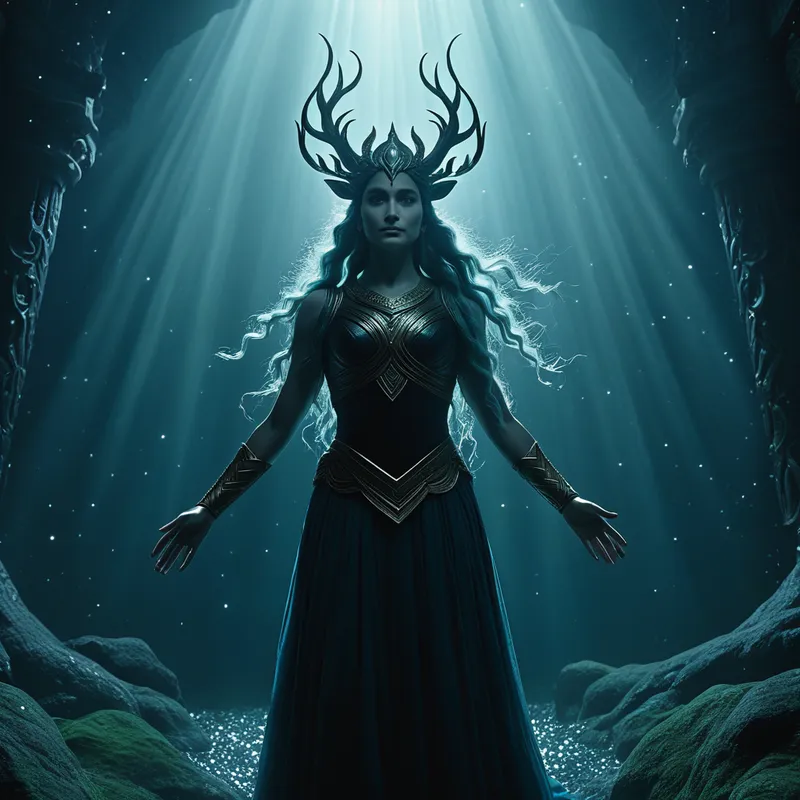
The tale begins not with a birth, but with a journey. Dhul-Qarnayn, the “Possessor of the Two Horns,” is a figure of immense power and profound righteousness, a ruler whose authority is granted and guided by divine will. His story is one of cosmic travel, a pilgrimage across the breadth of creation. He journeys to the very setting place of the sun, where he finds a people dwelling in primordial mud, and to its rising place, where it scorches a people with no shelter. In these liminal spaces, he administers justice not with tyranny, but with a merciful hand, offering the choice between righteous conduct and its consequence. His power is tempered by a higher law.
But his ultimate trial and purpose lie in a third direction, following a path until he reaches a place between two mighty barriers, mountains of iron-grey stone. Here, he finds a people who can scarcely understand his speech, living in the shadow of a terror. They tell him of Yājūj and Mājūj, a monstrous, chaotic horde. They are not merely an army, but a force of nature—a ceaseless, corrupting tide that breaches every barrier, spoils every field, and threatens the very order of the world. They are the ever-present noise of dissolution at the edge of civilization.
Moved by their plight and guided by divine inspiration, Dhul-Qarnayn does not raise an army to fight. He understands that this chaos cannot be defeated in battle, only contained. He proposes to build a wall, not of stone, but of something far more potent. With the people’s labor, he brings great blocks of iron, stacking them between the mountain passes until they form a colossal, seamless barrier. Then, he commands a fire to be kindled, and they pour molten copper over the iron, fusing the two metals into an impenetrable, gleaming bastion. The wall is not just a physical structure; it is an alchemical fusion, a work of sacred metallurgy. It shines under the sun, a defiant bulwark against the formless dark.
The chaotic ones, Yājūj and Mājūj, rush against it, but find no purchase. They cannot scale its fused surface, nor can they tunnel through it. They are imprisoned, their destructive energy held in check. Yet, Dhul-Qarnayn, in his wisdom, makes a prophetic declaration. This wall, he says, is a mercy from his Lord. But when the promise of his Lord comes to pass—a time appointed in the unseen scrolls of fate—He will level it to dust. The containment is not eternal. The wall is a respite, a sacred pause in the cosmic drama, holding back the flood until its destined hour.
Cultural Origins & Context
The narrative of Dhul-Qarnayn is revealed in the Qur’an, in Surah Al-Kahf (The Cave, 18:83-101). He is presented as a figure of divine favor, a model of the just ruler who uses his power to establish order and protect the vulnerable. His story is intimately linked with the eschatological themes central to Islamic prophecy, serving as a direct precursor to the signs of the Final Hour. The identification of Yājūj and Mājūj with the biblical Gog and Magog demonstrates the Qur’anic engagement with and re-contextualization of earlier Abrahamic and Near Eastern apocalyptic traditions, weaving them into a distinctly Islamic cosmological vision.
Scholars and historians have long debated the identity of the “Two-Horned One.” Many classical commentators, drawing on the theme of a righteous, journeying conqueror, associated him with Alexander the Great, whose iconography often included ram’s horns, identifying him with the god Zeus-Ammon. Others have proposed ancient Mesopotamian or Persian kings. However, within the Islamic exegetical tradition, the precise historical identification is ultimately secondary to the theological and moral function of the story. Dhul-Qarnayn is less a specific historical personage and more an archetype of divinely-sanctioned sovereignty, a counterpoint to tyrannical rulers like the Pharaoh. His tale is a cornerstone of Islamic apocalyptic literature, a vivid depiction of the fragile boundary between cosmic order and chaos, and a reminder that all temporal barriers are subject to divine will.
Symbolic Architecture
The myth constructs a profound psychic and cosmological architecture. Dhul-Qarnayn’s three journeys—to the west, the east, and the north—map the soul’s confrontation with different aspects of existence: the murky unconscious (the setting sun), the scorching light of raw consciousness (the rising sun), and finally, the confrontation with the unintegrated, shadowy chaos that threatens the psyche’s coherence.
The Wall itself is the central symbol. It is not a negation, but a defining limit. It creates the very possibility of a contained, habitable inner world—a nafs or self—by holding at bay the formless, devouring energies of the undifferentiated psyche. It represents the necessary function of the ego in its healthiest form: not as a tyrant, but as a steward, building structures of consciousness that allow life and culture to flourish.
The iron is the strength of resolve and earthly power; the molten copper is the flowing, conductive spirit of divine mercy and wisdom. Their fusion is the alchemy of righteous action—where worldly means are sanctified by a higher purpose.
The prophecy of the Wall’s eventual destruction is crucial. It acknowledges that no structure of order, no psychological defense, is ultimate. The contained chaos has a destined role to play in the totality of existence. The final leveling is not a tragedy, but a necessary dissolution preceding a transformation, a terrifying yet integral part of the soul’s full reckoning.
The Dreamer's Resonance
To encounter Dhul-Qarnayn in the imaginal realm is to confront the part of oneself tasked with being a responsible ruler. It asks the dreamer: Where in your life are you called to establish just boundaries? What chaotic, disruptive forces—inner compulsions, old wounds, addictive patterns—are you currently allowing to run rampant, “spoiling your springs”? The figure invites a building project within the soul.
The Wall may appear in dreams as any formidable barrier that both protects and isolates. It could be a sudden resolution, a vow of sobriety, the firm “no” to a toxic relationship, or the disciplined routine that fences out chaos. The key is its dual nature: it feels impregnable and necessary, yet there is a whispered knowledge that it is temporary. The terror of Yājūj and Mājūj symbolizes the fear of what might happen if this hard-won structure fails, if the repressed returns. The myth validates that fear while also placing it within a larger, destined narrative. The ruler’s journey assures us that containment is a sacred, temporary phase, not the final goal.
Alchemical Translation
Psychologically, the entire narrative is an alchemical opus. Dhul-Qarnayn is the adept, the conscious ego aligned with the Self (the divine will). His journeys represent the circumambulatio, the traversal of the psychic perimeter to gather its qualities. The people at the ends of the earth represent psychic contents living in extreme, unbalanced states.
The core operation is the construction of the Wall: the coniunctio oppositorum (union of opposites). Iron (ferrum) symbolizes Mars: will, strength, aggression, and the defensive armoring of the psyche. Copper (cuprum) symbolizes Venus: relatedness, beauty, conductivity, and the spirit that binds. The fiery fusion is the transformative heat of a focused, purposeful effort—the ignis geist, the fire of the spirit.
This is the alchemy of psychological integration. The raw, martial force of the ego’s defenses is melted and blended with the conductive, relational spirit of the heart. The result is not a brittle armor, but a resilient, living boundary that can withstand the corrosive pressure of the shadow.
The imprisoned Yājūj and Mājūj represent the massa confusa, the primal, chaotic material of the unconscious that must be contained before it can be transformed. Their eventual release, prophesied but not enacted by Dhul-Qarnayn, points to the final stage of the alchemical work: the nigredo or chaos that must be re-engaged for a higher synthesis. The wall-building is the stage of coagulatio—giving solid form—which must one day undergo solutio—dissolution—for the work to be complete.
Associated Symbols
Explore related symbols from the CaleaDream lexicon:
- Wall — The quintessential symbol of boundary, separation, and protection; a structure that defines inside from outside, order from chaos, and self from other.
- Order — The principle of cosmic and psychic arrangement, the imposition of pattern and limit upon formless potential, creating the conditions for life and meaning.
- Chaos — The primordial, undifferentiated state of energy and matter; the formless potential that both precedes creation and threatens to dissolve established order.
- Prophecy — The foreknowledge of a destined pattern or endpoint, often concerning the collapse of an old order and the inevitable return of what has been contained.
- Journey — The archetypal passage through significant realms or states of being, undertaken to gain wisdom, administer justice, or fulfill a cosmic purpose.
- Mountain — The natural, immovable barrier and place of revelation; often the foundational support for man-made structures of order and containment.
- Iron — The metal of martial strength, resolve, and defensive fortitude; representing the raw, unyielding power used to frame a boundary.
- Fire — The transformative agent that melts and fuses; the spiritual heat that sanctifies worldly materials and enables alchemical union.
- Border — The liminal space where one defined realm meets another; a site of both danger and negotiation, requiring vigilance and clear demarcation.
- Destiny — The inescapable timeline of events woven by divine will, within which even the most solid human constructions have their appointed beginning and end.
- Ruler — The archetype of conscious authority and stewardship, tasked with using power justly to establish and maintain order for the benefit of the whole.
- Dream — The inner realm where the drama of containment and chaos is played out symbolically, offering guidance on the structures of the psyche.