Demeter's Mystery Myth Meaning & Symbolism
The goddess Demeter's grief over her daughter Persephone's abduction creates winter and reveals the sacred cycle of loss, descent, and renewal.
The Tale of Demeter's Mystery
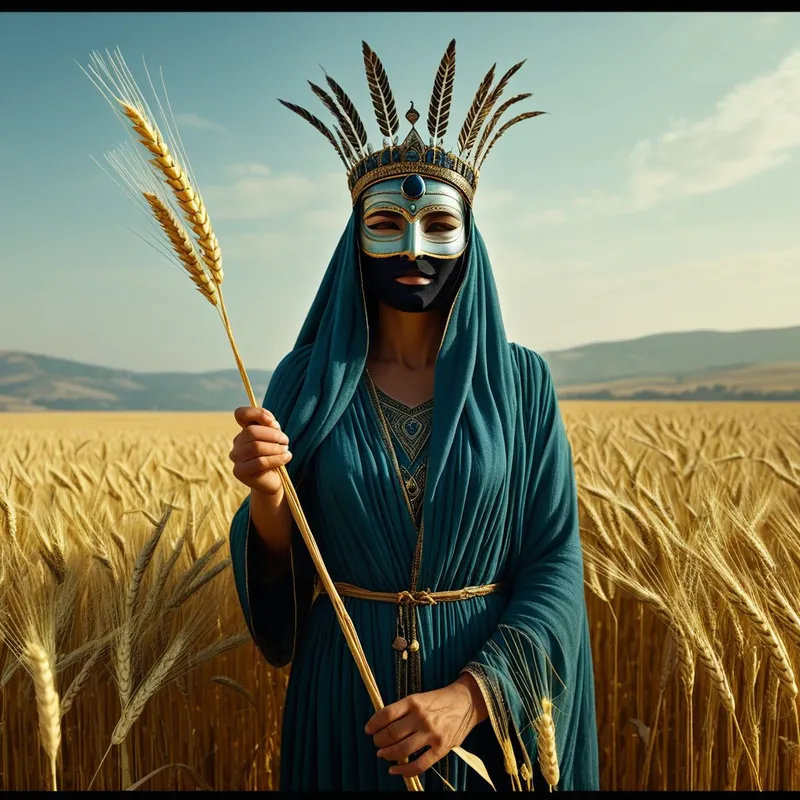
Listen. The world was once an eternal, golden afternoon. Demeter walked the earth, and wherever her foot fell, life sprang forth. Wheat grew tall without sowing, trees bent heavy with fruit, and the very air hummed with fertile warmth. Her joy was her daughter, Kore, whom we would come to know as Persephone. She was the very spirit of the blossoming meadow, a girl of laughter and light, whose footsteps coaxed violets from the soil.
But in the deep, silent places, a hunger stirred. Hades, lord of the unseen, looked upon the radiant maiden and was seized by a longing as vast and empty as his kingdom. He sought and received the silent consent of his brother, Zeus. On a day when Kore wandered far from her companions, enchanted by a narcissus of unearthly beauty, the earth itself groaned and split. From the chasm, a chariot of black adamant erupted, drawn by immortal steeds. A hand, strong as fate and cold as stone, seized the maiden. Her cry was swallowed by the closing earth as Hades bore her down, down into the sunless realm.
A silence fell upon the world. Then, a sound began—a low, keening wail that was not a sound at all, but a feeling in the roots of things. It was Demeter’s grief. She heard the echo of her daughter’s vanished cry and knew a terror no immortal had ever known. The golden veil of the world tore. She cast down her crown of grain and, taking the form of a mortal crone, began to wander the earth, a torrent of sorrow pouring from her. Where she walked, life recoiled. The soil hardened. Green shoots turned brown and brittle. The rivers of nourishment within the trees froze. The great, laughing bounty of the world shriveled into a gray, silent husk. Famine stalked mortals, and the smoke of sacrifice ceased to rise to Olympus.
In her despair, she came to Eleusis. There, in the palace of King Celeus, she served as a nurse to the infant prince Demophoön. In the quiet of the royal hearth, she found a fragment of purpose. But her secret rite—holding the child in the sacred fire each night to burn away his mortality—was discovered by the queen. The goddess threw off her disguise, revealing herself in terrible splendor, and demanded a temple be built for her at Eleusis. There, in her dark temple, she sat. And the world sat with her, locked in barren, endless winter.
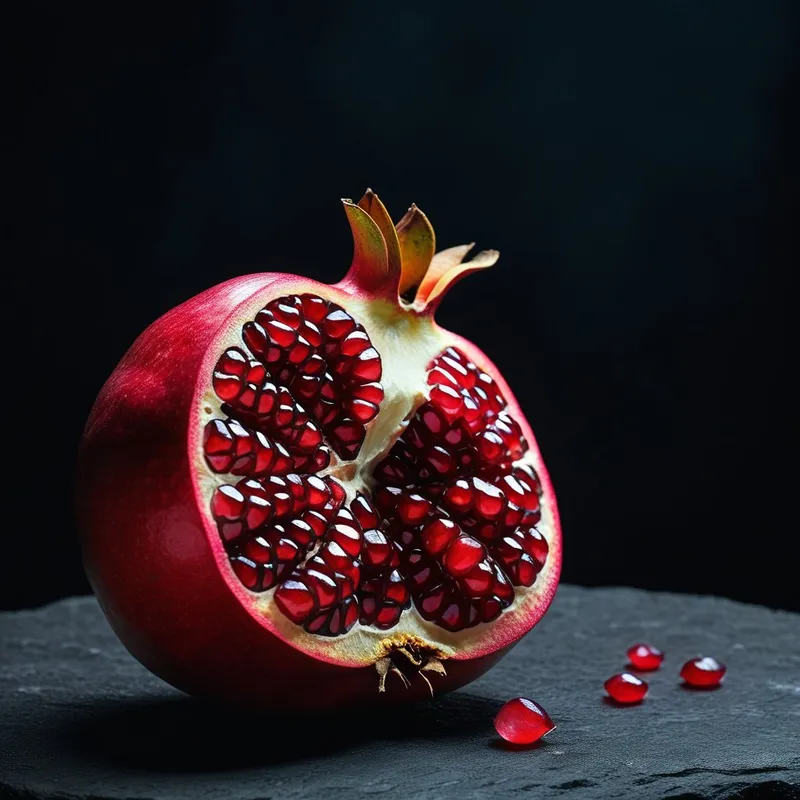
The gods grew weak without mortal tribute. Zeus sent messenger after messenger, but Demeter’s heart was a sealed tomb. She would not let the earth bloom until she gazed upon her daughter’s face. Finally, commanded by a universe on the brink of eternal death, Hermes descended to the land of the dead. He found Persephone, now a queen seated beside a somber Hades, and delivered the decree. Hades, cunning in his loneliness, did not refuse. But as Persephone turned to leave, he offered her a pomegranate seed—a simple, final token of hospitality. In her joy, or perhaps in a dawning understanding of a bond forged in darkness, she ate it.
Thus, the great compromise was struck. For eating the food of the dead, a part of her must forever belong to it. She would ascend for two-thirds of the year, bringing spring and summer in her wake as she rushed into her mother’s arms. But for one-third, she must descend again, ruling as Queen of the Shades. Demeter, her grief now woven with a bitter thread of law, accepted. She touched the dead earth, and life, tentative and glorious, returned. But the memory of frost was now written into the soul of the world. The first green shoot of spring was forever kin to the last fallen leaf of autumn.
Cultural Origins & Context
This was not merely a story; it was the beating heart of a sacrament. The Eleusinian Mysteries, celebrated for nearly two thousand years, were built upon this myth. Initates from all walks of life—enslaved persons, aristocrats, philosophers like Plato—underwent a sacred pilgrimage to Eleusis. The details of the rites (drómena), the things shown (deiknýmena), and the things spoken (legómena) were protected by a vow of silence so profound we still know little of their specifics.
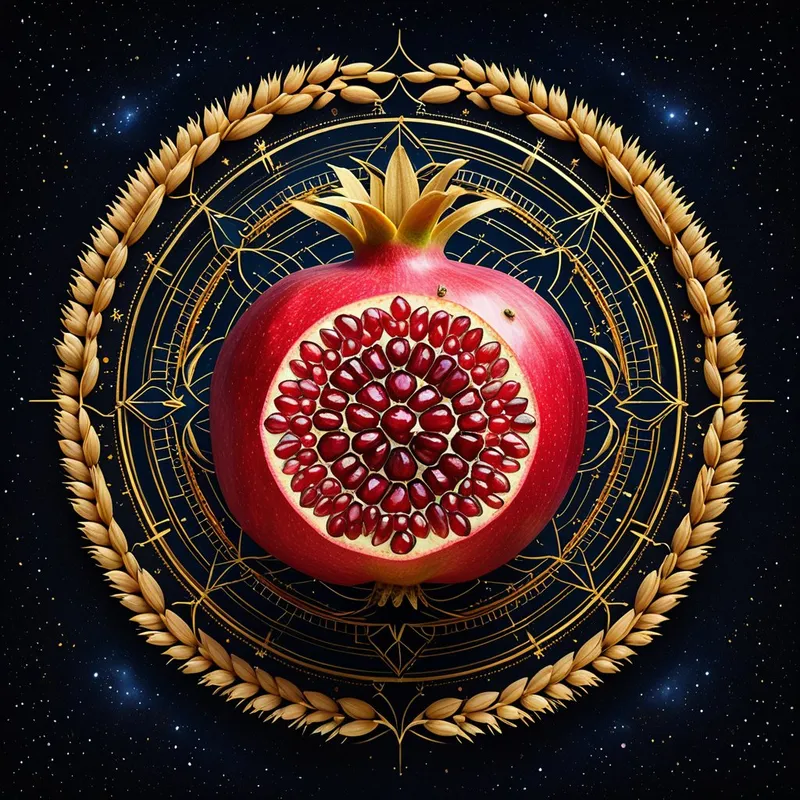
What is clear is that the ritual re-enacted the myth: the descent (kathodos), the frantic search, the dark night of despair, and the triumphant revelation (epopteia)—likely involving a sacred ear of grain shown in a blinding flash of light. This was not about belief, but about experience. It was a direct, somatic encounter with the pattern of loss and return, death and rebirth. The function was societal and deeply personal: to dissolve the terror of mortality by aligning the individual’s fate with the sacred, cyclical law revealed in the story. It promised the initiate a better lot in the afterlife, but more immediately, it offered understanding—a mystic knowledge (gnosis) that life, in its essence, is this very cycle.
Symbolic Architecture
The myth is a perfect symbolic map of a fundamental psychic reality. Demeter represents the principle of nurturance, continuity, and conscious connection. She is the ego’s attachment to what it loves and cultivates. Persephone is the vital, budding consciousness—the soul, the anima, the inner child—full of potential but naive to the depths of existence.
The abduction is not a crime, but a necessity of the soul's education. What the conscious mind nurtures must, for its own completion, be taken into the unconscious.
Hades is not evil, but the sovereign of the shadow and the underworld of the psyche—the realm of all that is unseen, repressed, forgotten, and potent. The pomegranate seed is the symbol of involuntary commitment. Once the soul tastes the fruit of the deep—once it integrates a piece of shadow-knowledge, trauma, or profound experience—it can never fully return to its previous state of innocent unity. It is now complex. It carries the mark of the depths.
The cycle of descent and return is the archetypal pattern of depression, withdrawal, and renewal. The "winter" of Demeter is not a failure, but a sacred strike, a necessary withdrawal of psychic energy from the outer world so it may be reconstituted at a deeper level.
The Dreamer's Resonance
When this myth stirs in modern dreams, it announces a profound process of psychic relocation. To dream of a cherished figure (a child, a partner, a younger self) being pulled into the earth, or of a lush garden suddenly freezing over, is to feel the Demeter archetype activated. The dreamer may be experiencing a tangible loss, or more commonly, an inner loss: the death of an identity, a career, a relationship to the self.
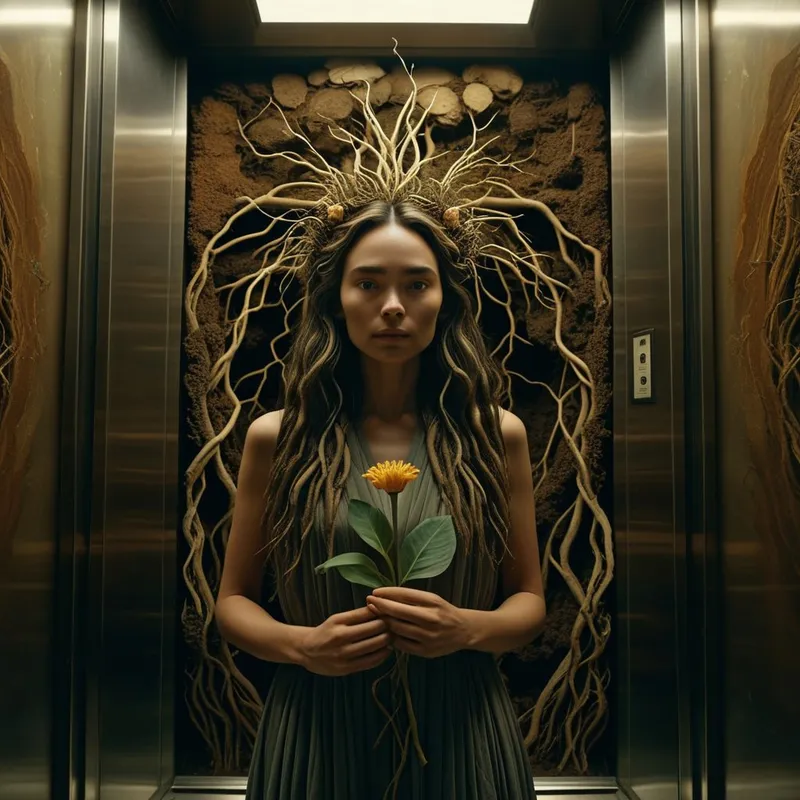
Somatically, this can feel like a heavy lethargy, a coldness in the chest, a loss of appetite for life itself—a literal depression (pressing down). The psyche is forcing a descent. Conversely, dreams of finding a single vibrant flower in a wasteland, or of a door opening to a sunlit field from a dark place, signal the Persephone-return. This is not mere "happiness," but the emergence of a new quality of being that has been tempered in the dark. The dreamer is navigating the non-negotiable law of their own depth: what has been known cannot be unknown, and the new self is a ruler of two realms.
Alchemical Translation
For the modern individual striving toward individuation, Demeter’s Mystery is the alchemical blueprint for transmuting attachment into wisdom. The process begins in the nigredo—the blackening. This is Demeter’s rage and grief, the utter devastation of the conscious attitude when its central value is taken. The ego’s project lies in ruins.
The temple at Eleusis is not built in joy, but in despair. It is the sacred container we must build around our pain, where the work of incubation can begin.
The albedo—the whitening—is the painful acceptance of the law. It is the recognition of the pomegranate seed. The soul has been changed by its journey. This is the crucial insight: the self that returns is not the self that was lost. Persephone the Maiden is gone; Persephone the Queen has taken her place. The final stage, the rubedo or reddening, is the integration. It is not a return to the old, eternal summer, but the establishment of a conscious, cyclical life. One now knows the seasons of the soul. One can consciously withdraw (descend) to incubate and renew, and consciously engage (ascend) to create and relate.
The ultimate mystery revealed at Eleusis is this: the terror of loss and the joy of return are not opposites, but two phases of a single, sacred motion. To be initiated is to stop clinging to the blossom and to embrace the whole root, stalk, flower, and seed. It is to become, like the grain, something that must die in the earth to be reborn, and in that knowledge, to find a profound and unshakable freedom.
Associated Symbols
Explore related symbols from the CaleaDream lexicon: