Demeter's Grief Myth Meaning & Symbolism
A mother's inconsolable grief for her abducted daughter halts all life, forcing a compromise with death that creates the seasons.
The Tale of Demeter's Grief
Hear now the story that cracks the world in two, the lament that stills the sun and silences the seed. It begins not with a bang, but with a pluck. In the Nysian meadow, where the air was thick with the scent of iris and violet, Persephone reached for a flower. It was no ordinary bloom, but a narcissus, planted by the deep earth itself as a trick. As her fingers closed around its stem, the ground roared. From a yawning chasm, a chariot of black iron drawn by steeds of shadow erupted. The hand that seized her was not of this world; it belonged to Hades, her uncle, king of the silent realms. Her cry was swallowed by the closing earth.
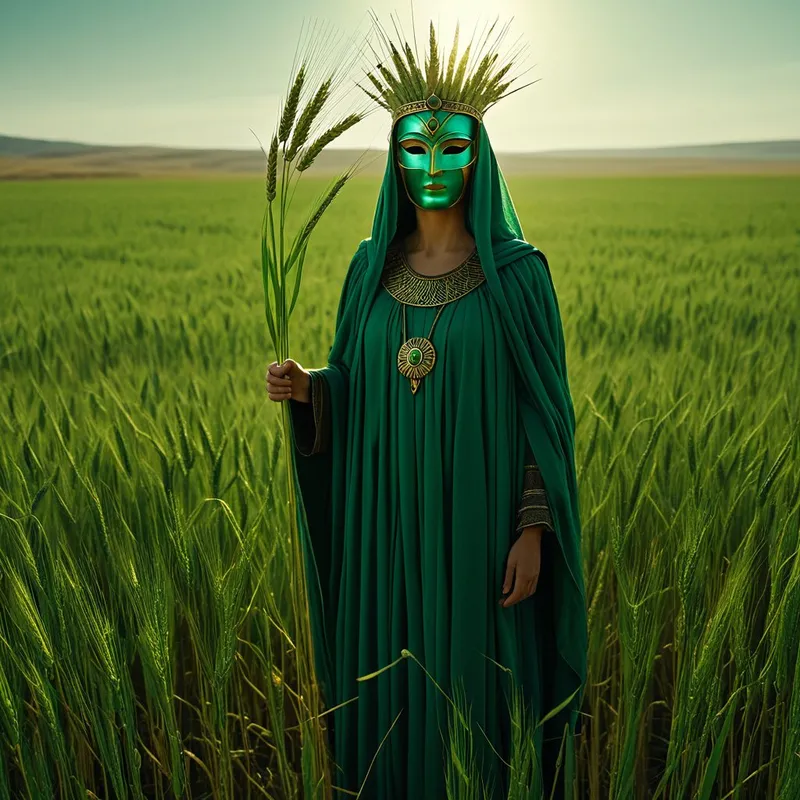
Far away, Demeter felt the rupture in her soul. The bond between mother and daughter, a cord woven from the very cycles of growth and decay, snapped. A chill, deeper than winter, entered her immortal heart. She cast off her divinity like a glittering cloak, wrapping herself in the guise of an old mortal woman. For nine days and nine nights, she wandered the sun-baked roads, a torch in each hand, her grief a dry, howling wind that withered the grass at her feet. She asked stones and rivers for news, but the world had gone mute with complicity.
Her journey led her to Eleusis, where she served as a nurse to a mortal prince. In that humble house, she attempted to grant the boy immortality, an act of desperate compensation for her own loss. When the ritual was interrupted by the child’s fearful mother, Demeter threw off her disguise. Her true form blazed forth, not in benevolence, but in annihilating sorrow. She declared her purpose: until her eyes beheld Persephone, no seed would split, no stalk would rise, no fruit would swell. The great green pulse of the world ceased.
Famine gripped the earth. Mortals’ prayers rose like smoke, unanswered. The gods of Olympus, who feed on sacrifice and praise, grew weak. Finally, Zeus, who had secretly sanctioned the abduction, was forced to act. He commanded Hermes to descend to the sunless kingdom and bring the maiden back. In the throne room of Hades, a deal was struck. Persephone could return, but because she had consumed a few seeds of the pomegranate, the food of the dead, she was bound to its king. For each seed eaten, a month of the year she must reign as his queen.
The reunion of mother and daughter at the threshold of the worlds was a tempest of tears and trembling joy. But the joy was tempered, forever changed. Demeter’s grief had not been erased, but transmuted. In compromise, she restored life to the earth, but henceforth, when Persephone descends to her dark throne, Demeter lets the world grow cold and still. And when her daughter ascends, the earth erupts in a riot of green, a celebration laced with the memory of loss.

Cultural Origins & Context
This myth, central to the Eleusinian Mysteries, was not merely a story but the sacred, beating heart of a profound cult. It was formalized in the Homeric Hymn to Demeter, a text likely used in ritual. Unlike the public dramas of Olympus, this tale was intimately tied to the earth, to agriculture, and to the most fundamental human experiences: a parent’s love, the terror of loss, and the fragile hope of return.
The myth functioned on multiple societal levels. Practically, it was an etiological tale explaining the origin of seasons, giving agrarian societies a divine narrative for the annual death and rebirth of crops. Spiritually, for initiates at Eleusis, it offered a paradigm for conquering the fear of death. By ritually re-enacting Demeter’s search and Persephone’s return, participants were believed to gain eudaimonia—not just happiness, but a blessed fate after death. The mother’s grief became a universal key, unlocking a promise that the soul, like the grain, does not perish but undergoes a necessary, cyclical transformation.
Symbolic Architecture
At its core, this is a myth of the psyche’s necessary descent. Persephone is not just a daughter; she is the innocent, burgeoning consciousness, the anima, the soul itself. Her abduction is the inevitable, often traumatic, encounter with the unconscious—the realm of Hades. This is not a punishment, but a fateful call to maturation.
The pomegranate seeds are the indelible marks of experience. Once tasted, the unconscious claims a part of us forever; we can never return to a state of naive innocence.
Demeter represents the conscious ego’s attachment to its previous form. Her grief is the ego’s rage and depression when faced with the loss of a cherished part of the self (the daughter/soul) to the depths. Her strike against nature is the psychic stagnation that occurs when we refuse the process of inner change. The compromise—the cyclical return—symbolizes the achieved state of wholeness, where consciousness acknowledges and integrates its relationship with the deep, often dark, sources of its own being. Life is no longer a perpetual summer, but a meaningful cycle of engagement and retreat, expression and incubation.

The Dreamer's Resonance
When this myth stirs in modern dreams, it often manifests not as classical figures, but through potent symbols of rupture and search. To dream of a suddenly barren landscape, a cherished room turned to dust, or a child who vanishes in a crowd is to feel Demeter’s shock. The dreamer is in the "nine days" of wandering, somatically experiencing the freeze of profound loss—which may be the loss of a relationship, a career, an identity, or a vital creative spark.
Dreams of descending elevators, finding hidden rooms underground, or being offered dark, jewel-like fruit point to the Persephone phase: the soul’s reluctant but necessary engagement with the underworld of the psyche. This is the territory of depression, deep introspection, or shadow work. The dreamer is being asked to "eat the seeds"—to consciously assimilate a difficult truth, a memory, or a rejected aspect of the self. The grief process in the dream is not pathology; it is the psyche’s non-negotiable demand for a re-negotiation of the terms of life, forcing a confrontation with what has been taken, or what must be given up.
Alchemical Translation
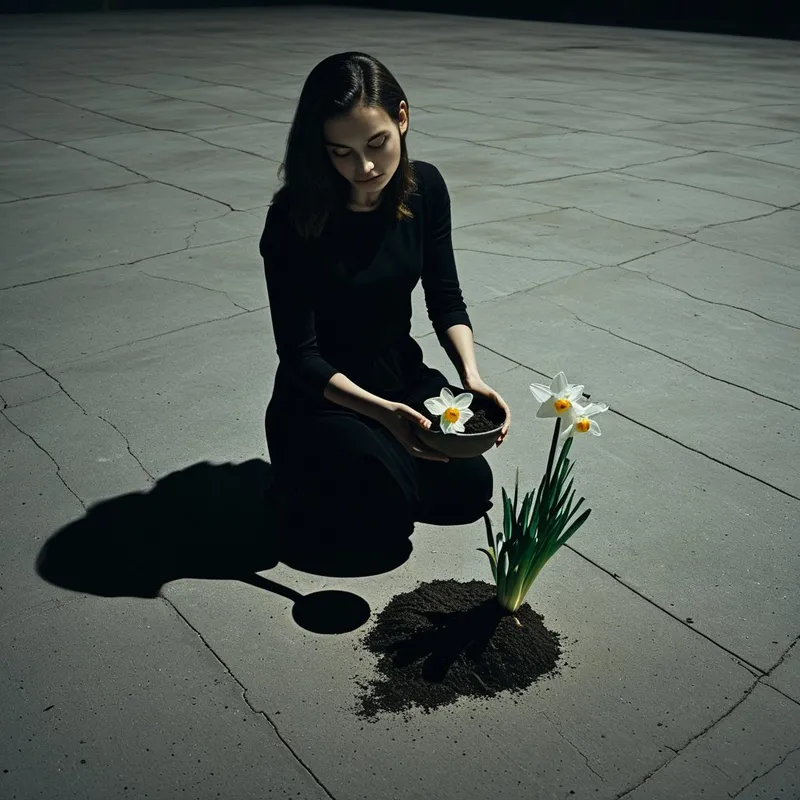
The alchemy of Demeter’s Grief models the individuation process—the transformation of personality through the integration of the unconscious. The initial state is nigredo: the black despair of Demeter, the world laid waste. This is the necessary dissolution of the old, rigid ego-structure that cannot accommodate the soul’s journey.
The myth teaches that the cure for the grief of the conscious mind is not the return of what was lost, but the revelation of what it has become.
The abduction is the albedo, the separation and purification of the soul (Persephone) in the reflective, lunar realm of the unconscious. Her consumption of the pomegranate seeds is the citrinitas, the impregnation of the soul with the substance of the deep self, creating an unbreakable bond.
The final compromise is the rubedo: the red gold of achieved wholeness. The conscious mother (ego) and the queen of the underworld (the integrated soul/animus) are reconciled. The individual no longer seeks to live in eternal spring, resisting all decay and depth. Instead, they learn to move with the inner seasons—to create and withdraw, to engage with the world and to descend for crucial renewal. The grief is not erased; it is woven into the fabric of being, becoming the fertile ground from which compassion, depth, and authentic resilience grow. We become, like the earth itself, hosts to both the flowering and the fallow.
Associated Symbols
Explore related symbols from the CaleaDream lexicon: