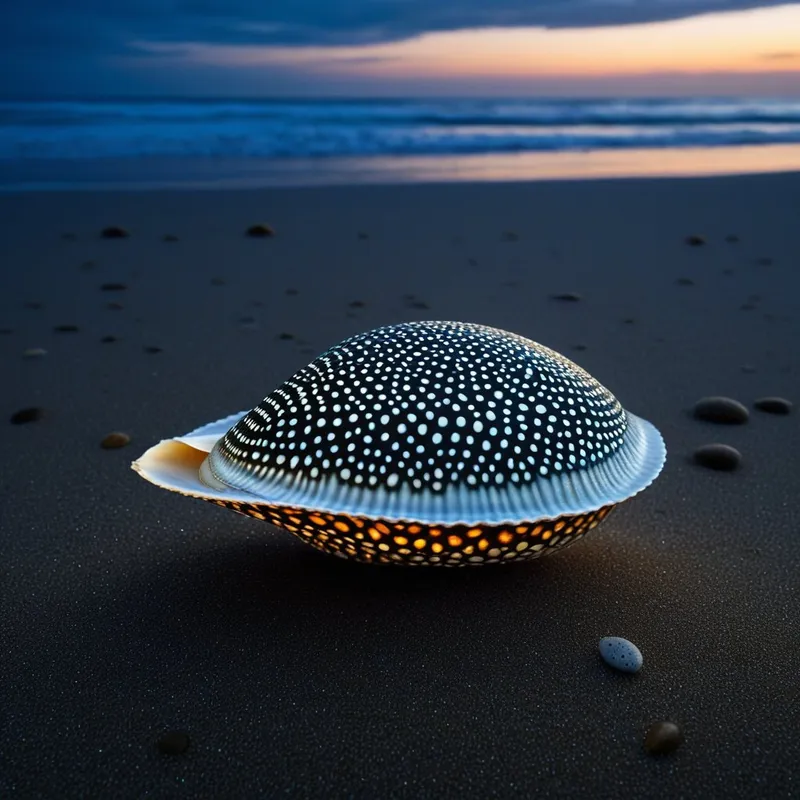
Cowrie Shell Myth Meaning & Symbolism
A sacred vessel born from the sea's womb, the cowrie shell became a global symbol of life, wealth, and the hidden power of the feminine.
The Tale of Cowrie Shell
Listen. Before coins, before gold, before the first king stamped his face upon a disk of metal, there was a different kind of treasure. It did not come from the dark, grasping earth, but from the great, sighing womb of the sea.
In the beginning, when the world was soft and the waters spoke in the voices of tides, the Ocean Mother looked upon the creatures of the land. She saw their struggles, their hunger, their longing for something more than mere survival. A deep compassion stirred within her abyssal heart. She did not gather pearls or heap up sunken gold. Instead, she breathed a secret into the foam.
From the luminous deep, she summoned her most cunning and graceful artisans: the Cypraeidae. To them, she whispered a design—not for a house, but for a temple. A small, perfect vessel, smooth as a polished moonstone, with a slit like a knowing eye or a sealed mouth. Its underside, she decreed, would bear the mark of her authority: a long, dark aperture, a gateway. “You will make these,” she murmured, her voice the sound of waves on a distant shore. “And you will cast them upon my shores, a gift for the two-legged ones.”
And so it was. With infinite patience, the creatures spun their calcium mantles, forming these porcelain-like gifts. The Ocean Mother’s tides, her great watery hands, then gathered them and laid them tenderly upon the sands of every continent she touched—the golden shores of Mali and Benin, the archipelagos of Oceania, the river deltas of Zhongguo, the coasts of the First Nations.
The people came to the water’s edge and found them. They held the cool, dense weight in their palms. They saw its resemblance to the eye that sees all, to the vulva that gives all life. They understood. This was not a rock. This was a word from the deep. It was a seed of possibility, a solidified piece of the divine feminine’s promise. It was wealth that could be held, life that could be traded, magic that could be worn. The shell was born not of conquest, but of grace; not of mining, but of receiving. And in that act of finding, humanity entered into a covenant with the unseen, trading not just with each other, but with the very mystery of creation.
Cultural Origins & Context
The cowrie shell myth is not a single story with a named hero, but a profound, polyphonic narrative woven across millennia and continents. Its “authors” are the countless generations of coastal and riverine peoples from West Africa to Oceania, from Asia to the Americas, who encountered this natural object and recognized its inherent numinosity. It was passed down not in epic verse, but in ritual, trade, and daily practice.
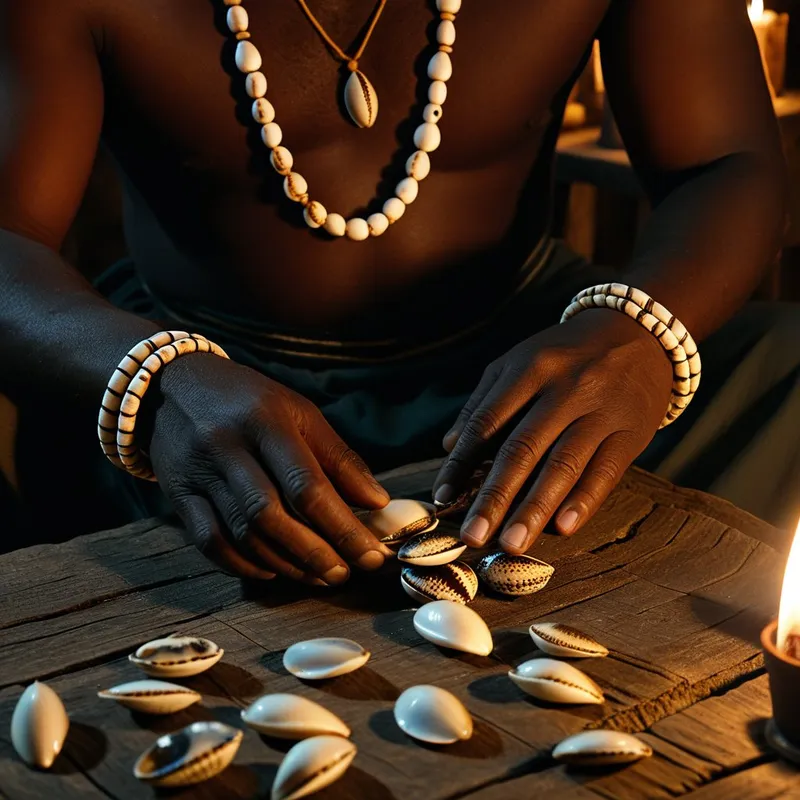
In West Africa, particularly within the Akan and Yoruba empires, cowries (owo eyo) became the very lifeblood of economy and spirituality. They were counted in vast quantities to purchase goods, pay tribute, and compensate for transgressions. Their use was formalized, creating one of the world’s most stable and widespread pre-coinage currencies. In China, cowrie shells (bei) were entombed with the dead as early as the Shang Dynasty, serving as currency for the afterlife, their glyph becoming the radical for “wealth” in the written language.
Across the Pacific, in cultures from Hawai’i to Aotearoa, the shell was less about currency and more about direct connection. It was used in divination, as a lure for octopus, and as ornamentation that conveyed status and mana (spiritual power). This global thread reveals the myth’s core function: to bridge the tangible and intangible. The cowrie provided a concrete, beautiful, and durable symbol for abstract, vital forces—economic value, spiritual protection, and generative power—allowing these forces to circulate through human society as palpably as the shells themselves circulated across the globe.
Symbolic Architecture
The cowrie shell is a master symbol, a natural archetypal image whose form dictates its meaning. Its symbolism is an architecture built on three foundational pillars.
First, it is the Vessel of the Feminine Divine. Its shape is an unambiguous icon of the vulva, the gateway of life. It represents the Great Mother in her generative aspect: the womb of the ocean, the fertility of the earth, the mystery of birth and renewal. It is a symbol of what Jung might call the creative, containing principle of the psyche.
Second, it is the Eye of Providence and Hidden Wealth. The smooth, rounded back with its slender slit resembles a closed, all-seeing eye. This speaks to the shell’s role in divination and its connection to hidden knowledge. The true “wealth”—the living creature—is concealed within, just as spiritual insight or future prosperity is hidden within the folds of fate. The shell promises that value and insight are present, even if not immediately visible.
To hold a cowrie is to hold a paradox: the exterior is a sealed door, while the interior is a spiral chamber leading to an unseen center. It is the psyche itself—a protective barrier guarding an inner, priceless reality.
Third, it is a Token of Sacred Exchange. As currency, it transformed barter into a ritual. To give a cowrie was not merely to transfer purchasing power; it was to transfer a piece of the sacred, a particle of the Ocean Mother’s blessing. It imbued commerce with a spiritual dimension, reminding people that true wealth flows from a generative source and must circulate to sustain life.
The Dreamer's Resonance
When the cowrie shell appears in a modern dream, it is rarely a simple memory of the beach. It arrives as an emissary from the deep unconscious, signaling a process related to value, creation, and the feminine principle.
To dream of finding a cowrie shell suggests the dreamer is on the cusp of discovering an inner resource or a latent creative potential. It is a psychic “find,” an indication that something of immense personal value—an idea, a feeling, a talent—is ready to be recognized and brought to the surface of conscious life. The somatic feeling is often one of surprise and delight, a cool, solid certainty in the palm.
To dream of a string of cowries, or using them as currency, points to the dreamer’s internal economy of energy and emotion. Are they spending their vital resources wisely? Is there a balanced exchange in their relationships, or are they feeling depleted? The dream may call for an audit of what one truly values and how that value is being traded.
A dream of a cracked or broken cowrie can be a profound warning. It may indicate a violation of one’s creative container, a feeling that one’s fertility (of ideas, projects, or literal fertility) has been damaged or is under threat. It resonates with a deep, somatic fear of being exposed, robbed of one’s inner treasure, or rendered infertile. The psyche is highlighting a vulnerability in the dreamer’s protective boundaries or creative self-concept.
Alchemical Translation
For the modern individual navigating a world of digital abstractions and fragmented identity, the cowrie myth models the alchemical process of re-grounding value in the organic and the archetypal. Our individuation journey often requires us to rediscover what is truly valuable, not by external market standards, but by the soul’s own metrics.
The first stage, nigredo, is the murky confusion of not knowing one’s worth, of feeling adrift in a sea of others’ expectations. The cowrie’s journey begins in the dark, unseen deep—this is our own unconscious.
The albedo, the whitening, is the moment of discovery. It is the act of psychological beachcombing, of sifting through the debris of daily life and personal history to find that one solid, beautiful, undeniable truth about oneself—the core talent, the authentic desire, the sacred wound. This is the “finding” of the shell. It must be recognized and picked up.
The alchemical work is to internalize the cowrie’s lesson: that your most sacred value is not manufactured by the ego, but secreted slowly, organically, from the depths of your own nature, and then offered up to the world.
The rubedo, the reddening or culmination, is the circulation of this discovered value. It is the process of taking that inner treasure—be it creativity, compassion, or insight—and putting it into sacred exchange. To create art, to form deep relationships, to build something meaningful, is to string your cowries together and offer them in the marketplace of life. This transforms the personal discovery into a social and spiritual reality, completing the circuit from the deep unconscious (the ocean), to the conscious ego (the hand that finds), to the world (the community that receives).
Thus, the myth of the cowrie shell invites us to cease mining for approval and instead learn to listen for the tide. Our true currency, it whispers, is not what we extract, but what we naturally, gracefully, and resiliently create from the sacred depths within.
Associated Symbols
Explore related symbols from the CaleaDream lexicon: