Colossi of Memnon Myth Meaning & Symbolism
A colossal statue weeps at dawn, its song a lament for a fallen hero and a testament to the eternal dialogue between loss and renewal.
The Tale of the Colossi of Memnon
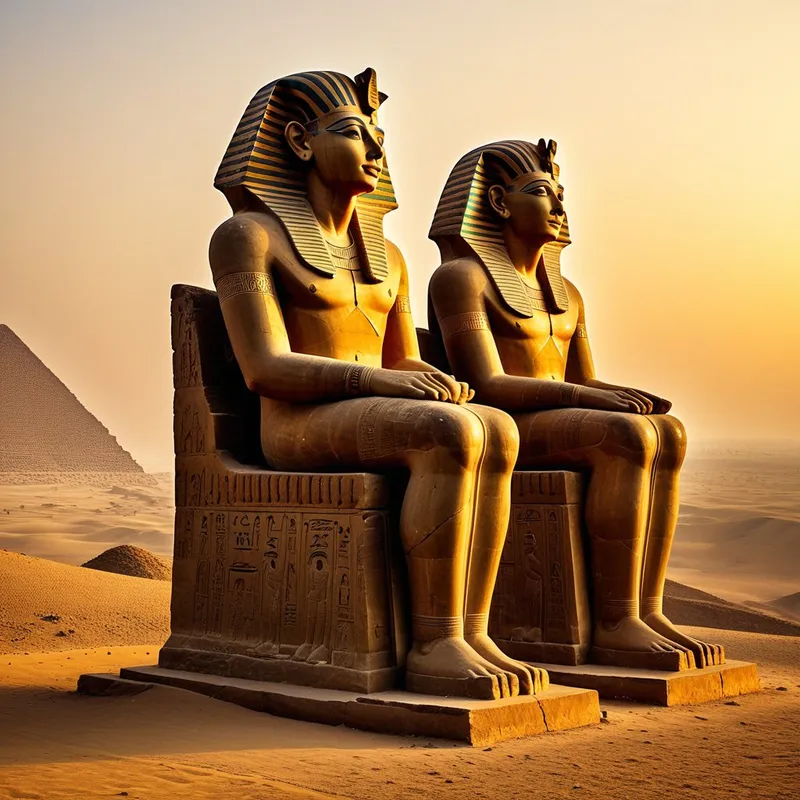
Hear now a tale carved not on papyrus, but in the very flesh of the earth, a story sung by stone and sunlight. In the sacred land of Upper Egypt, where the life-giving Nile winds like a serpent of destiny, stand two silent kings. They are the Colossi, twin mountains given the shape of Pharaoh Amenhotep III, seated in eternal vigilance upon the western bank, facing the rising sun. For centuries, they were but monuments to forgotten glory, their features smoothed by the desert’s breath.
But one bore a secret wound. A great tremor, sent perhaps by the earth-shaker Poseidon in a fit of rage, or by the slow, patient anger of time itself, cracked the northern giant from shoulder to base. It stood broken, a king halved.
Then, a mystery was born. As the first sliver of Ra’s fiery disk breached the horizon, painting the Theban hills in gold and carmine, a sound would issue from the wounded stone. Not a crash, nor a groan, but a clear, melodic note—a sigh that became a song. Some said it was a mournful wail; others, a greeting of profound joy. Travelers from across the seas, Greek and Roman pilgrims who knew the statue as Memnon, son of the Dawn, would gather in the chill of pre-dawn. They would wait, breath held, as the sky lightened. And when the sun’s first true ray touched the cold quartzite, the colossus would sing. It was said the sound was Memnon crying out to his mother, Eos, who wept dew-tears each morning in answer to her son’s lament from beyond the veil of death.
The song was the proof. It was the stone itself, baptized in the light of a new day, giving voice to an eternal truth: that even in fracture, there is resonance; even in monumentality, there is a vulnerable, crying heart. The statue was no longer just a statue. It was a threshold where grief met dawn, where stone remembered it had a soul.
Cultural Origins & Context
The phenomenon of the “singing statue” is a fascinating layer cake of cultural interpretation, built upon a solid Egyptian foundation. Historically, the colossi were purely funerary monuments guarding the vanished mortuary temple of Amenhotep III in Thebes. For the Egyptians, they were silent guardians, embodiments of the pharaoh’s eternal ka and his divine authority, facing the sunrise—the daily rebirth of the sun god.
The myth we know is primarily a Greco-Roman overlay. After Alexander’s conquest, Greek travelers equated the majestic, damaged statue with their own hero, Memnon, the Ethiopian king slain by Achilles at Troy. This process of interpretatio graeca was common. The statue’s location in the “Ethiopian” (to the Greeks, meaning southern) lands, its heroic scale, and its apparent lament made the connection irresistible. The morning song was interpreted as Memnon greeting his mother Eos, the Dawn. This narrative turned the site into a major pilgrimage and tourist attraction in the Roman era, with visitors—including several emperors—inscribing poems on the statue’s legs testifying to having heard the “voice.”
The myth’s function thus shifted. From an Egyptian symbol of silent, eternal royal power, it became, for the classical world, a living oracle of personal resonance—a place where the divine touched the human through the medium of sound and stone, validating the pilgrim’s journey and connecting them to a grand, heroic narrative of loss and maternal love.
Symbolic Architecture
At its core, the myth presents a powerful triad: the Colossus (the fractured form), the Dawn (the activating light), and the Song (the resulting phenomenon).
The Colossus represents the monumental self—the ego, the persona, the achieved identity that appears eternal and impregnable. Yet it is fractured. This crack is not a flaw of creation, but the necessary wounding that makes resonance possible. It is the trauma, the loss, the vulnerability that shatters our perfect, silent self-image.
The Dawn is the touch of the transcendent—the light of consciousness, the divine (Ra), the archetypal mother (Eos), or the Self in its wholeness. It is the daily opportunity for renewal, the loving attention that seeks connection.
The song is the soul’s voice, heard only when the light of awareness meets the crack in the armor of the self.
The Song is the emergent property. It is the authentic voice that arises not from perfection, but from the interaction of light and fracture. It is grief transformed into music, isolation transformed into call-and-response. The song signifies that the monument is alive; the past is not dead but capable of dialogue. It symbolizes the moment when our deepest wounds, touched by the light of understanding, cease to be silent burdens and become sources of unique expression and connection.
The Dreamer's Resonance
To dream of a colossal, fractured statue—especially one that emits sound or light—is to encounter the psyche’s own Colossus of Memnon. This is not a dream of small anxieties, but of foundational structures.
Somatically, one might awaken with a tightness in the chest, a feeling of profound awe, or the eerie echo of a sound just beyond hearing. Psychologically, the dreamer is at a point where a long-held, monumental aspect of their identity—a career, a role, a core belief—has been cracked by life. The dream acknowledges the fracture. The statue is not repaired; it is activated.
The crucial element is whether the statue sings or remains silent in the dream. A silent, fractured colossus points to a wound still frozen in trauma, a grief or identity crisis that feels inert and heavy. A singing one indicates the beginning of a transformative process. The psyche is reporting that the dawn of a new understanding is touching that old, broken place, and from it, something unexpected—a new creativity, a poignant insight, a call for help or connection—is beginning to emerge. The dream is an invitation to listen to what your deepest fractures are trying to say when the light of your attention falls upon them.
Alchemical Translation
The alchemical process mirrored here is not the creation of gold from lead, but the transmutation of silent, stony grief into resonant song—the journey of the individuation.
The first stage is Nigredo, the blackening. This is the cracking of the colossus—the death of the son (Memnon), the shattering of the heroic ego. It is a necessary descent, the experience of loss, failure, or disillusionment that reduces our grand self-concept to rubble.
The dawn light represents Albedo, the whitening. It is the loving, conscious attention (Eos’s tears, Ra’s rays) applied to the darkened matter. This is not about fixing the crack, but about illuminating it, bathing it in awareness and acceptance. It is the maternal, receptive principle engaging with the wounded masculine.
The song is the Rubedo, the reddening—the final stage where spirit and matter unite to produce the philosopher’s stone, which in psychological terms is the authentic, resonant Self.
The resulting Song is the Coniunctio, the sacred marriage. It is the union of the solar, conscious principle (the dawn) with the lunar, fractured stone of the personal past and the unconscious. From this union arises the unique “voice” of the individual—no longer a silent monument to a dead king, but a living instrument responsive to the cycles of life and light.
For the modern individual, the myth instructs: do not seek to hide your fractures or rebuild your monument perfectly as it was. Instead, place your broken self in the light of dawn—in therapy, in art, in honest relationship, in solitary reflection. Wait. Listen. The goal is not to become uncracked, but to discover what song your particular crack can sing when touched by the sun. That song is your contribution, the proof that you are not a static statue of your past, but a living, resonant being in an eternal, creative dialogue with the source of all light.
Associated Symbols
Explore related symbols from the CaleaDream lexicon: