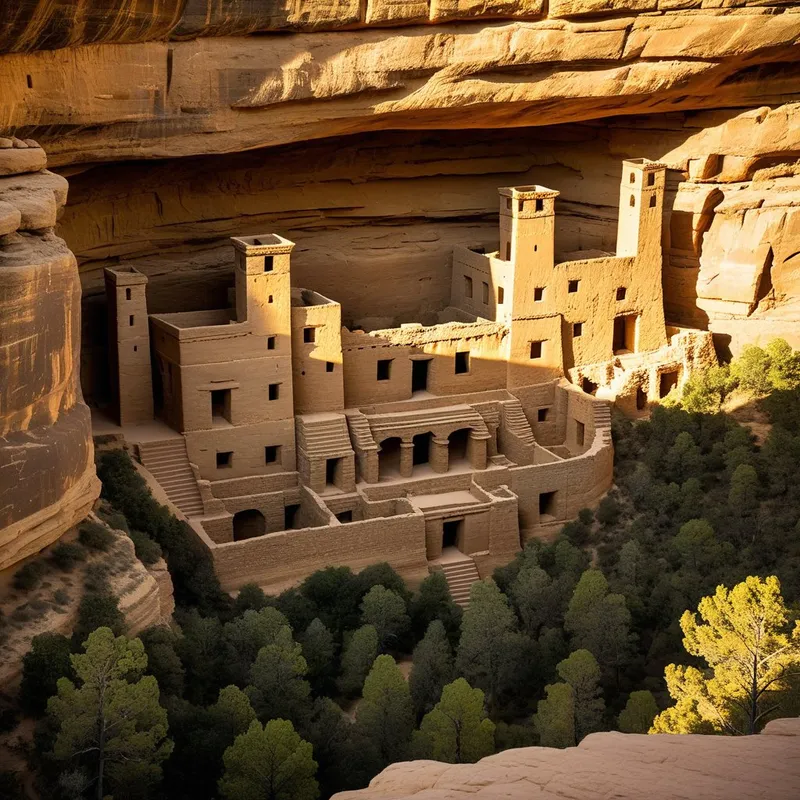
Cliff Palace of Mesa Verde Myth Meaning & Symbolism
A Pueblo story of a people guided by earth and sky to build a sanctuary within the cliff, embodying the union of community and the sacred landscape.
The Tale of Cliff Palace of Mesa Verde
Listen. The wind in the high desert does not blow; it remembers. It carries the voices from a time when the people walked the mesa tops, their feet tracing the paths of sun and rain. But the sun grew fierce, a relentless eye that drank the springs and parched the corn. The rain became a stranger, visiting less and less. The earth, their mother, was tightening her embrace, asking for a deeper listening.
In those days, the people were led by those who listened not just with their ears, but with their bones. They heard the sigh of the sandstone, the patient heartbeat of the canyon. A whisper came, not in words, but in the cool shadow cast by the great cliffs at midday. It spoke of shelter. It spoke of a womb of stone.
Guided by this whisper—by the wisdom of the Shamans who read the language of ravens and the patterns of erosion—the people turned their gaze from the open sky to the sheltered void. They descended. Not as a retreat, but as a pilgrimage into the body of the earth itself.
With hands that knew the clay and the shaping fire, they began. They did not carve the cliff; they revealed the home that waited within it. Each stone was set with a prayer, each room shaped to hold the warmth of family and the silence of ceremony. They built ladders of supple wood, weaving a vertical village between the canyon floor and the sky. They became people of two worlds: the solid earth at their back, the vast expanse of sky before their eyes.
The Cliff Palace was not built in a season, but over generations, a living tapestry of effort and dream. Its greatest chamber, the Kiva, was dug deep into the living rock. Here, in the dark, damp earth, they would descend via ladder, leaving the world of sun and wind above. In that sacred darkness, lit only by the central fire, they touched the Sipapu—the navel of the world. They sang the songs that kept the stars in their courses and called the clouds from the horizon.
For a long age, the people thrived in their stone nest. The cliffs protected them from winter's bite and summer's glare. The community, stacked and interconnected, lived in a constant, physical conversation. A child's laughter would drift upward; smoke from a hearth would curl and be shared by all. They were a single organism, nestled in the ribs of the canyon.
But the wind remembers all stories, and all stories have their season. The whispers from the stone changed. The springs spoke less freely. The game grew scarce. The world was shifting again, and the sanctuary that had held them now asked for a new journey. With the same profound listening that had led them to the cliff, they heard the call to depart. They did not leave in chaos, but in ceremony. They sealed doorways with care, leaving offerings in the dark corners of rooms. They took their essence with them but left their shell as a prayer, a perfectly crafted vessel of memory set into the cliff face, waiting for the wind to tell its tale to those who would come after.
Cultural Origins & Context
The story of Cliff Palace is not a single, codified myth with named deities, but a living narrative woven from the archaeological record, the oral histories of descendant Pueblo nations (including the Hopi, Zuni, and Rio Grande Pueblos), and the landscape itself. It is a etiological narrative for a place, born from collective memory.
The tellers of this story are the ancestors of the Ancestral Puebloans (formerly known as the Anasazi) and their modern descendants. It is passed down not as a fantastical legend, but as a historical and spiritual account of adaptation. Its societal function is multifaceted: it explains the profound architectural achievement of their forebears, it encodes the sacred relationship between a people and a specific, powerful place, and it teaches the core values of community cohesion, attentiveness to the natural world, and the courage to migrate when necessary. The story validates the deep-time connection of Pueblo people to the Colorado Plateau, asserting that their departure was not an end, but a purposeful transition in an ongoing journey.
Symbolic Architecture
The myth of Cliff Palace is a masterclass in symbolic architecture. The cliff dwelling itself is the central symbol—a perfect image of the psyche finding equilibrium between opposites.
The sanctuary is not found by conquering the height, but by honoring the depth. It is the ego consenting to be held by the vast, unconscious body of the earth.
The mesa top represents the conscious world: exposed, rational, agricultural, and solar. The canyon floor symbolizes the unconscious: hidden, fertile, instinctual, and lunar. Cliff Palace exists in the liminal space between them—the sheltered alcove. This is the symbolic realm of the psychic threshold. To build there is to consciously construct a personality (the community) that is rooted in both realms. The countless small rooms signify the individuated members, while the central Kiva represents the collective, unifying core of the Self.
The act of descending into the kiva via ladder is a profound ritual of psychic descent—entering the unconscious to commune with ancestral patterns (the Sipapu) and returning enriched. The eventual, orderly departure from the palace completes the symbol: it represents the necessary dissolution of a once-necessary psychic structure to allow for new growth. The structure remains as a "soul image," a permanent testament to a phase of development.
The Dreamer's Resonance
When this myth pattern appears in modern dreams, it often signals a process of seeking profound inner shelter and integration. To dream of discovering or inhabiting a cliff dwelling suggests the dreamer is in a phase of conscious introspection, pulling back from an overly exposed, exhausting conscious stance (the barren mesa) to find refuge and wisdom in a deeper, more instinctual part of themselves (the protective cliff).
The somatic experience is often one of relief, coolness, and solid support at one's back. Psychologically, it marks a move toward internal consolidation. Dreaming of building such a place indicates active, careful construction of a new inner structure—perhaps setting boundaries, creating a personal practice, or integrating disparate parts of the personality into a cohesive whole.
Conversely, dreaming of being unable to enter, or of the dwelling crumbling, may point to a felt disconnect from one's inner sanctuary or ancestral wisdom, a sense of being exposed without protection. The dream calls for a descent, a listening to the "whisper of the stone"—the often-ignored intuitive or bodily knowing.
Alchemical Translation
The alchemical journey modeled here is that of creating the vas, the sacred vessel, within the psyche. The process begins with the nigredo: the scorching sun on the mesa, the drought, the conscious life feeling barren and unsustainable. This suffering forces the crucial turn inward (introversion).
The alchemical work is not done in the fire of ambition, but in the shadow of the cliff, where the heat of the sun is transformed into the enduring warmth of community and purpose.
The guided descent into the canyon is the solutio—a dissolving of old, rigid ways of being on the surface. The construction of the palace is the coagulatio: a patient, meticulous re-solidification of the personality in a new, more resilient and integrated form. The kiva, with its connection to the sipapu, represents the coniunctio oppositorum—the sacred marriage of above and below, conscious and unconscious, individual and collective.
The eventual departure is the final, critical stage: mortificatio and sublimatio. The ego must willingly "die to" or leave behind the very sanctuary it built, carrying the earned wisdom forward. The palace left behind is the lapis philosophorum, the philosopher's stone—not as a physical object, but as the enduring, perfected memory of a completed stage of individuation. It teaches that the goal is not to reside forever in one perfect structure, but to learn the art of building—and when necessary, blessing and leaving—sacred space, again and again, on the soul's long migration.
Associated Symbols
Explore related symbols from the CaleaDream lexicon: